Thank you for visiting SNEWPapers!
Sign up free
Story
May 2, 1825
Palladium Of Virginia And The Pacific Monitor
Lewisburg, Greenbrier County, West Virginia
What is this article about?
Biography of Seneca chief Cornplanter, his role in Wyoming, opposition to land sales and missionaries, son's betrayal via forgery, and his prophecy of famine fulfilled by mild winter with little snow.
Clipping
OCR Quality
98%
Excellent
Full Text
CORNPLANTER AND THE SEASON
From the Conenwango (Warren) Emigrant.
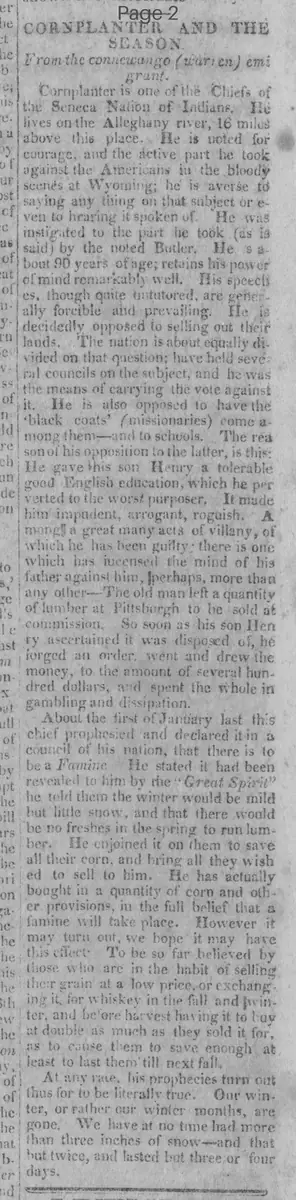
Cornplanter is one of the Chiefs of the Seneca Nation of Indians. He lives on the Alleghany river, 16 miles above this place. He is noted for courage, and the active part he took against the Americans in the bloody scenes at Wyoming; he is averse to saying any thing on that subject or even to hearing it spoken of. He was instigated to the part he took (as is said) by the noted Butler. He is about 90 years of age; retains his power of mind remarkably well. His speeches, though quite untutored, are generally forcible and prevailing. He is decidedly opposed to selling out their lands. The nation is about equally divided on that question; have held several councils on the subject, and he was the means of carrying the vote against it. He is also opposed to have the 'black coats' (missionaries) come among them—and to schools. The reason of his opposition to the latter, is this: He gave his son Henry a tolerable good English education, which he perverted to the worst purposes. It made him impudent, arrogant, roguish. Among a great many acts of villany, of which he has been guilty: there is one which has incensed the mind of his father against him, perhaps, more than any other. The old man let a quantity of lumber at Pittsburgh to be sold at commission. So soon as his son Henry ascertained it was disposed of, he forged an order, went and drew the money, to the amount of several hundred dollars, and spent the whole in gambling and dissipation.
About the first of January last this chief prophesied and declared it in a council of his nation, that there is to be a Famine. He stated it had been revealed to him by the "Great Spirit" he told them the winter would be mild but little snow. and that there would be no freshes in the spring to run lumber. He enjoined it on them to save all their corn, and bring all they wished to sell to him. He has actually bought in a quantity of corn and other provisions, in the full belief that a famine will take place. However it may turn out, we hope it may have this effect: To be so far believed by those who are in the habit of selling their grain at a low price. or exchanging it. for whiskey in the fall and winter. and before harvest having it to buy at double as much as they sold it for, as to cause them to save enough at least to last them'till next fall.
At any rate. his prophecies turn out thus far to be literally true. Our winter, or rather our winter months, are gone. We have at no time had more than three inches of snow—and that but twice, and lasted but three or four days.
From the Conenwango (Warren) Emigrant.
Cornplanter is one of the Chiefs of the Seneca Nation of Indians. He lives on the Alleghany river, 16 miles above this place. He is noted for courage, and the active part he took against the Americans in the bloody scenes at Wyoming; he is averse to saying any thing on that subject or even to hearing it spoken of. He was instigated to the part he took (as is said) by the noted Butler. He is about 90 years of age; retains his power of mind remarkably well. His speeches, though quite untutored, are generally forcible and prevailing. He is decidedly opposed to selling out their lands. The nation is about equally divided on that question; have held several councils on the subject, and he was the means of carrying the vote against it. He is also opposed to have the 'black coats' (missionaries) come among them—and to schools. The reason of his opposition to the latter, is this: He gave his son Henry a tolerable good English education, which he perverted to the worst purposes. It made him impudent, arrogant, roguish. Among a great many acts of villany, of which he has been guilty: there is one which has incensed the mind of his father against him, perhaps, more than any other. The old man let a quantity of lumber at Pittsburgh to be sold at commission. So soon as his son Henry ascertained it was disposed of, he forged an order, went and drew the money, to the amount of several hundred dollars, and spent the whole in gambling and dissipation.
About the first of January last this chief prophesied and declared it in a council of his nation, that there is to be a Famine. He stated it had been revealed to him by the "Great Spirit" he told them the winter would be mild but little snow. and that there would be no freshes in the spring to run lumber. He enjoined it on them to save all their corn, and bring all they wished to sell to him. He has actually bought in a quantity of corn and other provisions, in the full belief that a famine will take place. However it may turn out, we hope it may have this effect: To be so far believed by those who are in the habit of selling their grain at a low price. or exchanging it. for whiskey in the fall and winter. and before harvest having it to buy at double as much as they sold it for, as to cause them to save enough at least to last them'till next fall.
At any rate. his prophecies turn out thus far to be literally true. Our winter, or rather our winter months, are gone. We have at no time had more than three inches of snow—and that but twice, and lasted but three or four days.
What sub-type of article is it?
Biography
Historical Event
Curiosity
What themes does it cover?
Fate Providence
Misfortune
Moral Virtue
What keywords are associated?
Cornplanter
Seneca Chief
Prophecy
Famine
Mild Winter
Land Sales Opposition
Son Betrayal
What entities or persons were involved?
Cornplanter
Henry
Butler
Where did it happen?
Alleghany River, 16 Miles Above Conenwango (Warren); Pittsburgh
Story Details
Key Persons
Cornplanter
Henry
Butler
Location
Alleghany River, 16 Miles Above Conenwango (Warren); Pittsburgh
Event Date
About The First Of January Last
Story Details
Seneca chief Cornplanter, aged 90, opposed land sales and education after son's forgery betrayal; prophesied famine via Great Spirit revelation of mild winter with little snow, bought provisions accordingly; prophecy partially true as winter had minimal snow.