Thank you for visiting SNEWPapers!
Sign up free
Constitutional Whig
Richmond, Virginia
What is this article about?
An anonymous observer addresses the Judges of the Court of Appeals, criticizing candidates for the Clerk position at the new Lewisburg branch who sought recommendations from legislators to influence the appointment, arguing this undermines the Court's constitutional independence and that selections should prioritize merit over popular favor.
Clipping
OCR Quality
Full Text
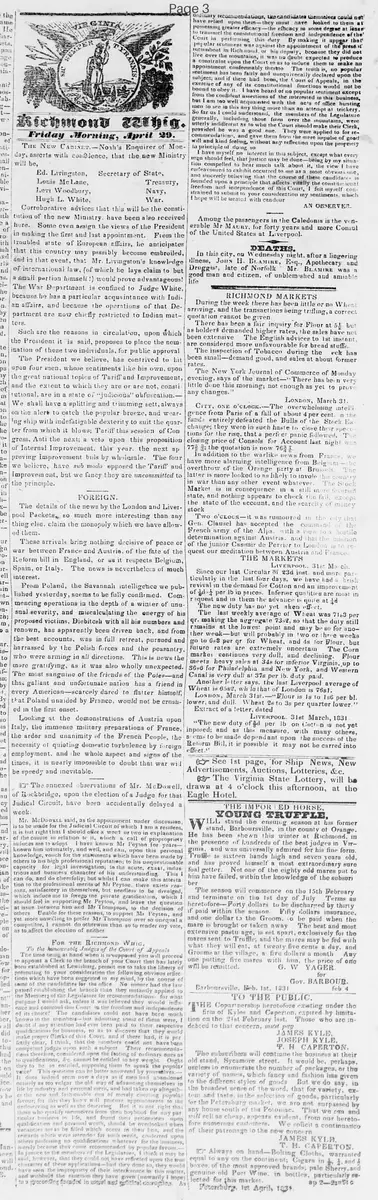
To the honourable Judges of the Court of Appeals
The time being at hand when it is supposed you will proceed to appoint a Clerk to the branch of your Court that has lately been established at Lewisburg, permit me to take the liberty of presenting to your consideration the following obvious reflections which have been suggested to my mind, by the course of some of the candidates for the office No sooner had the law passed establishing the branch than they instantly applied to the Members of the Legislature for recommendations—for what purpose I would ask, unless it was believed they would influence and controul the Court in the freedom and independence of its choice? The candidates could not have been much known to the members—but admitting some of them were, I doubt if any attention had ever been paid to their respective qualifications for business as to discover that they would make proper Clerks of this Court. and if there had, it is perfectly clear, I think, that the members could not have been competent judges upon such a subject Their recommendations therefore, considered upon the footing of ordinary ones as to qualifications, &c cannot be entitled to any weight Ought they to be so entitled, supposing them to speak the popular voice? This question can be better answered by yourselves.— It does indeed seem now a days as if men had abandoned entirely as too vulgar the old way of advancing themselves in life by industry and personal merit, and had taken up altogether the new and fashionable one of merely courting popular favour, for this they know will procure appointments to the undeserving as well as the deserving.
But it is not right that those who qualify themselves from their boyhood for any particular business in life, and found their pretensions upon qualification and personal worth, should be overlooked when vacancies are to be filled which occur in their line, and the rewards which were intended for such merit, conferred upon others professing no qualifications whatever for the business, merely because they come recommended by popular favour.—
In justice to the members of the Legislature, I think it may be said, however, that they could not have reflected upon the true character of these applications—had they done so, they would have seen the impropriety of their interference in this matter, and withheld the sanction they have given (unwarily I hope) to a proceeding founded in moral and political corruption. As ordinary recommendations, the candidates themselves could not have relied upon them—they must have looked to them as possessing greater efficacy—the efficacy in some degree at least to trammel the constitutional freedom and independence of the Court in performing this duty By making it appear that popular sentiment was against the appointment of the present incumbent in Richmond, or his deputy, because they did not live over the mountains, it was no doubt expected to produce a constraint upon the Court so as to induce them to make an appointment conformably thereto The truth is, no popular sentiment has been fairly and unequivocally declared upon the subject; and if there had been, the Court of Appeals, in the exercise of any of its constitutional functions would not be bound to obey it. I have heard of no popular sentiment except from the confident assertions of the interested in this business, but I am too well acquainted with the acts of office hunting men to see in this any thing more than an attempt at trickery.
So far as I could understand, the members of the Legislature generally, including those from over the mountains, were utterly indifferent as to who the Court should make their Clerk, provided he was a good one. They were applied to for recommendations. and gave them from the mere impulse of good will and kind feeling. without any reflection upon the propriety in principle of doing so
I have myself no interest in this subject, except what every man should feel, that justice may be done—being by my situation compelled to hear much talk about it, the view I have endeavoured to exhibit occurred to me as a most obvious one, and sincerely believing that the course of these candidates is founded upon a principle that affects vitally the constitutional freedom and independence of this Court, I felt myself constrained to submit to your consideration my sentiments, which I hope will be treated with candour
AN OBSERVER.
What sub-type of article is it?
What themes does it cover?
What keywords are associated?
What entities or persons were involved?
Letter to Editor Details
Author
An Observer.
Recipient
To The Honourable Judges Of The Court Of Appeals
Main Argument
candidates for clerk of the court at lewisburg improperly sought legislative recommendations to influence the court's independent appointment, which should be based on merit rather than popular favor, to avoid moral and political corruption and preserve constitutional freedom.
Notable Details