Thank you for visiting SNEWPapers!
Sign up free
Story
June 12, 1885
The Warner Weekly Sun
Warner, Brown County, South Dakota
What is this article about?
Land Commissioner Sparks rules that U.S. settlers cannot claim land under both the 1882 homestead law (160 acres free) and pre-emption law (additional 160 acres), reversing prior practice as contrary to congressional intent.
Clipping
OCR Quality
98%
Excellent
Full Text
A Crank Commissioner.
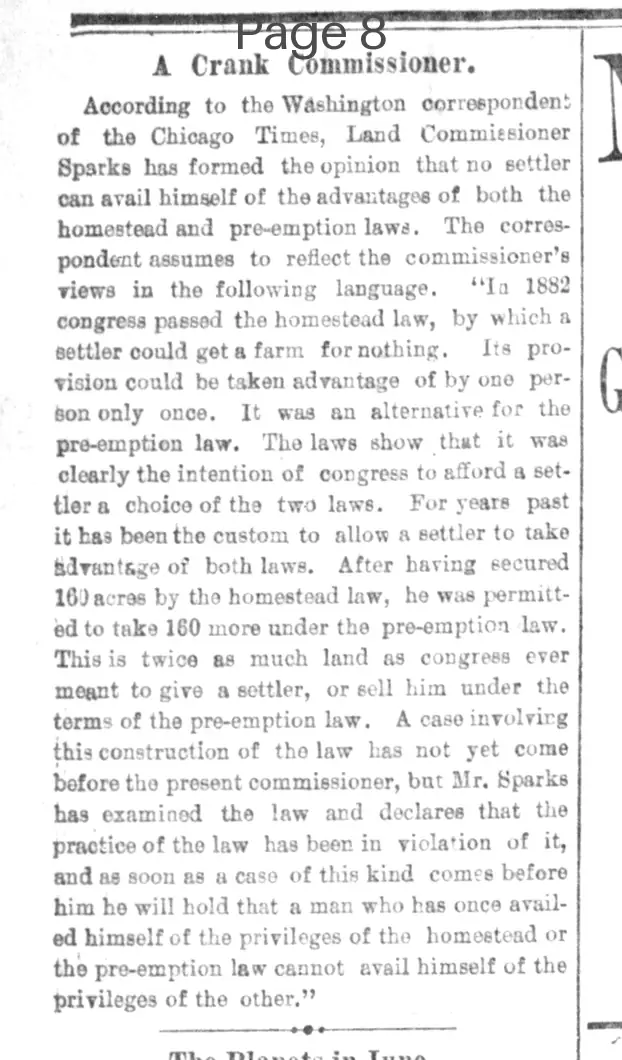
According to the Washington correspondent of the Chicago Times, Land Commissioner Sparks has formed the opinion that no settler can avail himself of the advantages of both the homestead and pre-emption laws. The correspondent assumes to reflect the commissioner's views in the following language. "In 1882 congress passed the homestead law, by which a settler could get a farm for nothing. Its provision could be taken advantage of by one person only once. It was an alternative for the pre-emption law. The laws show that it was clearly the intention of congress to afford a settler a choice of the two laws. For years past it has been the custom to allow a settler to take advantage of both laws. After having secured 160 acres by the homestead law, he was permitted to take 160 more under the pre-emption law. This is twice as much land as congress ever meant to give a settler, or sell him under the terms of the pre-emption law. A case involving this construction of the law has not yet come before the present commissioner, but Mr. Sparks has examined the law and declares that the practice of the law has been in violation of it. and as soon as a case of this kind comes before him he will hold that a man who has once availed himself of the privileges of the homestead or the pre-emption law cannot avail himself of the privileges of the other."
According to the Washington correspondent of the Chicago Times, Land Commissioner Sparks has formed the opinion that no settler can avail himself of the advantages of both the homestead and pre-emption laws. The correspondent assumes to reflect the commissioner's views in the following language. "In 1882 congress passed the homestead law, by which a settler could get a farm for nothing. Its provision could be taken advantage of by one person only once. It was an alternative for the pre-emption law. The laws show that it was clearly the intention of congress to afford a settler a choice of the two laws. For years past it has been the custom to allow a settler to take advantage of both laws. After having secured 160 acres by the homestead law, he was permitted to take 160 more under the pre-emption law. This is twice as much land as congress ever meant to give a settler, or sell him under the terms of the pre-emption law. A case involving this construction of the law has not yet come before the present commissioner, but Mr. Sparks has examined the law and declares that the practice of the law has been in violation of it. and as soon as a case of this kind comes before him he will hold that a man who has once availed himself of the privileges of the homestead or the pre-emption law cannot avail himself of the privileges of the other."
What sub-type of article is it?
Historical Event
What themes does it cover?
Justice
What keywords are associated?
Homestead Law
Pre Emption Law
Land Policy
Settler Rights
Commissioner Sparks
What entities or persons were involved?
Land Commissioner Sparks
Where did it happen?
Washington
Story Details
Key Persons
Land Commissioner Sparks
Location
Washington
Event Date
1882
Story Details
Land Commissioner Sparks opines that settlers cannot benefit from both the homestead and pre-emption laws, as Congress intended only one choice; prior practice allowed 320 acres total, which he deems a violation.