Thank you for visiting SNEWPapers!
Sign up free
Telegram Herald
Grand Rapids, Kent County, Michigan
What is this article about?
An article from Washington on Sept. 19 examines how many successful public figures, including U.S. presidents from Washington to Harrison, attribute their achievements to intelligent and supportive wives who aid their careers socially and intellectually, contrasting with the rarity of unhappy marriages or bachelors among them.
Clipping
OCR Quality
Full Text
OF
GREAT MEN
Many Public Figures Owe Success to Marriage.
Remarkable Cases Wives of the Presidents—Great Men as a Rule are Happily Married—Messrs. Garfield,
Hayes, Cleveland, Logan, Etc.
[Special Correspondence]
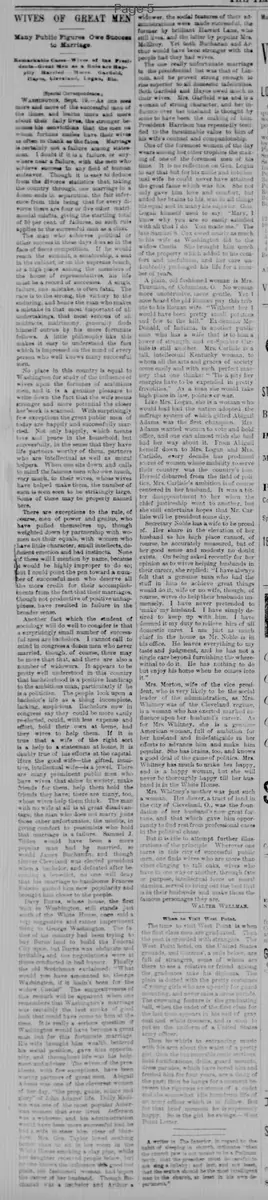
WASHINGTON, Sept. 19.—As one sees more and more of the successful men of the times, and learns more and more about their daily lives, the stronger becomes his conviction that the men on whom fortune smiles have their wives as often to thank as the fates. Marriage is certainly not a failure among statesmen. I doubt if it is a failure, or anywhere near a failure, with the men who achieve success in any field of human endeavor. Though it is easy to deduce from the divorce statistics that, taking the country through, one marriage in a dozen ends in separation, the fair inference from this being that for every divorce there are four or five other matrimonial misfits, giving the startling total of 50 per cent. of failures, no such rule applies to the successful men as a class. The man who achieves political or other success in these days is so in the face of fierce competition. If he would reach the summit, a senatorship, a seat in the cabinet, or on the supreme bench, or a high place among the members of the house of representatives, his life must be a record of successes. A single failure, one mistake, is often fatal. The race is to the strong, the victory to the enduring, and hence the man who makes a mistake in that most important of all undertakings, that most serious of all contracts, matrimony, generally finds himself outrun by his more fortunate fellows. A little philosophy like this makes it easy to understand the fact which is impressed on the mind of every person who well knows many successful men.
No place in this country is equal to Washington for study of the influence of wives upon the fortunes of ambitious men, and it is a genuine pleasure to write down the fact that the wife seems stronger and more potential the closer her work is scanned. With surprisingly few exceptions the great public men of today are happily and successfully married. Not only happily, which means love and peace in the household, but successfully, in the sense that they have life partners worthy of them, partners who are intellectual as well as moral helpers. When one sits down and calls to mind the famous men who owe much, very much, to their wives, whose wives have helped make them, the number of such is soon seen to be strikingly large. Some of these may be properly named here.
There are exceptions to the rule, of course, men of power and genius, who have pulled themselves up, though weighted down by partnership with women not their equals, with women who have little character, small intellects, deficient emotion and bad instincts. None of these will I mention by name, because it would be highly improper to do so; but I could point the pen toward a number of successful men who deserve all the more credit for their accomplishments from the fact that their marriages, though not productive of positive unhappiness, have resulted in failure in the broader sense.
Another fact which the student of sociology will do well to consider is that a surprisingly small number of successful men are bachelors. I cannot call to mind in congress a dozen men who never married, though, of course, there may be more than that, and there are also a number of widowers. It appears to be pretty well understood in this country that bachelorhood is a positive handicap to the ambitious man, particularly if he is a politician. The people look upon a bachelor's life as a thing incomplete, lacking, suspicious. Bachelors now in congress say they could be more easily re-elected, could, with less expense and effort, hold their own at home, had they wives to help them. If it is true that a wife of the right sort is a help to a statesman at home, it is doubly true of his efforts at the capital. Here the good wife—the gifted, intuitive, intellectual wife—is a jewel. There are many prominent public men who have wives that shine in society, make friends for them, help them hold the friends they have; there are many, too, whose wives help them think. The man with no wife at all is at great disadvantage, the man who does not marry joins those other unfortunates, the misfits, in giving comfort to pessimists who hold that marriage is a failure. Samuel J. Tilden would have been a more popular man had he married, so would James Buchanan, and though Grover Cleveland was elected president when a bachelor, and defeated after becoming a benedict, no one will deny that his marriage to handsome Frances Folsom gained him new popularity and brought him closer to the people.
Henry Burns, whose house, the first built in Washington, still stands just south of the White House, once said a very suggestive and rather impertinent thing to George Washington. The father of his country had been trying to buy Burns' land to build the federal city upon, but Burns was obdurate and irritable and the negotiations were at times conducted in bad humor. Finally the old Scotsman exclaimed: "What would you have amounted to, George Washington, if it hadn't been for the widow Custis?" The suggestiveness of this remark will be apparent when one remembers that Washington's marriage was certainly the best stroke of good luck that could have come to him at the time. It is really a grievous question if Washington would have become a great man but for this fortunate marriage. It brought him wealth, bettered his social position, gave him opportunity, wit, and throughout life was his help, meet and adviser. The wives of the presidents with few exceptions, have been worthy partners of great men. Abigail Adams was one of the cleverest women of her day, "the prop, guide, solace and stay" of John Adams' life. Dolly Madison was one of the most popular American women that ever lived; Jefferson's administration would have been more successful had he had a wife to steer him clear of blunders. Mrs. Gen. Taylor loved anything better than to sit in her room in the White House smoking a clay pipe, while her daughter received people for her. But in so far as she knows the influence she gave had played the career of her husband. Though Buchanan was a bachelor and Arthur a widower, the social features of their administrations were made successful, the former by brilliant Harriet Lane, who still lives, and the latter by popular Mrs. McElroy. Yet both Buchanan and Arthur would have been stronger with the people had they had wives.
The one really unfortunate marriage in the presidential list was that of Lincoln, and he proved strong enough to rise superior to all domestic infelicitities. Both Garfield and Hayes owed much to their wives. Mrs. Garfield was and is a woman of strong character, and her influence over her husband is thought by some to have been the making of him. President Harrison has repeatedly testified to the inestimable value to him of his wife's counsel and companionship.
One of the foremost women of the day wears among her other trophies the thanks of one of the foremost men of his time. It is no reflection on Gen. Logan to say that but for his noble and intellectual wife he could never have attained the great fame which was his. She not only gave him love and comfort, but added her brains to his; was in all things his equal and in many his superior. Gen. Logan himself used to say: "Mary, I know why you are so easily satisfied with all that I do. You made me."
The late Samuel S. Cox owed nearly as much to his wife as Washington did to the widow Custis. She brought him much of the property which added to his comfort and usefulness, and her care undoubtedly prolonged his life for a number of years.
A plain, old fashioned woman is Mrs. Thurman, of Columbus, O. No woman more unobtrusive, more gentle. Yet I once heard the old man pay this tribute to his Roman wife. "Without her I would have been pretty small potatoes and few to the hill."
Ex-Senator McDonald, of Indiana, is another public man who has a wife that is to him a tower of strength, and ex-Speaker Carlisle is still another. Mrs. Carlisle is a tall, intellectual Kentucky woman, to whom all the arts and graces of society come easily and with such perfect mastery that one thinks: "'Tis a pity her energies have to be expended in pretty frivolities." As a man she would take high place in law, politics or war.
Like Mrs. Logan, she is a woman who would lead had the nation adopted the suffrage system of which gifted Abigail Adams was the first champion. Mrs. Adams wanted women to vote and hold office, and one can almost wish she had had her way about it. From Abigail herself down to Mrs. Logan and Mrs. Carlisle, every decade has produced scores of women whose inability to serve their country was the country's loss. Herself debarred from the field of politics, Mrs. Carlisle's ambition is of course centered in her husband. It was a bitter disappointment to her when the chief justiceship went to another, but she still entertains hopes that Mr. Carlisle will be president some day.
Secretary Noble has a wife to be proud of. Her share in the elevation of her husband to his high place cannot, of course, be accurately measured, but of her good sense and modesty no doubt exists. On being asked recently for her opinion as to wives helping husbands in their career, she replied: "I have always felt that a genuine man who had the stuff in him to achieve great things would do it, wife or no wife, though, of course, wives do help their husbands immensely. I have never pretended to 'make' my husband. I have simply desired to keep up with him. I have deemed it my duty to relieve him of all domestic cares. I am just as much chief in the house as Mr. Noble is in his office. He leaves everything to my taste and judgment, and he has not a single care beyond furnishing the wherewithal to do it. He has nothing to do but enjoy his home when he comes into it."
Mrs. Morton, wife of the vice president, who is very likely to be the social leader of the administration, as Mrs. Whitney was of the Cleveland regime, is a woman who has exerted marked influence upon her husband's career. As for Mrs. Whitney, she is a genuine American woman, full of ambition for her husband and indefatigable in her efforts to advance him and make him popular. She has brains, too, and knows a good deal of the game of politics. Mrs. Whitney has much to make her happy, and is a happy woman, but she will never be thoroughly happy till her husband is in the White House.
Mrs. Whitney's mother was just such a woman. Her dower, a tract of land in the city of Cleveland, O., was the foundation of her husband's now great fortune, and that which gave him opportunity to find rest from professional cares in the political chase.
But it is idle to attempt further illustrations of the principle. Wherever one turns in this city of successful public men, one finds wives who are more than vines clinging to tall oaks, wives who have in one way or another, through fate or purpose, intellectual force or moral stamina, served to bring out the best that is in their husbands and make them the famous personages they are.
WALTER WELLMAN
What sub-type of article is it?
What themes does it cover?
What keywords are associated?
What entities or persons were involved?
Where did it happen?
Story Details
Key Persons
Location
Washington
Event Date
Sept. 19
Story Details
The article argues that successful men, especially statesmen and presidents, often owe their achievements to happy and supportive marriages with intelligent wives who provide emotional, intellectual, and social support. It cites examples from George Washington to contemporary figures like Mrs. Logan and Mrs. Carlisle, noting exceptions like Lincoln's unfortunate marriage and the handicaps of bachelors.