Thank you for visiting SNEWPapers!
Sign up free
Gazette Of The United States, & Philadelphia Daily Advertiser
Philadelphia, Philadelphia County, Pennsylvania
What is this article about?
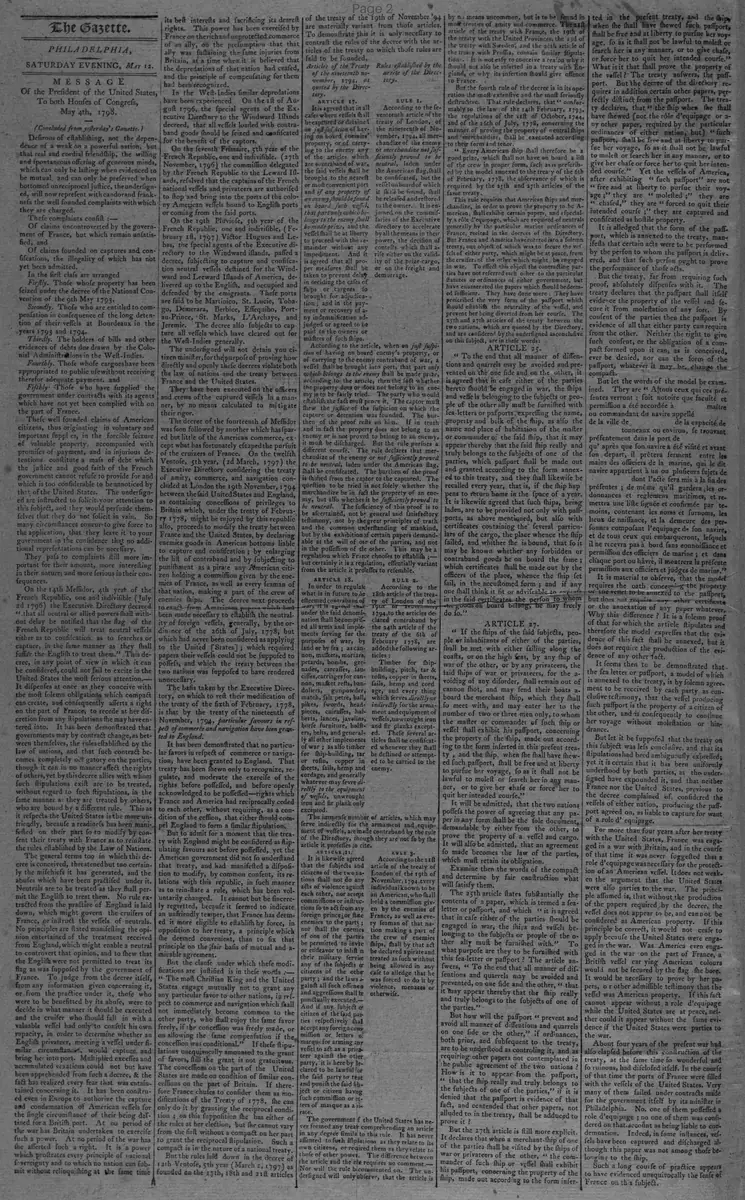
US envoys in Paris present formal complaints to French minister on January 17, 1798, regarding unsatisfied claims, illegal captures, and decrees violating treaties, devastating American commerce. Includes translated French law of January 18, 1798, declaring vessels with English goods as prizes.
Merged-components note: This is a single continuous diplomatic dispatch from the American envoys in France, split across pages 2 and 3 due to page boundaries; merging based on sequential reading order and textual continuation.
Clippings
1 of 2
OCR Quality
Full Text
To both Houses of Congress,
May 4th, 1798.
(Concluded from yesterday's Gazette.)
Desirous of establishing, not the dependence of a weak on a powerful nation, but that real and cordial friendship, the willing and spontaneous offering of generous minds, which can only be lasting when evidenced to be mutual, and can only be preserved when bottomed on reciprocal justice, the undersigned, will now represent with candor and frankness the well founded complaints with which they are charged.
These complaints consist:-
Of claims uncontroverted by the government of France, but which remain unsatisfied, and
Of claims founded on captures and confiscations, the illegality of which has not yet been admitted.
In the first class are arranged
Firstly. Those whose property has been seized under the decree of the National Convention of the 9th May 1793.
Secondly. Those who are entitled to compensation in consequence of the long detention of their vessels at Bordeaux in the years 1793 and 1794.
Thirdly. The holders of bills and other evidences of debts due drawn by the Colonial Administrations in the West-Indies.
Fourthly. Those whose cargoes have been appropriated to public use without receiving therefor adequate payment. and
Fifthly Those who have supplied the government under contracts with its agents which have not yet been complied with on the part of France.
These well founded claims of American citizens, thus originating in voluntary and important supplies, in the forcible seizure of valuable property, accompanied with promises of payment, and in injurious detentions, constitute a mass of debt which the justice and good faith of the French government cannot refuse to provide for and which is too considerable to be unnoticed by that of the United States. The undersigned are instructed to solicit your attention to this subject, and they would persuade themselves that they do not solicit in vain. So many circumstances concur to give force to the application, that they leave it to your government in the confidence that no additional representations can be necessary.
They pass to complaints still more important for their amount, more interesting in their nature, and more serious in their consequences.
On the 14th Messidor, 4th year of the French Republic, one and indivisible (July 2d 1796) the Executive Directory decreed ".that all neutral or allied powers shall without delay be notified that the flag of the French Republic will treat neutral vessels either as to confiscation, as to searches or capture, in the same manner as they shall suffer the English to treat them." This decree, in any point of view in which it can be considered, could not fail to excite in the United States the most serious attention.
It dispenses at once as they conceive with the most solemn obligations which compact can create, and consequently asserts a right on the part of France, to recede at her discretion from any stipulations she may have entered into. It has been demonstrated that governments may by contract change, as between themselves, the rules established by the law of nations, and that such contract becomes completely obligatory on the parties, though it can in no manner affect the rights of others, yet by this decree allies with whom such stipulations exist are to be treated, without regard to such stipulations, in the same manner as they are treated by others, who are bound by a different rule. This as it respects the United States is the more unfriendly, because a readiness has been manifested on their part so to modify by consent their treaty with France as to reinstate the rules established by the Law of Nations.
The general terms too in which this decree is conceived, threatened but too certainly the mischiefs it has generated, and the abuses which have been practiced under it. Neutrals are to be treated as they shall permit the English to treat them. No rule extracted from the practice of England is laid down, which might govern the cruizers of France, or instruct the vessels of neutrals. No principles are stated manifesting the opinion entertained of the treatment received from England, which might enable a neutral to controvert that opinion, and to shew that the English were not permitted to treat its flag as was supposed by the government of France. To judge from the decree itself, from any information given concerning it, or from the practice under it, those who were to be benefitted by its abuse, were to decide in what manner it should be executed and the cruizer who should fall in with a valuable vessel had only to consult his own rapacity, in order to determine whether an English privateer, meeting a vessel under similar circumstance, would capture and bring her into port. Multiplied excesses and accumulated vexations could not but have been apprehended from such a decree, & the fact has realized every fear that was entertained concerning it. It has been construed even in Europe to authorize the capture and condemnation of American vessels for the single circumstance of their being destined for a British port. At no period of the war has Britain undertaken to exercise such a power. At no period of the war has she asserted such a right. It is a power which prostrates every principle of national sovereignty and to which no nation can submit without relinquishing at the same time its best interests and sacrificing its dearest rights. This power has been exercised by France on the rich and unprotected commerce of an ally, on the presumption that that ally was sustaining the same injuries from Britain, at a time when it is believed that the depredations of that nation had ceased, and the principle of compensating for them had been recognized.
In the West-Indies similar depredations have been experienced On the 1st of August 1796, the special agents of the Executive Directory to the Windward Islands decreed. that all vessels loaded with contraband goods should be seized and confiscated for the benefit of the captors.
On the seventh Frimaire, 5th year of the French Republic, one and indivisible. (27th November, 1796) the commission delegated by the French Republic to the Leeward Islands, resolved that the captains of the French national vessels and privateers are authorized to stop and bring into the ports of the colony American vessels bound to English ports or coming from the said ports.
On the 19th Pluviose, 5th year of the French Republic, one and indivisible, (February 1st, 1797) Victor Hugues and Laveaux, the special agents of the Executive directory to the Windward islands, passed a decree, subjecting to capture and confiscation neutral vessels destined for the Windward and Leeward Islands of America, delivered up to the English, and occupied and defended by the emigrants. These ports are said to be Martinico, St. Lucie, Tobago, Demerara, Berbice, Essequibo, Port-au-Prince, St. Marks, L'Archaye, and Jeremie. The decree also subjects to capture all vessels which have cleared out for the West-Indies generally.
The undersigned will not detain you citizen minister, for the purpose of proving how directly and openly these decrees violate both the law of nations and the treaty between France and the United States.
They have been executed on the officers and crews of the captured vessels in a manner, by no means calculated to mitigate their rigor.
The decree of the fourteenth of Messidor was soon followed by another which has spared but little of the American commerce, except what has fortunately escaped the pursuit of the cruizers of France. On the twelfth Ventose, 5th year, (2d March, 1797) the Executive Directory considering the treaty of amity, commerce, and navigation concluded at London the 19th November, 1794 between the said United States and England, as containing concessions of privileges to Britain which, under the treaty of February 1778, might be enjoyed by this republic also, proceeds to modify the treaty between France and the United States, by declaring enemies goods in American bottoms liable to capture and confiscation ; by enlarging the list of contraband and by subjecting to punishment as a pirate any American citizen holding a commission given by the enemies of France, as well as every seaman of that nation, making a part of the crew of enemies ships. The decree next proceeds to exact from Americans papers which had been made necessary to establish the neutrality of foreign vessels, generally, by the ordinance of the 26th of July, 1778, but which had never been considered as applying to the United States; which required papers their vessels could not be supposed to possess, and which the treaty between the two nations was supposed to have rendered unnecessary.
The basis taken by the Executive Directory, on which to rest their modification of the treaty of the sixth of February, 1778, is that by the treaty of the nineteenth of November, 1794, particular favours in respect of commerce and navigation have been granted to England.
It has been demonstrated that no particular favors in respect of commerce or navigation, have been granted to England. That treaty has been shewn only to recognize, regulate, and moderate the exercise of the rights before possessed, and before openly acknowledged to be possessed-rights which France and America had reciprocally ceded to each other, without requiring, as a condition of the cession, that either should compel England to form a similar stipulation.
But to admit for a moment that the treaty with England might be considered as stipulating favours not before possessed, yet the American government did not so understand that treaty, and had manifested a disposition to modify, by common consent, its relations with this republic, in such manner as to reinstate a rule, which has been voluntarily changed. It cannot but be sincerely regretted, because it seemed to indicate an unfriendly temper, that France has deemed it more eligible to establish by force, in opposition to her treaty, a principle which she deemed convenient, than to fix that principle on the fair basis of mutual and amicable agreement.
But the clause under which these modifications are justified is in these words :-
" The most Christian King and the United States engage mutually not to grant any particular favor to other nations, in respect to commerce and navigation which shall not immediately become common to the other party, who shall enjoy the same favor freely, if the concession was freely made, or on allowing the same compensation if the concession was conditional." If these stipulations unequivocally amounted to the grant of favors, still the grant is not gratuitous. The concessions on the part of the United States are made on condition of similar concessions on the part of Britain. If therefore France chooses to consider them as modifications of the Treaty of 1778, she can only do it by granting the reciprocal condition ; on this supposition she has either of the rules at her election, but she cannot vary from the first without a compact on her part to grant the reciprocal stipulation. Such a compact is in the nature of a national treaty.
But the rules laid down in the decree of 12th Ventose, 5th year (March 2, 1797) as founded on the 17th, 18th and 21st articles of the treaty of the 19th of November '94 are materially variant from those articles.
To demonstrate this it is only necessary to contrast the rules of the decree with the articles of the treaty on which those rules are said to be founded.
Articles of the Treaty of the nineteenth November, 1794, as quoted by the Directory.
ARTICLE 17.
It is agreed that in all cases where vessels shall be captured or detained on just suspicion of having on board enemy's property, or of carrying to the enemy any of the articles which are contraband of war, the said vessels shall be brought to the nearest or most convenient port, and if any property of an enemy should be found on board such vessel, that part only which belongs to the enemy shall be made prize, and the vessel shall be at liberty to proceed with the remainder without any impediment. And it is agreed that all proper measures shall be taken to prevent delay, in deciding the cases of ships or cargoes brought for adjudication; and in the payment or recovery of any indemnification adjudged or agreed to be paid to the owners or masters of such ships.
According to the seventeenth article of the treaty of London, of the nineteenth of November, 1794, all merchandise of the enemy or merchandise not sufficiently proved to be neutral, laden under the American flag, shall be confiscated, but the vessel on board of which it shall be found, shall be released and restored to the owner. It is enjoined on the commissaries of the Executive Directory to accelerate by all the means in their power, the decision of contests which shall arise either on the validity of the prize-cargo, or on the freight and demurrage.
According to the article, when on just suspicion of having on board enemy's property, or of carrying to the enemy contraband of war, a vessel shall be brought into port, that part only which belongs to the enemy shall be made prize, according to the article, then the fact whether the property does or does not belong to an enemy is to be fairly tried. The party who would establish the fact must prove it, The captor must shew the justice of the suspicion on which the capture or detention was founded. The burthen of the proof rests on him. If in truth and in fact the property does not belong to an enemy or is not proved to belong to an enemy, it must be discharged. But the rule pursues a different course. The rule declares that merchandise of the enemy or not sufficiently proved to be neutral, laden under the American flag, shall be confiscated. The burthen of the proof is shifted from the captor to the captured. The question to be tried is not solely whether the merchandise be in fact the property of an enemy, but also whether it be sufficiently proved to be neutral. The sufficiency of this proof is to be ascertained, not by general and satisfactory testimony, not by the great principles of truth and the common understanding of mankind, but by the exhibition of certain papers demandable at the will of one of the parties, and not in the possession of the other. This may be a regulation which France chooses to establish ; but certainly it is a regulation, essentially variant from the article it professes to resemble.
In order to regulate what is in future to be esteemed contraband of war, it is agreed that under the said denomination shall be comprehended all arms and implements serving for the purposes of war, by land or by sea ; as cannon, muskets, mortars, petards, bombs, grenades, carcases, carriages for cannon, musket rests, bandoliers, gunpowder, match, salt petre, ball, pikes, swords, head-pieces, cuirasses, halberts, lances, javelins, horse furniture, belts, and generally all other implements of war ; as also timber for ship-building, pitch, tar or rosin, copper in sheets, sails, hemp and cordage, and generally whatever may serve directly to the equipment of vessels, unwrought iron and fir planks only excepted.
These several articles shall be confiscated, whenever they shall be destined or attempted to be carried to the enemy.
According to the 18th article of the treaty of London of the 19th November 1794, to the articles declared contraband by the 24th article of the treaty of the 6th of February 1778, are added the following articles: Timber for ship-building, pitch, tar & roin, copper in sheets, ails, hemp and cordage, and every thing which serves directly or indirectly for the armament and equipment of vessels, unwrought iron and fir planks excepted. These several articles shall be confiscated whenever they shall be destined or attempted to be carried to the enemy.
The immense number of articles, which may serve indirectly for the armament and equipment of vessels, are made contraband by the rule of the Directory, though they are not so by the article it professes to cite.
ARTICLE 21.
It is likewise agreed that the subjects and citizens of the two nations shall not do any acts of violence against each other, nor accept commissions or instructions so to act from any foreign prince or state, enemies to the other party ; nor shall the enemies of one of the parties be permitted to invite or endeavor to enlist in their military service, any of the subjects or citizens of the other party; and the laws against all such offenses and aggressions shall be punctually executed. And if any subject or citizen of the said parties respectively shall accept any foreign commission or letters of marque for arming any vessel to act as a privateer against the other party, it is hereby declared to be lawful for the said party to treat and punish the said subject or citizen having such commission or letters of marque as a pirate.
According to the 21st article of the treaty of London of the 19th of November, 1794, every individual known to be an American, who shall hold a commission given by the enemies of France, as well as every seaman of that nation making a part of the crew of enemies ships, shall by that act be declared a pirate and treated as such without being allowed in any case to allege that he was forced to do it by violence, menaces or otherwise.
The government of the United States has never formed any treaty comprehending an article in any degree similar to this rule. It has never assented to such stipulations as they relate to its own citizens, or required them as they relate to those of other powers. The difference between the article and the rule requires no comment. Nor will the rule be commented on. The undersigned will only observe, that the article is by no means uncommon, but is to be found in most treaties of amity and commerce, The 24th article of the treaty with France, the 19th of the treaty with the United Provinces, the 23d of the treaty with Sweden, and the 20th article of the treaty with Prussia, contain similar stipulations. It is not easy to conceive a reason why it should not also be inserted in a treaty with England, or why its insertion should give offence to France.
But the fourth rule of the decree is in its operation the most extensive and the most seriously destructive. That rule declares, that " conformably to the law of the 14th February, 1793, the regulations of the 1st of October, 1744, and of the 26th of July, 1778, concerning the manner of proving the property of neutral ships and merchandise, shall be executed according to their form and tenor."
" Every American ship shall therefore be a good prize, which shall not have on board a list of the crew in proper form, such as is prescribed by the model annexed to the treaty of the 6th of February, 1778, the observance of which is required by the 25th and 27th articles of the same treaty."
This rule requires that American ships and merchandise, in order to prove the property to be American, shall exhibit certain papers, and especially a rôle d'equipage, which are required of neutrals generally by the particular marine ordinances of France, recited in the decrees of the Directory.
But France and America have entered into a solemn treaty, one object of which was to secure the vessels of either party, which might be at peace, from the cruizers of the other which might be engaged in war. 'To effect this object the contracting parties have not referred each other to the particular statutes or ordinances of either government, but have enumerated the papers which should be deemed sufficient. They have done more : They have prescribed the very form of the passport which should establish the neutrality of the vessel, and prevent her being diverted from her course. The 25th and 27th articles of the treaty between the two nations, which are quoted by the Directory, and are considered by the undersigned as conclusive on this subject, are in these words:
ARTICLE 25.
" To the end that all manner of dissensions and quarrels may be avoided and prevented on the one side and on the other, it is agreed that in case either of the parties hereto should be engaged in war, the ships and vessels belonging to the subjects or people of the other ally must be furnished with sea-letters or passports, expressing the name, property and bulk of the ship, as also the name and place of habitation of the master or commander of the said ship, that it may appear thereby that the said ship really and truly belongs to the subjects of one of the parties, which passport shall be made out and granted according to the form annexed to this treaty, and they shall likewise be recalled every year, that is, if the ship happens to return home in the space of a year. It is likewise agreed that such ships, being laden, are to be provided not only with passports as above mentioned, but also with certificates containing the several particulars of the cargo,' the place whence the ship sailed, and whither he is bound, that so it may be known whether any forbidden or contraband goods be on board the same : which certificates shall be made out by the officers of the place, whence the ship set sail, in the accustomed form ; and if any one shall think it fit or advisable to express in the said certificates the person to whom the goods on board belong, he may freely do so."
ARTICLE 27.
" If the ships of the said subjects, people or inhabitants of either of the parties, shall be met with either sailing along the coasts, or on the high seas, by any ship of war of the other, or by any privateers, the said ships of war or privateers,, for the avoiding of any disorder, shall remain out of cannon shot, and may end their boats aboard the merchant ship, which they shall meet with, and may enter her to the number of two or three men only, to whom the master or commander of such ship or vessel shall exhibit his passport, concerning the property of the ship, made out according to the form inserted in this present treaty , and the ship, when he shall have shewed such passport, shall be free and at liberty to pursue her voyage, so as it shall not be lawful to molest or search her in any manner, or to give her chase or force her to quit her intended course."
It will be admitted, that the two nations possess the power of agreeing that any paper in any form shall be the sole document, demandable by either from the other, to prove the property of a vessel and cargo.
It will also be admitted, that an agreement so made becomes the law of the parties, which must retain its obligation.
Examine then the words of the compact and determine by fair construction what will satisfy them.
The 25th article states substantially . the contents of a paper, which is termed a sea-letter or passport, and which " it is agreed that in case either of the parties should be engaged in war, the ships and vessels belonging to the subjects or people of the other ally must be furnished with." To what purpose are they to be furnished with this sea-letter or passport ? The article answers, " To the end that all manner of dissensions and quarrels may be avoided and prevented, on one side and the other, " that it may appear thereby that the ship really and truly belongs to the subjects of one of the parties."
But how will the passport " prevent and avoid all manner of dissensions and quarrels on one side or the other," if ordinances, both prior, and subsequent to the treaty, are to be understood as controlling it, and as requiring other papers not contemplated in the public agreement of the two nations ?
How is it to appear from the passport, " that the ship really and truly belongs to the subjects of one of the parties," if it is denied that the passport is evidence of that fact, and contended that other papers, not alluded to in the treaty, shall be adduced to prove it ?
But the 27th article is still more explicit. It declares that when a merchant-ship of one of the parties shall be visited by the ships of war or privateers of the other, " the commander of such ship or vessel shall exhibit his passport, concerning the property of the ship, made out according to the form inserted in the present treaty, and the ship, when she shall have shewed such, passport, shall be free and at liberty to pursue her voyage, so as it shall not be lawful to molest or search her in any manner, or to give her chase, or force her to quit her intended course."
What is it that shall prove the property of the vessel?-The treaty answers, the passport. But the decree of the directory requires in addition certain other papers, perfectly distinct from the passport. The treaty declares, that " the ship when she shall have shewed (not, the rôle d'equipage or any other paper, required by the particular ordinances of either nation, but" such passport, shall be free and at liberty to pursue her voyage, so as it shall not be lawful to molest or search her in any manner, or to give her chase or force her to quit her intended course." Yet the vessels of America, after exhibiting " such passport" are not " free and at liberty to pursue their voyage;" they are " molested ;" they are " searched," they are " chased," they are " forced to quit their intended course ;" they are captured and confiscated as hostile property.
It is alleged that the form of the passport, which is annexed to the treaty, manifests that certain acts were to be performed. by the person to whom the passport is delivered, and that such person ought to prove the performance of those acts.
But the treaty, far from requiring such proof, absolutely dispenses with it. The treaty declares that the passport shall itself evidence the property of the vessel and secure it from molestation of any sort. By consent of the parties then the passport is evidence of all that either party can require from the other. Neither the right to give such consent, or the obligation of a compact formed upon it can, as is conceived, ever be denied, nor can the form of the passport, whatever it may be, change the compact.
But let the words of the model be examined. They are " A tous ceux qui ces présentes verront : soit notoire que faculté et permission a été accordée à maitre ou commandant du navire appelé de la ville de de la capacité de tonneaux ou environ, e trouvant présentement dans le port de qu' après que on navire a été visité et avant on depart, il prêtera serment entre les mains des officiers de la marine, qui le dit navire appartient à un ou plusieurs sujets de dont l'acte sera mis a la fin des présentes ; de même qu'il gardera, les ordonnances et reglemens maritimes, et remettra une liste signée et confirmée par témoin, contenant les noms et surnoms, les lieux de naissance, et la demeure des personnes composant l'equipage de on navire, et de tous ceux qui embarqueront, lesquels il ne recevra pas à bord sans connoissance et permission des officiers de marine; et dans chaque port ou havre, il montrera la présente permission aux officiers et juges de marine."
It is material to observe, that the model requires the oath concerning the property of the vessel to be annexed to the passport but does not require any other certificate or the annexation of any paper whatever.
Why this difference ? It is a solemn proof of that for which the article stipulates and therefore the model expresses that the evidence of this fact shall be annexed, but it does not require the production of the evidence of any other fact.
It seems then to be demonstrated that. the sea letter or passport, a model of which is annexed to the treaty, is by solemn agreement to be received by each party as conclusive testimony, that the vessel producing such passport is the property of a citizen of the other, and is consequently to continue her voyage without molestation or hindrance.
But let it be supposed that the treaty on this subject was less conclusive, and that its stipulations had been ambiguously expressed; yet it is certain that it has been uniformly understood by both parties, as the undersigned have expounded it, and that neither France nor the United States, previous to the decree complained of, considered the vessels of either nation, producing the passport agreed on, as liable to capture for want of a role d' equipage.
For more than four years after her treaty with the United States, France was engaged in a war with Britain, and in the course of that time it was never suggested that a role d'equipage was necessary for the protection of an American vessel. It does not weaken the argument that the United States were also parties to the war. The principle assumed is, that without the production of the papers required by the decree, the vessel does not appear to be, and cannot be considered! as American property. If this principle be correct, it would not cease to apply because the United States were engaged in the war. Was America even engaged in the war on the part of France, a British vessel carrying American colours would not be secured by the flag she bore. It would be necessary to prove by her papers, or other admissible testimony that the vessel was American property. If this fact cannot appear without a role d'equipage while the United States are at peace, neither could it appear without the same evidence if the United States were parties to the war.
About four years of the present war had also elapsed before this construction of the treaty, at the same time so wonderful and so ruinous, had disclosed itself. In the course of that time the ports of France were filled with the vessels of the United States. Very many of them sailed under contracts made for the government itself by its minister in Philadelphia. No. one of them possessed a role d'equipage ; no one of them was considered on that account as being liable to condemnation. Indeed, in some instances, vessels have been captured and discharged although this paper was not among those belonging to the ship.
Such a long course of practice appears to have evidenced unequivocally the sense of France on this subject.
It is too apparent to be questioned for a moment, that on the part of the United States no suspicion had ever been entertained that such a paper could have been required. A rôle d'équipage could have been obtained with as much facility as that passport for which the treaty stipulates. Could it have been imagined that American vessels incurred the possible hazard of being retarded only one day in a voyage for want of such paper, it would in every instance have been supplied. No vessels would have sailed without it.
Your own mind, Citizen Minister, will suggest to you, with irresistible force, the extreme hardship of thus putting a new construction on a long existing contract, or of giving a new and unexpected extension to ancient municipal regulations, and of condemning thereby vessels taken on the high seas for want of a paper not known to be required, when they sailed out of port. If a rôle d'équipage was really considered by France as necessary evidence of any fact, the establishment of which was deemed essential, common usage and those plain principles of justice which all nations should respect, indispensably require that the regulation should first be made known to a neutral and friendly nation by other means than by the capture and confiscation of its property. If this measure had been announced to the government of the United States, before it had been put in practice, and American vessels had sailed without a rôle d'équipage, they would have taken upon themselves the hazard of such a procedure. But in a moment when the ocean is covered with peaceful merchantmen, pursuing a just and lawful commerce, to bring into sudden operation a measure which had never before been applied to them, which had for so many years slept unheard of, and by the force of this regulation, to confiscate unguarded property which had been trusted to the seas, under the faith of solemn and existing treaties, and without conjecture that this, more than any other formality, would have been required, is to impose on unoffending individuals a ruin from which no wise precautions, no human foresight could possibly have protected them.
On this subject then the undersigned appeal with confidence to the justice and equity of the French government.
But could it be conceded for a moment that the Executive Directory might rightfully modify the treaty of France with the United States by that of the United States with Britain, and might rightfully require a rôle d'équipage in order to establish the neutrality of a vessel, for want of which the vessel might be confiscated, yet, the cargo being proved to be neutral ought to be safe. According to the law of Nations, the goods of an enemy found on board the ship of a friend are liable to capture, and the goods of a friend found on board the ship of an enemy are safe. The United States and France have consented to change this rule as between themselves. They have agreed that the goods of an enemy found on board the vessels of either party shall be safe, and that the goods of either found on board the vessel of an enemy shall be liable to capture. The one part of the rule is in consequence of and dependent on the other. The one part cannot on any principle of justice be abandoned while the other is maintained.
In their treaty with England the United States retain unchanged the principle of the law of nations. If France modifies her treaty in this respect by that of England, she ought to take the principle entire. If in conformity to the treaty between the United States and England, France claims the right of taking enemies property found on board an American ship, then, in conformity with that treaty also, France ought to spare American property, found on board an enemy's ship. If, therefore, this extraordinary position could be maintained, that an American ship without a rôle d'équipage becomes the ship of an enemy, till the cargo, being proved to be the property of a friend, ought, on the principle of modifying the treaty between the two nations by that with England, to have been restored to the owners.
The result of these regulations has been the most extensive and universal devastation of the American commerce. Not only vessels bound to and from the enemies of France but vessels bound to and from her allies, and to and from her own ports have been seized and confiscated.
The inevitable consequence has been, that direct commerce between the two nations is almost annihilated, and that the property of American citizens has been taken to a much larger amount than would have been possible in a state of actual war.
Yet the government of the United States, wishing, if it be possible, to avoid even defensive measures, has sought assiduously and unremittingly, though hitherto without success, for such peaceful and amicable explanations as might do away existing animosities, and restore between the two republics that harmony which it so truly desires.
America has accustomed herself to perceive in France only the ally and the friend. Consulting the feelings of her own bosom, she has believed that between republics an elevated and refined friendship could exist, and that free nations were capable of maintaining for each other a real and permanent affection. If this pleasing theory, erected with so much care and viewed with so much delight, has been impaired by experience, yet the hope continues to be cherished that this circumstance does not necessarily involve the opposite extreme. It is believed that there exists no sufficient cause for solid and permanent enmity between France and the United States, but that on the contrary the interests of both would be promoted by that friendly intercourse, which a reciprocal observance of the great and immutable principles of justice would certainly establish and can alone preserve. Under this impression America resists the opinion that the present state of things has grown out of a digested system to which France designs to adhere. She wishes and endeavors to persuade herself that temporary causes, which too often produce effects as sound and just policy must reprobate, connected with a misconstruction of the conduct of her government, as well as of the motives on which it has acted, may have occasioned those very serious aggressions of which she complains. She recedes therefore, even under the pressure of these aggressions, slowly and with difficulty from the attachments she has formed. So intertwined with every ligament of her heart have been the chords of affection which bound her to France, that only repeated and continual acts of hostility can tear them asunder.
The government of the United States, therefore, still searches the means of terminating peacefully, and in a manner which ought to be mutually satisfactory, the calamities of the moment, and of averting the still greater calamities which may be reserved for the future. Not even the discouraging and unusual events which had preceded the present effort to negotiate could deter that government from repeating its endeavors for the preservation of amity and peace. Three citizens of the United States have been deputed as envoys extraordinary and ministers plenipotentiary to the French republic. Their instructions authorize and direct them to review the existing treaties between the two nations, and to remove by all proper means, the inequalities which have grown out of the stipulations of those treaties, in consequence of the refusal of England to adopt the principles they contain. They are also directed to give fair and complete explanations of the conduct of the government they represent; to state fully and truly the heavy injuries which their fellow citizens have sustained; and to ask from the equity of a great and magnanimous republic that compensation for those injuries which we flatter ourselves, their justice will not refuse and their liberal policy will not hesitate to give.
Bringing with them the temper of their government and country, searching only for the means of effecting the objects of their mission, they have permitted no personal considerations to influence their conduct, but have waited under circumstances beyond measure embarrassing and unpleasant, with that respect which the American government has so uniformly paid to that of France for permission to lay before you, citizen minister, these important communications with which they have been charged.
Perceiving no probability of being allowed to enter, in the usual forms, on those discussions which might tend to restore harmony between the two republics, they have deemed it most advisable, even under the circumstances of informality which attend the measure, to address to your government, through you, this candid review of the conduct, and this true representation of the sentiments and wishes of the government of the United States. They pray that it may be received in the temper with which it is written, and considered as an additional effort, growing out of a disposition common to the government and people of America, to cultivate and restore, if it be possible, harmony between the two republics. If, citizen minister, there remains a hope that these desirable objects can be effected by any means which the United States have authorized, the undersigned will still solicit and will still respectfully attend the development of those means.
If on the contrary no such hope remains; they have only to pray that their return to their own country may be facilitated; and they will leave France with the most deep-felt regret that neither the real and sincere friendship, which the government of the United States has so uniformly and unequivocally displayed for this great republic, nor its continued efforts to demonstrate the purity of its conduct and intentions, can protect its citizens, or preserve them from the calamities which they have sought by a just and upright conduct to avert.
The undersigned pray you, citizen minister, to accept the assurances of their perfect respect and consideration.
Paris, January 17th, 1798, in the 22d year of American Independence.
Translated extract from the Bulletin des Lois, No. 178. printed at Paris, and enclosed with the quadruplicate of the Envoys letter, No. 6.
Law relative to vessels laden with English merchandise of the 29th Nivose, 6th year, (18th Jan. 1798.)
The council of Ancients, adopting the reasons for the declaration of urgency, which precedes the resolution herein after contained, approves the act of urgency.
Here follows the tenor of the declaration of urgency, and of the resolution of the 29th Nivose, [11th January 1798.]
The council of Five Hundred, after having heard the report of a special committee upon the message of the Executive Directory of the 18th Nivose 6th Jan. relative to English merchandise;
Considering, that the interest of the Republic demands the most prompt measures against all vessels which may be loaded therewith;
Declares, that there is urgency.
The Council, after having declared the urgency, resolves as follows:
ARTICLE 1.
The character of vessels, relative to their quality of neuter or enemy, shall be determined by their cargo; in consequence, every vessel found at sea, loaded in whole or in part with merchandise the production of England or of her possessions, shall be declared good prize, whoever the owner of these goods or merchandise may be.
ARTICLE 2.
Every foreign vessel which, in the course of her voyage, shall have entered into an English port, shall not be admitted into a port of the French Republic, except in case of necessity; in which case she shall be bound to depart from the said port as soon as the causes of her entry shall have ceased.
ARTICLE 3.
The present resolution shall be printed.
(Signed)
Boulay (of la Meurthe) President.
Guillemardet,
Secretaries.
Roziers,
After a second reading, the council of Ancients approves the above resolution. The 29th of Nivose, sixth year of the French republic (18th January, 1798.) (Signed).
Maraugor, President.
Et. Laveaux Kaufmann,
Menuau,
Secretaries
Meric,
The Executive Directory orders, that the above law shall be printed, executed, and that it shall be sealed with the seal of the republic.
Done at the national palace of the executive directory, the 29th Nivose, sixth year of the French republic, one and indivisible. (11th January, 1798)
For a true copy:
(Signed)
P. Barras, President.
By the Executive Directory,
The Secretary-General, LACRADE
And sealed with the seal of the Republic.
What sub-type of article is it?
What keywords are associated?
What entities or persons were involved?
Where did it happen?
Foreign News Details
Primary Location
Paris
Event Date
January 17th, 1798
Key Persons
Outcome
extensive devastation of american commerce through captures and confiscations; direct commerce between us and france almost annihilated; property taken exceeding amounts in actual war; new french law declares vessels with english goods as prizes.
Event Details
US envoys present complaints to French minister about unsatisfied claims from 1793-1794, French decrees from 1796-1797 authorizing captures of American vessels, violations of 1778 treaty, modifications based on US-UK 1794 treaty, and requirements for additional papers like rôle d'équipage; enclosed French law of 29th Nivose (18th Jan 1798) on vessels with English merchandise.