Thank you for visiting SNEWPapers!
Sign up free
The Virginia Gazette
Richmond, Williamsburg, Richmond County, Virginia
What is this article about?
Extract of a letter from Col. Robert Howe to the President of the Convention, dated Dec. 28, 1775, reporting stalled prisoner exchange negotiations with Lord Dunmore over disputes regarding the ranks of militia officers versus regulars, following actions at Great Bridge.
Clipping
OCR Quality
Full Text
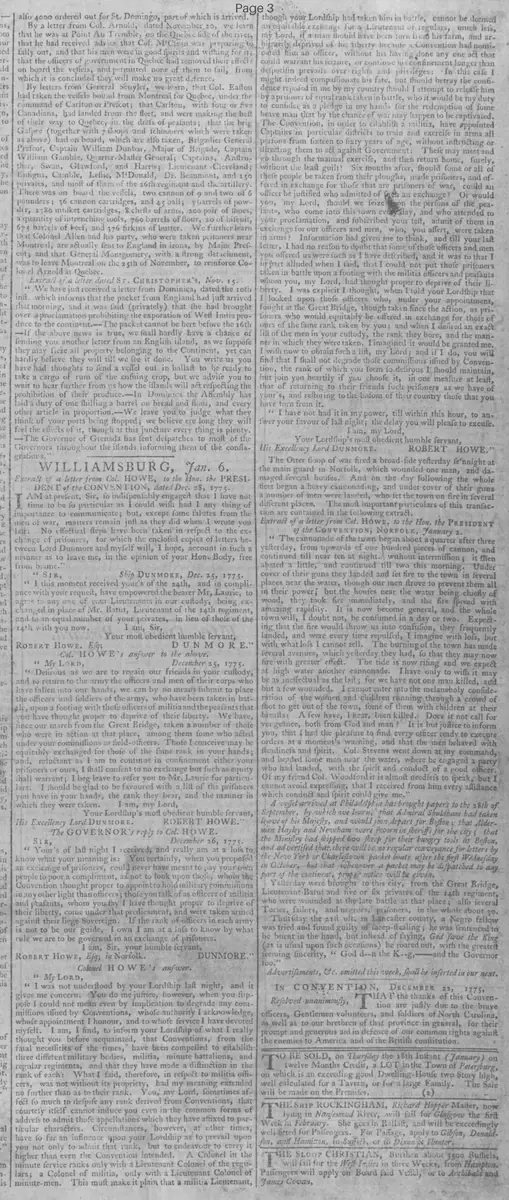
Extract of a letter from Col. HOWE, to the Hon. the PRESIDENT of the CONVENTION, dated Dec. 28, 1775.
I AM at present, Sir, so indispensably engaged that I have not time to be so particular as I could wish had I any thing of importance to communicate; but, except some salutes from the men of war, matters remain just as they did when I wrote you last: No effectual steps have been taken in respect to the exchange of prisoners, for which the enclosed copies of letters between Lord Dunmore and myself will, I hope, account in such a manner as to leave me, in the opinion of your Hon. Body, free from blame.
" SIR,
Ship Dunmore, Dec. 25, 1775.
" I this moment received your's of the 24th, and in compliance with your request, have empowered the bearer Mr, Laurie, to agree to any one of your Lieutenants in our custody, being exchanged in place of Mr. Batut, Lieutenant of the 14th regiment, and to an equal number of your privates, in lieu of those of the 14th with you now. I am, Sir,
Your most obedient humble servant,
DUNMORE.
Robert Howe, Esq;
Col. HOWE's answer to the above.
"My LORD,
December 25, 1775.
" Desirous as we are to regain our friends in your custody, and to return to the army the officers and men of their corps who have fallen into our hands, we can by no means submit to place the officers and soldiers of the army, who have been taken in battle, upon a footing with those officers of militia and the peasants that you have thought proper to deprive of their liberty. We have, since our march from the Great Bridge, taken a number of those who were in action at that place, among them some who acted under your commissions as field-officers. Those I conceive may be equitably exchanged for those of the same rank in your hands; and, reluctant as I am to continue in confinement either your prisoners or ours, I shall consent to no exchange but such as equity shall warrant; I beg leave to refer you to Mr. Laurie for particulars. I should be glad to be favoured with a list of the prisoners you have in your hands, the rank they bear, and the manner in which they were taken.
I am, my Lord,
Your Lordship's most obedient humble servant,
ROBERT HOWE.
His Excellency Lord Dunmore.
The GOVERNOR's reply to Col. HOWE.
SIR,
December 26, 1775.
" Your's of last night I received, and really am at a loss to know what your meaning is: You certainly, when you proposed an exchange of prisoners, could never have meant to pay your own people so poor a compliment, as not to look upon those, whom the Convention thought proper to appoint to hold military commissions in any other light than officers; those you talk of as officers of militia and peasants, whom you say I have thought proper to deprive of their liberty, come under that predicament, and were taken armed against their liege Sovereign. If the rank of officers in each army is not to be our guide, I own I am at a loss to know by what rule we are to be governed in an exchange of prisoners.
I am, Sir, your humble servant,
DUNMORE.
Robert Howe, Esq; in Norfolk.
Colonel HOWE's answer.
"My LORD,
" I was not understood by your Lordship last night, and it gives me concern. You do me justice, however, when you suppose I could not mean even by implication to degrade any commissions issued by Conventions, whose authority I acknowledge, whose appointment I honour, and to whose service I have devoted myself. I am, I find, to inform your Lordship of what I really thought you before acquainted, that Conventions, from the fatal necessities of the times, have been compelled to establish three different military bodies, militia, minute battalions, and regular regiments, and that they have made a distinction in the rank of each: What I said, therefore, in respect to militia officers, was not without its propriety, had my meaning extended no further than as to their rank. You, my Lord, sometimes affect so much to despise any rank derived from Conventions, that courtesy itself cannot induce you even in the common forms of address to admit those appellations which they have affixed to particular characters. Circumstances, however, at other times, have so far an influence upon your Lordship as to prevail upon you not only to admit that rank, but to endeavour to carry it higher than even the Convention intended. A Colonel in the minute service ranks only with a Lieutenant Colonel of the regulars; a Colonel of militia, only with a Lieutenant Colonel of minute-men. This must make it plain that a militia Lieutenant, though your Lordship had taken him in battle, cannot be deemed an equitable exchange for a Lieutenant of regulars, much less, my Lord, if a man should have been torn from his farm, and arbitrarily deprived of his liberty because a Convention had nominated him an officer, without his having done any one act that could warrant his seizure, or continue his confinement longer than despotism prevails over rights and privileges: In this case I might indeed compassionate his fate, but should betray the confidence reposed in me by my country should I attempt to release him by a prisoner of equal rank taken in battle, who it would be my duty to consider as a pledge in my hands for the redemption of some brave man that by the chance of war may happen to be captivated. The Convention, in order to establish a militia, have appointed Captains in particular districts to train and exercise in arms all persons from sixteen to sixty years of age, without instructing or directing them to act against Government: These may meet and go through the manual exercise, and then return home, surely, without the least guilt! Six months after, should some or all of these people be taken from their ploughs, made prisoners, and offered in exchange for those that are prisoners of war, could an officer be justified who admitted of such an exchange? Or would you, my Lord, should we seize on the persons of the peasants, who come into this town every day, and who attended to your proclamation, and subscribed your test, admit of them in exchange for our officers and men, who, you assert, were taken in arms? Information had given me to think, and till your last letter, I had no reason to doubt that some of those officers and men you offered us were such as I have described, and it was to that I in part alluded when I said, that I could not put those prisoners taken in battle upon a footing with the militia officers and peasants whom you, my Lord, had thought proper to deprive of their liberty. I was explicit I thought, when I told your Lordship that I looked upon those officers who, under your appointment, fought at the Great Bridge, though taken since the action, as prisoners who would equitably be offered in exchange for those of ours of the same rank taken by you; and when I desired an exact list of the men in your custody, the rank they bore, and the manner in which they were taken, I imagined it would be granted me. I wish now to obtain such a list, my Lord; and if I do, you will find that I shall not degrade those commissions issued by Convention, the rank of which you seem so desirous I should maintain, but join you heartily if you choose it, in one measure at least, that of returning to their friends such prisoners as we have of yours, and restoring to the bosom of their country those that you have torn from it.
" I have not had it in my power, till within this hour, to answer your favour of last night; the delay you will please to excuse.
I am, my Lord,
Your Lordship's most obedient humble servant,
ROBERT HOWE.
His Excellency Lord DUNMORE."
What sub-type of article is it?
What keywords are associated?
What entities or persons were involved?
Where did it happen?
Domestic News Details
Primary Location
Norfolk
Event Date
Dec. 25 28, 1775
Key Persons
Outcome
no agreement reached on prisoner exchange due to disputes over ranks; howe requests list of prisoners.
Event Details
Col. Howe reports to the Convention on correspondence with Lord Dunmore regarding prisoner exchange, refusing to equate regular army prisoners with militia officers or civilians detained by Dunmore, referencing ranks established by Conventions and actions at Great Bridge.