Thank you for visiting SNEWPapers!
Sign up free
Literary
January 7, 1773
The Virginia Gazette
Williamsburg, Virginia
What is this article about?
A letter from 'Frater' to Maria advising frequent reflection on death as a memento mori to prepare for eternity, contrasting the dread it brings to the wicked with peace for the virtuous. Includes translated excerpts from Port Royal moral essays by Mrs. Rowe on death's terrors and a quote from Cato on the soul's immortality.
Clipping
OCR Quality
98%
Excellent
Full Text
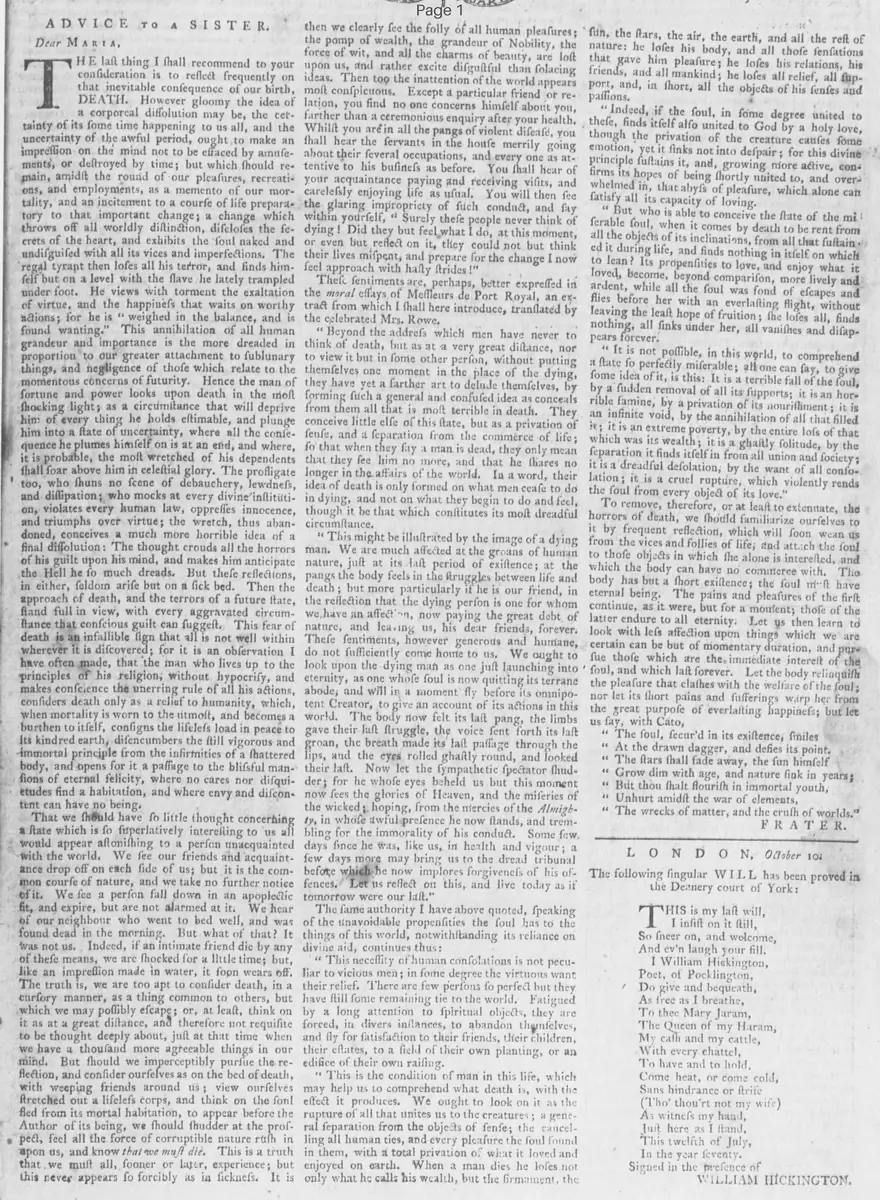
ADVICE TO A SISTER.
Dear MARIA,
The last thing I shall recommend to your consideration is to reflect frequently on that inevitable consequence of our birth, DEATH. However gloomy the idea of a corporeal dissolution may be, the certainty of its some time happening to us all, and the uncertainty of the awful period, ought to make an impression on the mind not to be effaced by amusements, or destroyed by time; but which should remain, amidst the round of our pleasures, recreations, and employments, as a memento of our mortality, and an incitement to a course of life preparatory to that important change; a change which throws off all worldly distinction, discloses the secrets of the heart, and exhibits the soul naked and undiguised with all its vices and imperfections. The regal tyrant then loses all his terror, and finds himself but on a level with the slave he lately trampled under foot. He views with torment the exaltation of virtue, and the happiness that waits on worthy actions: for he is "weighed in the balance, and is found wanting." This annihilation of all human grandeur and importance is the more dreaded in proportion to our greater attachment to sublunary things, and negligence of those which relate to the momentous concerns of futurity. Hence the man of fortune and power looks upon death in the most shocking light; as a circumstance that will deprive him of every thing he holds estimable, and plunge him into a state of uncertainty, where all the consequence he plumes himself on is at an end, and where, it is probable, the most wretched of his dependents shall soar above him in celestial glory. The profligate too, who shuns no scene of debauchery, lewdness, and dissipation; who mocks at every divine institution, violates every human law, oppresses innocence, and triumphs over virtue; the wretch, thus abandoned, conceives a much more horrible idea of a final dissolution: The thought crowds all the horrors of his guilt upon his mind, and makes him anticipate the Hell he so much dreads. But these reflections, in either, seldom arise but on a sick bed. Then the approach of death, and the terrors of a future state, stand full in view, with every aggravated circumstance that conscious guilt can suggest. This fear of death is an infallible sign that all is not well within wherever it is discovered; for it is an observation I have often made, that the man who lives up to the principles of his religion; without hypocrisy, and makes conscience the unerring rule of all his actions, considers death only as a relief to humanity, which, when mortality is worn to the utmost, and becomes a burden to itself, consigns the lifeless load in peace to its kindred earth, disencumbers the still vigorous and immortal principle from the infirmities of a shattered body, and opens for it a passage to the blissful mansions of eternal felicity, where no cares nor disquiets find a habitation, and where envy and discontent can have no being.
That we should have so little thought concerning a state which is so superlatively interesting to us all would appear astonishing to a person unacquainted with the world. We see our friends and acquaintance drop off on each side of us; but it is the common course of nature, and we take no further notice of it. We see a person fall down in an apoplectic fit, and expire, but are not alarmed at it. We hear of our neighbour who went to bed well, and was found dead in the morning. But what of that? It was not us. Indeed, if an intimate friend die by any of these means, we are shocked for a little time; but, like an impression made in water, it soon wears off. The truth is, we are too apt to consider death, in a cursory manner, as a thing common to others, but which we may possibly escape; or, at least, think on it as at a great distance, and therefore not requisite to be thought deeply about, just at that time when we have a thousand more agreeable things in our mind. But should we imperceptibly pursue the reflection, and consider ourselves as on the bed of death, with weeping friends around us; view ourselves stretched out a lifeless corps, and think on the soul fled from its mortal habitation, to appear before the Author of its being, we should shudder at the prospect, feel all the force of corruptible nature rush in upon us, and know that we must die. This is a truth that we must all, sooner or later, experience; but this never appears so forcibly as in sickness. It is then we clearly see the folly of all human pleasures: the pomp of wealth, the grandeur of Nobility, the force of wit, and all the charms of beauty, are lost upon us, and rather excite disgustful than solacing ideas. Then too the inattention of the world appears most conspicuous. Except a particular friend or relation, you find no one concerns himself about you, farther than a ceremonious enquiry after your health. Whilft you are in all the pangs of violent disease, you shall hear the servants in the house merrily going about their several occupations, and every one as attentive to his business as before. You shall hear of your acquaintance paying and receiving visits, and carelessly enjoying life as usual. You will then see the glaring impropriety of such conduct, and say within yourself, "Surely these people never think of dying! Did they but feel what I do, at this moment, or even but reflect on it, they could not but think their lives mispent, and prepare for the change I now feel approach with hasty strides!"
These sentiments are, perhaps, better expressed in the moral essays of Messieurs de Port Royal, an extract from which I shall here introduce, translated by the celebrated Mrs. Rowe.
"Beyond the address which men have never to think of death, but as at a very great distance, nor to view it but in some other person, without putting themselves one moment in the place of the dying, they have yet a farther art to delude themselves, by forming such a general and confused idea as conceals from them all that is most terrible in death. They conceive little else of this state, but as a privation of sense, and a separation from the commerce of life: so that when they say a man is dead, they only mean that they see him no more, and that he shares no longer in the affairs of the world. In a word, their idea of death is only formed on what men cease to do in dying, and not on what they begin to do and feel, though it be that which constitutes its most dreadful circumstance."
"This might be illustrated by the image of a dying man. We are much affected at the groans of human nature, just at its last period of existence; at the pangs the body feels in the Struggles between life and death; but more particularly if he is our friend, in the reflection that the dying person is one for whom we have an affection on, now paying the great debt of nature, and leaving us, his dear friends, forever. These sentiments, however generous and humane, do not sufficiently come home to us. We ought to look upon the dying man as one just launching into eternity, as one whose soul is now quitting its terrene abode; and will in a moment fly before its omnipotent Creator, to give an account of its actions in this world. The body now felt its last pang, the limbs gave their last struggle, the voice sent forth its last groan, the breath made its last passage through the lips, and the eyes rolled ghastly round, and looked their last. Now let the sympathetic spectator shudder: for he whose eyes beheld us but this moment now sees the glories of Heaven, and the miseries of the wicked: hoping, from the mercies of the Almighty, in whose awful presence he now stands, and trembling for the immorality of his conduct. Some few days since he was, like us, in health and vigour; a few days more may bring us to the dread tribunal before which he now implores forgiveness of his offences. Let us reflect on this, and live today as if tomorrow were our last."
The same authority I have above quoted, speaking of the unavoidable propensities the soul has to the things of this world, notwithstanding its reliance on divine aid, continues thus:
"This necessity of human consolations is not peculiar to vicious men; in some degree the virtuous want their relief. There are few persons so perfect but they have still some remaining tie to the world. Fatigued by a long attention to spiritual objects, they are forced, in divers instances, to abandon themselves, and fly for satisfaction to their friends, their children, their estates, to a field of their own planting, or an edifice of their own raising."
"This is the condition of man in this life. which may help us to comprehend what death is, with the effect it produces. We ought to look on it as the rupture of all that unites us to the creatures; a general separation from the objects of sense; the cancelling all human ties, and every pleasure the soul found in them, with a total privation of what it loved and enjoyed on earth. When a man dies he loses not only what he calls his wealth, but the firmament, the sun, the stars, the air, the earth, and all the rest of nature: he loses his body, and all those sensations that gave him pleasure; he loses his relations, his friends, and all mankind; he loses all relief, all support, and, in short, all the objects of his senses and passions."
"Indeed, if the soul, in some degree united to these, finds itself also united to God by a holy love, though the privation of the creature causes some emotion, yet it sinks not into despair; for this divine principle sustains it, and, growing more active, confirms its hopes of being shortly united to, and overwhelmed in, that abyss of pleasure, which alone can satisfy all its capacity of loving."
"But who is able to conceive the state of the miserable soul, when it comes by death to be rent from all the objects of its inclinations, from all that sustained it during life, and finds nothing in itself on which to lean? Its propensities to love, and enjoy what it loved, become, beyond comparison, more lively and ardent, while all the soul was fond of escapes and flies before her with an everlasting flight, without leaving the least hope of fruition; she loses all, finds nothing, all sinks under her, all vanishes and disappears forever."
"It is not possible, in this world, to comprehend a state so perfectly miserable; all one can say, to give some idea of it, is this: It is a terrible fall of the soul, by a sudden removal of all its supports; it is an horrible famine, by a privation of its nourishment; it is an infinite void, by the annihilation of all that filled it: it is an extreme poverty, by the entire loss of that which was its wealth; it is a ghastly solitude, by the separation it finds itself in from all union and society; it is a dreadful desolation, by the want of all consolation; it is a cruel rupture, which violently rends the soul from every object of its love."
To remove, therefore, or at least to extenuate, the horrors of death, we should familiarize ourselves to it by frequent reflection, which will soon wean us from the vices and follies of life; and attach the soul to those objects in which she alone is interested, and which the body can have no commerce with. The body has but a short existence: the soul must have eternal being. The pains and pleasures of the first continue, as it were, but for a moment; those of the latter endure to all eternity. Let us then learn to look with less affection upon things which we are certain can be but of momentary duration, and pursue those which are the immediate interest of the soul, and which last forever. Let the body relinquish the pleasure that clashes with the welfare of the soul: nor let its short pains and sufferings warp her from the great purpose of everlasting happiness; but let us say, with Cato,
"The soul, secur'd in its existence, smiles
At the drawn dagger, and defies its point.
The stars shall fade away, the sun himself
Grow dim with age, and nature sink in years;
But thou shalt flourish in immortal youth,
Unhurt amidst the war of elements,
The wrecks of matter, and the crush of worlds."
FRATER.
Dear MARIA,
The last thing I shall recommend to your consideration is to reflect frequently on that inevitable consequence of our birth, DEATH. However gloomy the idea of a corporeal dissolution may be, the certainty of its some time happening to us all, and the uncertainty of the awful period, ought to make an impression on the mind not to be effaced by amusements, or destroyed by time; but which should remain, amidst the round of our pleasures, recreations, and employments, as a memento of our mortality, and an incitement to a course of life preparatory to that important change; a change which throws off all worldly distinction, discloses the secrets of the heart, and exhibits the soul naked and undiguised with all its vices and imperfections. The regal tyrant then loses all his terror, and finds himself but on a level with the slave he lately trampled under foot. He views with torment the exaltation of virtue, and the happiness that waits on worthy actions: for he is "weighed in the balance, and is found wanting." This annihilation of all human grandeur and importance is the more dreaded in proportion to our greater attachment to sublunary things, and negligence of those which relate to the momentous concerns of futurity. Hence the man of fortune and power looks upon death in the most shocking light; as a circumstance that will deprive him of every thing he holds estimable, and plunge him into a state of uncertainty, where all the consequence he plumes himself on is at an end, and where, it is probable, the most wretched of his dependents shall soar above him in celestial glory. The profligate too, who shuns no scene of debauchery, lewdness, and dissipation; who mocks at every divine institution, violates every human law, oppresses innocence, and triumphs over virtue; the wretch, thus abandoned, conceives a much more horrible idea of a final dissolution: The thought crowds all the horrors of his guilt upon his mind, and makes him anticipate the Hell he so much dreads. But these reflections, in either, seldom arise but on a sick bed. Then the approach of death, and the terrors of a future state, stand full in view, with every aggravated circumstance that conscious guilt can suggest. This fear of death is an infallible sign that all is not well within wherever it is discovered; for it is an observation I have often made, that the man who lives up to the principles of his religion; without hypocrisy, and makes conscience the unerring rule of all his actions, considers death only as a relief to humanity, which, when mortality is worn to the utmost, and becomes a burden to itself, consigns the lifeless load in peace to its kindred earth, disencumbers the still vigorous and immortal principle from the infirmities of a shattered body, and opens for it a passage to the blissful mansions of eternal felicity, where no cares nor disquiets find a habitation, and where envy and discontent can have no being.
That we should have so little thought concerning a state which is so superlatively interesting to us all would appear astonishing to a person unacquainted with the world. We see our friends and acquaintance drop off on each side of us; but it is the common course of nature, and we take no further notice of it. We see a person fall down in an apoplectic fit, and expire, but are not alarmed at it. We hear of our neighbour who went to bed well, and was found dead in the morning. But what of that? It was not us. Indeed, if an intimate friend die by any of these means, we are shocked for a little time; but, like an impression made in water, it soon wears off. The truth is, we are too apt to consider death, in a cursory manner, as a thing common to others, but which we may possibly escape; or, at least, think on it as at a great distance, and therefore not requisite to be thought deeply about, just at that time when we have a thousand more agreeable things in our mind. But should we imperceptibly pursue the reflection, and consider ourselves as on the bed of death, with weeping friends around us; view ourselves stretched out a lifeless corps, and think on the soul fled from its mortal habitation, to appear before the Author of its being, we should shudder at the prospect, feel all the force of corruptible nature rush in upon us, and know that we must die. This is a truth that we must all, sooner or later, experience; but this never appears so forcibly as in sickness. It is then we clearly see the folly of all human pleasures: the pomp of wealth, the grandeur of Nobility, the force of wit, and all the charms of beauty, are lost upon us, and rather excite disgustful than solacing ideas. Then too the inattention of the world appears most conspicuous. Except a particular friend or relation, you find no one concerns himself about you, farther than a ceremonious enquiry after your health. Whilft you are in all the pangs of violent disease, you shall hear the servants in the house merrily going about their several occupations, and every one as attentive to his business as before. You shall hear of your acquaintance paying and receiving visits, and carelessly enjoying life as usual. You will then see the glaring impropriety of such conduct, and say within yourself, "Surely these people never think of dying! Did they but feel what I do, at this moment, or even but reflect on it, they could not but think their lives mispent, and prepare for the change I now feel approach with hasty strides!"
These sentiments are, perhaps, better expressed in the moral essays of Messieurs de Port Royal, an extract from which I shall here introduce, translated by the celebrated Mrs. Rowe.
"Beyond the address which men have never to think of death, but as at a very great distance, nor to view it but in some other person, without putting themselves one moment in the place of the dying, they have yet a farther art to delude themselves, by forming such a general and confused idea as conceals from them all that is most terrible in death. They conceive little else of this state, but as a privation of sense, and a separation from the commerce of life: so that when they say a man is dead, they only mean that they see him no more, and that he shares no longer in the affairs of the world. In a word, their idea of death is only formed on what men cease to do in dying, and not on what they begin to do and feel, though it be that which constitutes its most dreadful circumstance."
"This might be illustrated by the image of a dying man. We are much affected at the groans of human nature, just at its last period of existence; at the pangs the body feels in the Struggles between life and death; but more particularly if he is our friend, in the reflection that the dying person is one for whom we have an affection on, now paying the great debt of nature, and leaving us, his dear friends, forever. These sentiments, however generous and humane, do not sufficiently come home to us. We ought to look upon the dying man as one just launching into eternity, as one whose soul is now quitting its terrene abode; and will in a moment fly before its omnipotent Creator, to give an account of its actions in this world. The body now felt its last pang, the limbs gave their last struggle, the voice sent forth its last groan, the breath made its last passage through the lips, and the eyes rolled ghastly round, and looked their last. Now let the sympathetic spectator shudder: for he whose eyes beheld us but this moment now sees the glories of Heaven, and the miseries of the wicked: hoping, from the mercies of the Almighty, in whose awful presence he now stands, and trembling for the immorality of his conduct. Some few days since he was, like us, in health and vigour; a few days more may bring us to the dread tribunal before which he now implores forgiveness of his offences. Let us reflect on this, and live today as if tomorrow were our last."
The same authority I have above quoted, speaking of the unavoidable propensities the soul has to the things of this world, notwithstanding its reliance on divine aid, continues thus:
"This necessity of human consolations is not peculiar to vicious men; in some degree the virtuous want their relief. There are few persons so perfect but they have still some remaining tie to the world. Fatigued by a long attention to spiritual objects, they are forced, in divers instances, to abandon themselves, and fly for satisfaction to their friends, their children, their estates, to a field of their own planting, or an edifice of their own raising."
"This is the condition of man in this life. which may help us to comprehend what death is, with the effect it produces. We ought to look on it as the rupture of all that unites us to the creatures; a general separation from the objects of sense; the cancelling all human ties, and every pleasure the soul found in them, with a total privation of what it loved and enjoyed on earth. When a man dies he loses not only what he calls his wealth, but the firmament, the sun, the stars, the air, the earth, and all the rest of nature: he loses his body, and all those sensations that gave him pleasure; he loses his relations, his friends, and all mankind; he loses all relief, all support, and, in short, all the objects of his senses and passions."
"Indeed, if the soul, in some degree united to these, finds itself also united to God by a holy love, though the privation of the creature causes some emotion, yet it sinks not into despair; for this divine principle sustains it, and, growing more active, confirms its hopes of being shortly united to, and overwhelmed in, that abyss of pleasure, which alone can satisfy all its capacity of loving."
"But who is able to conceive the state of the miserable soul, when it comes by death to be rent from all the objects of its inclinations, from all that sustained it during life, and finds nothing in itself on which to lean? Its propensities to love, and enjoy what it loved, become, beyond comparison, more lively and ardent, while all the soul was fond of escapes and flies before her with an everlasting flight, without leaving the least hope of fruition; she loses all, finds nothing, all sinks under her, all vanishes and disappears forever."
"It is not possible, in this world, to comprehend a state so perfectly miserable; all one can say, to give some idea of it, is this: It is a terrible fall of the soul, by a sudden removal of all its supports; it is an horrible famine, by a privation of its nourishment; it is an infinite void, by the annihilation of all that filled it: it is an extreme poverty, by the entire loss of that which was its wealth; it is a ghastly solitude, by the separation it finds itself in from all union and society; it is a dreadful desolation, by the want of all consolation; it is a cruel rupture, which violently rends the soul from every object of its love."
To remove, therefore, or at least to extenuate, the horrors of death, we should familiarize ourselves to it by frequent reflection, which will soon wean us from the vices and follies of life; and attach the soul to those objects in which she alone is interested, and which the body can have no commerce with. The body has but a short existence: the soul must have eternal being. The pains and pleasures of the first continue, as it were, but for a moment; those of the latter endure to all eternity. Let us then learn to look with less affection upon things which we are certain can be but of momentary duration, and pursue those which are the immediate interest of the soul, and which last forever. Let the body relinquish the pleasure that clashes with the welfare of the soul: nor let its short pains and sufferings warp her from the great purpose of everlasting happiness; but let us say, with Cato,
"The soul, secur'd in its existence, smiles
At the drawn dagger, and defies its point.
The stars shall fade away, the sun himself
Grow dim with age, and nature sink in years;
But thou shalt flourish in immortal youth,
Unhurt amidst the war of elements,
The wrecks of matter, and the crush of worlds."
FRATER.
What sub-type of article is it?
Essay
Epistolary
What themes does it cover?
Death Mortality
Moral Virtue
Religious
What keywords are associated?
Memento Mori
Death Reflection
Soul Immortality
Moral Essay
Afterlife
Religious Consolation
Port Royal
Cato Quote
What entities or persons were involved?
Frater.
Literary Details
Title
Advice To A Sister.
Author
Frater.
Subject
Reflecting On Death And Preparing For Eternity
Form / Style
Moral Essay In Letter Form With Excerpts
Key Lines
This Fear Of Death Is An Infallible Sign That All Is Not Well Within Wherever It Is Discovered;
Let Us Reflect On This, And Live Today As If Tomorrow Were Our Last.
It Is A Terrible Fall Of The Soul, By A Sudden Removal Of All Its Supports; It Is An Horrible Famine, By A Privation Of Its Nourishment;
"The Soul, Secur'd In Its Existence, Smiles
At The Drawn Dagger, And Defies Its Point.
The Stars Shall Fade Away, The Sun Himself
Grow Dim With Age, And Nature Sink In Years;