Thank you for visiting SNEWPapers!
Sign up free
Editorial
March 12, 1834
Rhode Island Constitutionalist
Providence, Providence County, Rhode Island
What is this article about?
Historical outline of Rhode Island's government from Roger Williams' 1636 settlement in Providence through early compacts, town formations, the 1643 charter, internal disputes, and the 1663 Charter of Charles II, highlighting democratic governance and religious liberty.
Clipping
OCR Quality
95%
Excellent
Full Text
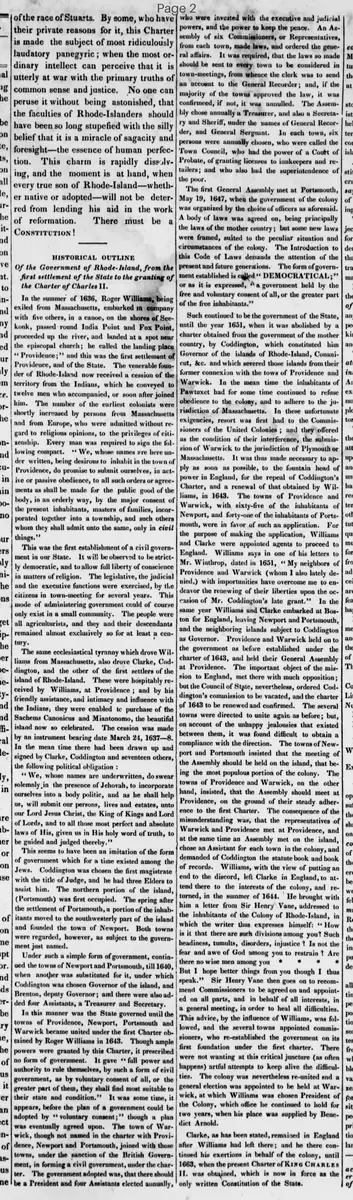
HISTORICAL OUTLINE
Of the Government of Rhode-Island, from the first settlement of the State to the granting of the Charter of Charles II.
In the summer of 1636, Roger Williams, being exiled from Massachusetts, embarked in company with five others, in a canoe, on the shores of Seekonk, passed round India Point and Fox Point, proceeded up the river, and landed at a spot near the episcopal church; he called the landing place "Providence;" and this was the first settlement of Providence, and of the State. The venerable founder of Rhode-Island now received a cession of the territory from the Indians, which he conveyed to twelve men who accompanied, or soon after joined him. The number of the earliest colonists were shortly increased by persons from Massachusetts and from Europe, who were admitted without regard to religious opinions, to the privileges of citizenship. Every man was required to sign the following compact. "We, whose names are here underwritten, being desirous to inhabit in the town of Providence, do promise to submit ourselves, in active or passive obedience, to all such orders or agreements as shall be made for the public good of the body, in an orderly way, by the major consent of the present inhabitants, masters of families, incorporated together into a township, and such others whom they shall admit unto the same, only in civil things."
This was the first establishment of a civil government in our State. It will be observed to be strictly democratic, and to allow full liberty of conscience in matters of religion. The legislative, the judicial and the executive functions were exercised, by the citizens in town-meeting for several years. This mode of administering government could of course only exist in a small community. The people were all agriculturists, and they and their descendants remained almost exclusively so for at least a century.
The same ecclesiastical tyranny which drove Williams from Massachusetts, also drove Clarke, Coddington, and the other of the first settlers of the island of Rhode-Island. These were hospitably received by Williams, at Providence; and by his friendly assistance, and intimacy and influence with the Indians; they were enabled to purchase of the Sachems Canonicus and Miantonomo, the beautiful island now so celebrated. The cession was made by an instrument bearing date March 24, 1638.
In the mean time there had been drawn up and signed by Clarke, Coddington and seventeen others, the following political obligation:
"We, whose names are underwritten, do swear solemnly in the presence of Jehovah, to incorporate ourselves into a body politic, and as he shall help us, will submit our persons, lives and estates, unto our Lord Jesus Christ, the King of Kings and Lord of Lords, and to all those most perfect and absolute laws of His, given us in His holy word of truth, to be guided and judged thereby."
This seems to have been an imitation of the form of government which for a time existed among the Jews. Coddington was chosen the first magistrate with the title of Judge, and he had three Elders to assist him. The northern portion of the island, (Portsmouth) was first occupied. The spring after the settlement of Portsmouth, a portion of the inhabitants moved to the southwesterly part of the island and founded the town of Newport. Both towns were regarded, however, as subject to the government just named.
Under such a simple form of government, continued the towns of Newport and Portsmouth, till 1640, when another was substituted for it, under which Coddington was chosen Governor of the island, and Brenton, deputy Governor; and there were also added four Assistants, a Treasurer and Secretary.
In this manner was the State governed until the towns of Providence, Newport, Portsmouth and Warwick became united under the first Charter obtained by Roger Williams in 1643. Though ample powers were granted by this Charter, it prescribed no form of government. It gave "full power and authority to rule themselves, by such a form of civil government, as by voluntary consent of all, or the greater part of them, they shall find most suitable to their state and condition." It was some time, it appears, before the plan of a government could be adopted by "voluntary consent;" though a plan was eventually agreed upon. The town of Warwick, though not named in the charter with Providence, Newport and Portsmouth, joined with those towns, under the sanction of the British Government, in forming a civil government, under the charter. The government adopted was, that there should be a President and four Assistants elected annually,
who were invested with the executive and judicial powers, and the power to keep the peace. An Assembly of six Commissioners, or Representatives, from each town, made laws, and ordered the general affairs. It was required, that the laws so made should be sent to every town to be considered in town-meetings, from whence the clerk was to send an account to the General Recorder; and, if the majority of the towns approved the law, it was confirmed, if not, it was annulled. The Assembly chose annually a Treasurer, and also a Secretary and Sheriff, under the names of General Recorder, and General Sergeant. In each town, six persons were annually chosen, who were called the Town Council, who had the power of a Court of Probate, of granting licenses to innkeepers and retailers; and who also had the superintendence of the poor.
The first General Assembly met at Portsmouth, May 19, 1647, when the government of the colony was organized by the choice of officers as aforesaid. A body of laws was agreed on, being principally the laws of the mother country; but some new laws were framed, suited to the peculiar situation and circumstances of the colony. The Introduction to this Code of Laws demands the attention of the present and future generations. The form of government established is called "DEMOCRATICAL;" or as it is expressed, "a government held by the free and voluntary consent of all, or the greater part of the free inhabitants."
Such continued to be the government of the State, until the year 1651, when it was abolished by a charter obtained from the government of the mother country, by Coddington, which constituted him Governor of the islands of Rhode-Island, Conanicut, &c. and which severed those islands from their former connexion with the towns of Providence and Warwick. In the mean time the inhabitants of Pawtuxet had for some time continued to refuse obedience to the colony, and to adhere to the jurisdiction of Massachusetts. In these unfortunate exigencies, resort was first had to the Commissioners of the United Colonies; and they offered as the condition of their interference, the submission of Warwick to the jurisdiction of Plymouth or Massachusetts. It was thus made necessary to apply as soon as possible, to the fountain head of power in England, for the repeal of Coddington's Charter, and a renewal of that obtained by Williams, in 1643. The towns of Providence and Warwick, with sixty-five of the inhabitants of Newport, and forty-one of the inhabitants of Portsmouth, were in favor of such an application. For the purpose of making the application, Williams and Clarke were appointed agents to proceed to England. Williams says in one of his letters to Mr. Winthrop, dated in 1651, "My neighbors of Providence and Warwick (whom I also lately denied,) with importunities have overcome me to endeavor the renewing of their liberties upon the occasion of Mr. Coddington's late grant." In the same year Williams and Clarke embarked at Boston for England, leaving Newport and Portsmouth, and the neighboring islands subject to Coddington as Governor. Providence and Warwick held on to the government as before established under the charter of 1643, and held their General Assembly at Providence. The important object of the mission to England, met there with much opposition; but the Council of State, nevertheless, ordered Coddington's commission to be vacated, and the charter of 1643 to be renewed and confirmed. The several towns were directed to unite again as before; but, on account of the unhappy jealousies that existed between them, it was found difficult to obtain a compliance with the direction. The towns of Newport and Portsmouth insisted that the meeting of the Assembly should be held on the island, that being the most populous portion of the colony. The towns of Providence and Warwick, on the other hand, insisted, that the Assembly should meet at Providence, on the ground of their steady adherence to the first Charter. The consequence of the misunderstanding was, that the representatives of Warwick and Providence met at Providence, and at the same time an Assembly met on the island, chose an Assistant for each town in the colony, and demanded of Coddington the statute book and book of records. Williams, with the view of putting an end to the discord, left Clarke in England, to attend there to the interests of the colony, and returned, in the summer of 1654. He brought with him a letter from Sir Henry Vane, addressed to the inhabitants of the Colony of Rhode-Island, in which the writer thus expresses himself: "How is it that there are such divisions among you? Such headiness, tumults, disorders, injustice? Is not the fear and awe of God among you to restrain? Are there no wise men among you
But I hope better things from you though I thus speak." Sir Henry Vane then goes on to recommend Commissioners to be agreed on and appointed on all parts, and in behalf of all interests, in a general meeting, in order to heal all difficulties. This advice, by the influence of Williams, was followed, and the several towns appointed commissioners, who re-established the government on its first foundation under the first charter. There were not wanting at this critical juncture (as often happens) artful attempts to keep alive the difficulties. The colony was nevertheless re-united and a general election was appointed to be held at Warwick, at which Williams was chosen President of the Colony, which office he continued to hold for two years, when his place was supplied by Benedict Arnold.
Clarke, as has been stated, remained in England after Williams had left there; and he there continued his exertions in behalf of the colony, until 1663, when the present Charter of KING CHARLES II. was obtained, which is now in force as the only written Constitution of the State.
Of the Government of Rhode-Island, from the first settlement of the State to the granting of the Charter of Charles II.
In the summer of 1636, Roger Williams, being exiled from Massachusetts, embarked in company with five others, in a canoe, on the shores of Seekonk, passed round India Point and Fox Point, proceeded up the river, and landed at a spot near the episcopal church; he called the landing place "Providence;" and this was the first settlement of Providence, and of the State. The venerable founder of Rhode-Island now received a cession of the territory from the Indians, which he conveyed to twelve men who accompanied, or soon after joined him. The number of the earliest colonists were shortly increased by persons from Massachusetts and from Europe, who were admitted without regard to religious opinions, to the privileges of citizenship. Every man was required to sign the following compact. "We, whose names are here underwritten, being desirous to inhabit in the town of Providence, do promise to submit ourselves, in active or passive obedience, to all such orders or agreements as shall be made for the public good of the body, in an orderly way, by the major consent of the present inhabitants, masters of families, incorporated together into a township, and such others whom they shall admit unto the same, only in civil things."
This was the first establishment of a civil government in our State. It will be observed to be strictly democratic, and to allow full liberty of conscience in matters of religion. The legislative, the judicial and the executive functions were exercised, by the citizens in town-meeting for several years. This mode of administering government could of course only exist in a small community. The people were all agriculturists, and they and their descendants remained almost exclusively so for at least a century.
The same ecclesiastical tyranny which drove Williams from Massachusetts, also drove Clarke, Coddington, and the other of the first settlers of the island of Rhode-Island. These were hospitably received by Williams, at Providence; and by his friendly assistance, and intimacy and influence with the Indians; they were enabled to purchase of the Sachems Canonicus and Miantonomo, the beautiful island now so celebrated. The cession was made by an instrument bearing date March 24, 1638.
In the mean time there had been drawn up and signed by Clarke, Coddington and seventeen others, the following political obligation:
"We, whose names are underwritten, do swear solemnly in the presence of Jehovah, to incorporate ourselves into a body politic, and as he shall help us, will submit our persons, lives and estates, unto our Lord Jesus Christ, the King of Kings and Lord of Lords, and to all those most perfect and absolute laws of His, given us in His holy word of truth, to be guided and judged thereby."
This seems to have been an imitation of the form of government which for a time existed among the Jews. Coddington was chosen the first magistrate with the title of Judge, and he had three Elders to assist him. The northern portion of the island, (Portsmouth) was first occupied. The spring after the settlement of Portsmouth, a portion of the inhabitants moved to the southwesterly part of the island and founded the town of Newport. Both towns were regarded, however, as subject to the government just named.
Under such a simple form of government, continued the towns of Newport and Portsmouth, till 1640, when another was substituted for it, under which Coddington was chosen Governor of the island, and Brenton, deputy Governor; and there were also added four Assistants, a Treasurer and Secretary.
In this manner was the State governed until the towns of Providence, Newport, Portsmouth and Warwick became united under the first Charter obtained by Roger Williams in 1643. Though ample powers were granted by this Charter, it prescribed no form of government. It gave "full power and authority to rule themselves, by such a form of civil government, as by voluntary consent of all, or the greater part of them, they shall find most suitable to their state and condition." It was some time, it appears, before the plan of a government could be adopted by "voluntary consent;" though a plan was eventually agreed upon. The town of Warwick, though not named in the charter with Providence, Newport and Portsmouth, joined with those towns, under the sanction of the British Government, in forming a civil government, under the charter. The government adopted was, that there should be a President and four Assistants elected annually,
who were invested with the executive and judicial powers, and the power to keep the peace. An Assembly of six Commissioners, or Representatives, from each town, made laws, and ordered the general affairs. It was required, that the laws so made should be sent to every town to be considered in town-meetings, from whence the clerk was to send an account to the General Recorder; and, if the majority of the towns approved the law, it was confirmed, if not, it was annulled. The Assembly chose annually a Treasurer, and also a Secretary and Sheriff, under the names of General Recorder, and General Sergeant. In each town, six persons were annually chosen, who were called the Town Council, who had the power of a Court of Probate, of granting licenses to innkeepers and retailers; and who also had the superintendence of the poor.
The first General Assembly met at Portsmouth, May 19, 1647, when the government of the colony was organized by the choice of officers as aforesaid. A body of laws was agreed on, being principally the laws of the mother country; but some new laws were framed, suited to the peculiar situation and circumstances of the colony. The Introduction to this Code of Laws demands the attention of the present and future generations. The form of government established is called "DEMOCRATICAL;" or as it is expressed, "a government held by the free and voluntary consent of all, or the greater part of the free inhabitants."
Such continued to be the government of the State, until the year 1651, when it was abolished by a charter obtained from the government of the mother country, by Coddington, which constituted him Governor of the islands of Rhode-Island, Conanicut, &c. and which severed those islands from their former connexion with the towns of Providence and Warwick. In the mean time the inhabitants of Pawtuxet had for some time continued to refuse obedience to the colony, and to adhere to the jurisdiction of Massachusetts. In these unfortunate exigencies, resort was first had to the Commissioners of the United Colonies; and they offered as the condition of their interference, the submission of Warwick to the jurisdiction of Plymouth or Massachusetts. It was thus made necessary to apply as soon as possible, to the fountain head of power in England, for the repeal of Coddington's Charter, and a renewal of that obtained by Williams, in 1643. The towns of Providence and Warwick, with sixty-five of the inhabitants of Newport, and forty-one of the inhabitants of Portsmouth, were in favor of such an application. For the purpose of making the application, Williams and Clarke were appointed agents to proceed to England. Williams says in one of his letters to Mr. Winthrop, dated in 1651, "My neighbors of Providence and Warwick (whom I also lately denied,) with importunities have overcome me to endeavor the renewing of their liberties upon the occasion of Mr. Coddington's late grant." In the same year Williams and Clarke embarked at Boston for England, leaving Newport and Portsmouth, and the neighboring islands subject to Coddington as Governor. Providence and Warwick held on to the government as before established under the charter of 1643, and held their General Assembly at Providence. The important object of the mission to England, met there with much opposition; but the Council of State, nevertheless, ordered Coddington's commission to be vacated, and the charter of 1643 to be renewed and confirmed. The several towns were directed to unite again as before; but, on account of the unhappy jealousies that existed between them, it was found difficult to obtain a compliance with the direction. The towns of Newport and Portsmouth insisted that the meeting of the Assembly should be held on the island, that being the most populous portion of the colony. The towns of Providence and Warwick, on the other hand, insisted, that the Assembly should meet at Providence, on the ground of their steady adherence to the first Charter. The consequence of the misunderstanding was, that the representatives of Warwick and Providence met at Providence, and at the same time an Assembly met on the island, chose an Assistant for each town in the colony, and demanded of Coddington the statute book and book of records. Williams, with the view of putting an end to the discord, left Clarke in England, to attend there to the interests of the colony, and returned, in the summer of 1654. He brought with him a letter from Sir Henry Vane, addressed to the inhabitants of the Colony of Rhode-Island, in which the writer thus expresses himself: "How is it that there are such divisions among you? Such headiness, tumults, disorders, injustice? Is not the fear and awe of God among you to restrain? Are there no wise men among you
But I hope better things from you though I thus speak." Sir Henry Vane then goes on to recommend Commissioners to be agreed on and appointed on all parts, and in behalf of all interests, in a general meeting, in order to heal all difficulties. This advice, by the influence of Williams, was followed, and the several towns appointed commissioners, who re-established the government on its first foundation under the first charter. There were not wanting at this critical juncture (as often happens) artful attempts to keep alive the difficulties. The colony was nevertheless re-united and a general election was appointed to be held at Warwick, at which Williams was chosen President of the Colony, which office he continued to hold for two years, when his place was supplied by Benedict Arnold.
Clarke, as has been stated, remained in England after Williams had left there; and he there continued his exertions in behalf of the colony, until 1663, when the present Charter of KING CHARLES II. was obtained, which is now in force as the only written Constitution of the State.
What sub-type of article is it?
Constitutional
What keywords are associated?
Rhode Island History
Roger Williams
Colonial Government
Charter 1643
Charter 1663
Religious Liberty
Democratic Governance
Coddington Commission
What entities or persons were involved?
Roger Williams
John Clarke
William Coddington
Canonicus
Miantonomo
Sir Henry Vane
Benedict Arnold
Charles Ii
Towns Of Providence, Newport, Portsmouth, Warwick
Editorial Details
Primary Topic
Historical Outline Of Rhode Island Government From Settlement To 1663 Charter
Stance / Tone
Neutral Historical Narrative
Key Figures
Roger Williams
John Clarke
William Coddington
Canonicus
Miantonomo
Sir Henry Vane
Benedict Arnold
Charles Ii
Towns Of Providence, Newport, Portsmouth, Warwick
Key Arguments
First Settlement In Providence By Roger Williams In 1636 With Democratic Compact Emphasizing Civil Obedience And Religious Liberty
Settlement Of Rhode Island Island In 1638 With Religious Based Political Obligation
Union Under 1643 Charter Allowing Self Government By Consent
Government Structure With President, Assistants, And Assembly Of Town Representatives
Disruption By Coddington's 1651 Charter Separating Islands
Reunification Efforts By Williams And Clarke Leading To Restoration Of 1643 Charter
Resolution Of Disputes Via Commissioners And Election Of Williams As President
Obtainment Of 1663 Charter Of Charles Ii As Enduring Constitution