Thank you for visiting SNEWPapers!
Sign up free
Editorial
June 19, 1810
The Enquirer
Richmond, Henrico County, Virginia
What is this article about?
Editorial critiques recent despatches from Britain and France revealing their unyielding trade restrictions and blockades against US commerce. Blames US government's repeal of the Embargo for inviting spoliations, urges reliance on domestic resources and resolve to protect national honor amid belligerents' hostilities.
Clipping
OCR Quality
92%
Excellent
Full Text
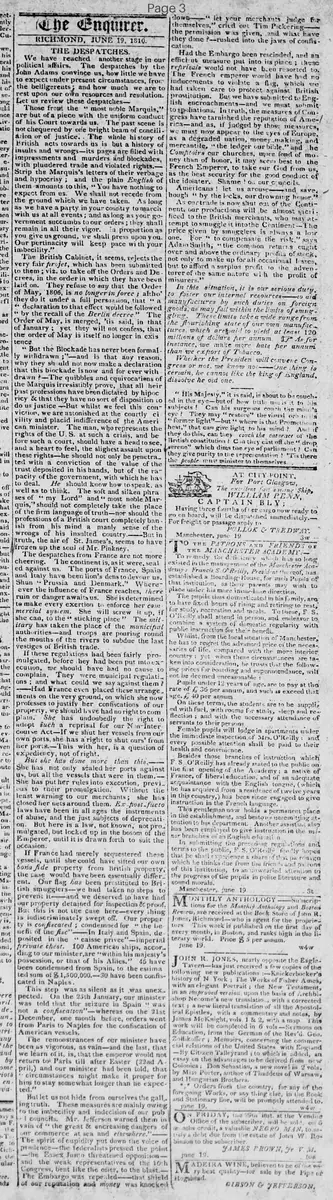
(The Enquirer.
RICHMOND, JUNE 19. 1810.
THE DESPATCHES.
We have reached another stage in our political affairs. The despatches by the John Adams convince us, how little we have to expect under present circumstances, from the belligerents; and how much we are to rest upon our own resources and resolution.
Let us review these despatches-
Those from the " most noble Marquis," are but of a piece with the uniform conduct of his Court towards us. The past scene is not chequered by one bright beam of conciliation or of justice. The whole history of British acts towards us is but a history of insults and wrongs-its pages are filled with impressments and murders and blockades, with plundered trade and violated rights.-- Strip the Marquis's letters of their verbiage and hypocrisy; and the plain English of them amounts to this, "You have nothing to expect from us. We shall not recede from the ground which we have taken. As long as we have a party in your country to march with us at all events; and as long as your government succumbs to our orders; they shall remain in all their vigor. In proportion as you give us ground, we shall press upon you. Our pertinacity will keep pace with your imbecility."
The British Cabinet, it seems, rejects the very fair project, which has been submitted to them; viz. to take off the Orders and Decrees, in the order in which they have been laid on. They refuse to say that the Order of May, 1806, is no longer in force : altho' they do it under a full persuasion, that "a declaration to that effect would be followed by the recall of the Berlin decree. The Order of May. is merged, 'tis said, in that of January: yet they will not confess, that the order of May is itself no longer in existence
But the Blockade has never been formally withdrawn ;"--and is that any reason, why they should not now make a declaration that this blockade is now and for ever withdrawn?-The quibbles and equivocations of the Marquis irresistibly prove, that all their past professions have been dictated by hypocrisy & that they have no sort of disposition to do us justice --But whilst we feel this conviction, we are astonished at the courtly civility and placid indifference of the American minister. The man, who represents the rights of the U.S. at such a crisis. and before such a court, should have a head to see, and a heart to feel, the slightest assault upon these rights--he should not only be penetrated with a conviction of the value of the trust deposited in his hands. but of the rapacity of the government, with which he has to deal. He should know how to speak, as well as to think. The soft and silken phrases of "my Lord" and "most noble Marquis," should not completely take the place of the firm language of truth-nor should the professions of a British court completely banish from his mind a manly sense of the wrongs of his insulted country.-But in truth, the air of St. James's, seems to have frozen up the soul of Mr. Pinkney.
The despatches from France are not more cheering. The continent is, as it were, sealed against us. The ports of France, Spain and Italy have been lion's dens to devour us. Shun "Prussia and Denmark." Wherever the influence of France reaches, there ruin or danger awaits us. She is determined to make every exertion to enforce her commercial system. She will screw it up. if she can, to the " sticking place" The military has taken the place of the municipal authorities--and troops are pouring round the mouths of the rivers to subdue the last vestiges of British trade.
If these regulations had been fairly promulgated, before they had been put into execution, we should have had no cause to complain. They were municipal regulations; and what could we say against them? ----Had France even placed these arrangements on the very ground, on which she now professes to justify her, confiscations of our property, we should have had no right to complain.' She has undoubtedly the right to adopt such a reprisal for our Non-intercourse Act--If we shut her vessels from our own ports, she has a right to shut ours' from her ports.-This with "her, is a question of expediency, not of right.
But she has done more than this.-- She has not only sealed her ports against us, but all the vessels that were in them.-- She has put her rules into execution, previous to their promulgation." Without the least warning to our merchants; she has closed her nets around them. Ex-post-facto laws have been in all ages the instruments of abuse, and the just subjects of deprecation. But here is a law, not known, not promulgated, but locked up in the bosom of the Emperor, until it is drawn forth to suit the occasion.
If France had merely sequestered these vessels, until she could have sifted our own bona fide property from British property; the case would have been essentially different. Our flag has been prostituted to British smugglers--we had taken no steps to prevent it-i and we deserved to have had our property detained for inspection & proof. But this is not the Case here-every thing is indiscriminately swept off. Our property is confiscated; condemned for "the benefit of the fisc"-In Italy and Spain, deposited in the "caisse privee"-imperial private chest. 100 American ships, according to our minister, are "within his majesty's possession, or that of his Allies." 45 have been condemned from Spain, to the estimated sum of $ 1,500,000.-30 have been confiscated in Naples.
This step was as silent as it was unexpected. On the 25th January, our minister was told that the seizure in Spain " was not a confiscation"-whereas on the 21st December, one month before, orders went from Paris to Naples for the confiscation of American vessels.
The remonstrances of our minister have been as vigorous, as vain-and the last, that we learn of it, is, that the emperor would not return to Paris till after Easter (22nd April,) and our minister had been told, that " circumstances might make it proper for him to stay somewhat longer than he expected.'
But let us not hide from ourselves the galling truth. These measures are mainly owing to the imbecility and indecision of our public councils. Mr. Jefferson warned them in vain of " the great & increasing dangers of our commerce at sea and elsewhere. The spirit of cupidity put down the voice of prudence--the federalists pressed the point —the Essex Junto threatened opposition- and the weak representatives of the 10th Congress, bent like the osier, to the blast.- The Embargo was repealed--that shield of our reputation and money was knocked down-and let your merchants judge for themselves," cried out Tim Pickering-the permission was given, .and what have they done ?--rushed into the jaws of confiscation.
Had the Embargo been rescinded, and an efficient measure put into its place; these reprisals would not have been resorted to. The French emperor would have had no inducements to violate a law. which we had taken care to protect against British prostitution. But we have submitted to English encroachments-and we must submit to spoliations. In truth, the measures of Congress have tarnished the reputation of America-and as, if judged by those measures, we must now appear to the eyes of Europe. as a degraded nation, money-making, and mercantile, " the ledger our bible." and the Counting houses our churches, more fond of money than of honor. it may seem best to the French Emperor. to take our God from us, as the best security for the good conduct of the idolater. Shame ! on our councils. Americans! let us arouse s-and save. though " by the locks, our drowning honor."
As our trade is now shut out of the Continent, our productions will be almost sacrificed to the British merchants, who may attempt to smuggle it into the Continent--The price given by smugglers is always a low one. For " to compensate the risk." says Adam Smith, "the common returns ought over and above the ordinary profits of stock, not only to make up for all occasional losses, but to afford a surplus profit to the adventurer of the same nature with the profit of insurers."
In this situation, it is our serious duty. to foster our internal resources-i-to aid manufactures by such duties on foreign goods, as may fall within the limits of smuggling. These limits take a wide range from the flourishing state of our own manufactures, which are said to yield at least 120 millions of dollars per annum. As for instance, we make more hats per annum than we export of Tobacco.
Whether the President will convene Congress or not. we know not-e-One thing is certain, he cannot like the king of England, dissolve the old one.
" His Majesty," it is said, is about to be couched in the eye-but of how little use is it to his subjects ! Can his surgeons couch the mind's eye? They may " restore" the visual orb to its "former light"-but " where is that Promethean heat," that can give light to his mind? And if they do this, can they couch the cataract of the British constitution ? Can they cast off the " drop serene" which dims the eye of parliament? Can they give purity to the representation ! Tis there the people must minister to themselves.
RICHMOND, JUNE 19. 1810.
THE DESPATCHES.
We have reached another stage in our political affairs. The despatches by the John Adams convince us, how little we have to expect under present circumstances, from the belligerents; and how much we are to rest upon our own resources and resolution.
Let us review these despatches-
Those from the " most noble Marquis," are but of a piece with the uniform conduct of his Court towards us. The past scene is not chequered by one bright beam of conciliation or of justice. The whole history of British acts towards us is but a history of insults and wrongs-its pages are filled with impressments and murders and blockades, with plundered trade and violated rights.-- Strip the Marquis's letters of their verbiage and hypocrisy; and the plain English of them amounts to this, "You have nothing to expect from us. We shall not recede from the ground which we have taken. As long as we have a party in your country to march with us at all events; and as long as your government succumbs to our orders; they shall remain in all their vigor. In proportion as you give us ground, we shall press upon you. Our pertinacity will keep pace with your imbecility."
The British Cabinet, it seems, rejects the very fair project, which has been submitted to them; viz. to take off the Orders and Decrees, in the order in which they have been laid on. They refuse to say that the Order of May, 1806, is no longer in force : altho' they do it under a full persuasion, that "a declaration to that effect would be followed by the recall of the Berlin decree. The Order of May. is merged, 'tis said, in that of January: yet they will not confess, that the order of May is itself no longer in existence
But the Blockade has never been formally withdrawn ;"--and is that any reason, why they should not now make a declaration that this blockade is now and for ever withdrawn?-The quibbles and equivocations of the Marquis irresistibly prove, that all their past professions have been dictated by hypocrisy & that they have no sort of disposition to do us justice --But whilst we feel this conviction, we are astonished at the courtly civility and placid indifference of the American minister. The man, who represents the rights of the U.S. at such a crisis. and before such a court, should have a head to see, and a heart to feel, the slightest assault upon these rights--he should not only be penetrated with a conviction of the value of the trust deposited in his hands. but of the rapacity of the government, with which he has to deal. He should know how to speak, as well as to think. The soft and silken phrases of "my Lord" and "most noble Marquis," should not completely take the place of the firm language of truth-nor should the professions of a British court completely banish from his mind a manly sense of the wrongs of his insulted country.-But in truth, the air of St. James's, seems to have frozen up the soul of Mr. Pinkney.
The despatches from France are not more cheering. The continent is, as it were, sealed against us. The ports of France, Spain and Italy have been lion's dens to devour us. Shun "Prussia and Denmark." Wherever the influence of France reaches, there ruin or danger awaits us. She is determined to make every exertion to enforce her commercial system. She will screw it up. if she can, to the " sticking place" The military has taken the place of the municipal authorities--and troops are pouring round the mouths of the rivers to subdue the last vestiges of British trade.
If these regulations had been fairly promulgated, before they had been put into execution, we should have had no cause to complain. They were municipal regulations; and what could we say against them? ----Had France even placed these arrangements on the very ground, on which she now professes to justify her, confiscations of our property, we should have had no right to complain.' She has undoubtedly the right to adopt such a reprisal for our Non-intercourse Act--If we shut her vessels from our own ports, she has a right to shut ours' from her ports.-This with "her, is a question of expediency, not of right.
But she has done more than this.-- She has not only sealed her ports against us, but all the vessels that were in them.-- She has put her rules into execution, previous to their promulgation." Without the least warning to our merchants; she has closed her nets around them. Ex-post-facto laws have been in all ages the instruments of abuse, and the just subjects of deprecation. But here is a law, not known, not promulgated, but locked up in the bosom of the Emperor, until it is drawn forth to suit the occasion.
If France had merely sequestered these vessels, until she could have sifted our own bona fide property from British property; the case would have been essentially different. Our flag has been prostituted to British smugglers--we had taken no steps to prevent it-i and we deserved to have had our property detained for inspection & proof. But this is not the Case here-every thing is indiscriminately swept off. Our property is confiscated; condemned for "the benefit of the fisc"-In Italy and Spain, deposited in the "caisse privee"-imperial private chest. 100 American ships, according to our minister, are "within his majesty's possession, or that of his Allies." 45 have been condemned from Spain, to the estimated sum of $ 1,500,000.-30 have been confiscated in Naples.
This step was as silent as it was unexpected. On the 25th January, our minister was told that the seizure in Spain " was not a confiscation"-whereas on the 21st December, one month before, orders went from Paris to Naples for the confiscation of American vessels.
The remonstrances of our minister have been as vigorous, as vain-and the last, that we learn of it, is, that the emperor would not return to Paris till after Easter (22nd April,) and our minister had been told, that " circumstances might make it proper for him to stay somewhat longer than he expected.'
But let us not hide from ourselves the galling truth. These measures are mainly owing to the imbecility and indecision of our public councils. Mr. Jefferson warned them in vain of " the great & increasing dangers of our commerce at sea and elsewhere. The spirit of cupidity put down the voice of prudence--the federalists pressed the point —the Essex Junto threatened opposition- and the weak representatives of the 10th Congress, bent like the osier, to the blast.- The Embargo was repealed--that shield of our reputation and money was knocked down-and let your merchants judge for themselves," cried out Tim Pickering-the permission was given, .and what have they done ?--rushed into the jaws of confiscation.
Had the Embargo been rescinded, and an efficient measure put into its place; these reprisals would not have been resorted to. The French emperor would have had no inducements to violate a law. which we had taken care to protect against British prostitution. But we have submitted to English encroachments-and we must submit to spoliations. In truth, the measures of Congress have tarnished the reputation of America-and as, if judged by those measures, we must now appear to the eyes of Europe. as a degraded nation, money-making, and mercantile, " the ledger our bible." and the Counting houses our churches, more fond of money than of honor. it may seem best to the French Emperor. to take our God from us, as the best security for the good conduct of the idolater. Shame ! on our councils. Americans! let us arouse s-and save. though " by the locks, our drowning honor."
As our trade is now shut out of the Continent, our productions will be almost sacrificed to the British merchants, who may attempt to smuggle it into the Continent--The price given by smugglers is always a low one. For " to compensate the risk." says Adam Smith, "the common returns ought over and above the ordinary profits of stock, not only to make up for all occasional losses, but to afford a surplus profit to the adventurer of the same nature with the profit of insurers."
In this situation, it is our serious duty. to foster our internal resources-i-to aid manufactures by such duties on foreign goods, as may fall within the limits of smuggling. These limits take a wide range from the flourishing state of our own manufactures, which are said to yield at least 120 millions of dollars per annum. As for instance, we make more hats per annum than we export of Tobacco.
Whether the President will convene Congress or not. we know not-e-One thing is certain, he cannot like the king of England, dissolve the old one.
" His Majesty," it is said, is about to be couched in the eye-but of how little use is it to his subjects ! Can his surgeons couch the mind's eye? They may " restore" the visual orb to its "former light"-but " where is that Promethean heat," that can give light to his mind? And if they do this, can they couch the cataract of the British constitution ? Can they cast off the " drop serene" which dims the eye of parliament? Can they give purity to the representation ! Tis there the people must minister to themselves.
What sub-type of article is it?
Foreign Affairs
Economic Policy
Trade Or Commerce
What keywords are associated?
British Despatches
French Decrees
American Trade
Orders In Council
Embargo Repeal
Confiscations
Non Intercourse Act
Internal Resources
What entities or persons were involved?
British Cabinet
Marquis
Mr. Pinkney
French Emperor
Mr. Jefferson
Tim Pickering
Essex Junto
10th Congress
Editorial Details
Primary Topic
Critique Of British And French Despatches On Trade Restrictions And Us Policy Failures
Stance / Tone
Strongly Critical Of Belligerents' Hypocrisy And Us Governmental Imbecility, Exhortative For National Resolve
Key Figures
British Cabinet
Marquis
Mr. Pinkney
French Emperor
Mr. Jefferson
Tim Pickering
Essex Junto
10th Congress
Key Arguments
British Despatches Show Uniform Insults And Refusal To Withdraw Orders In Council, Especially May 1806
British Hypocrisy In Maintaining Blockades And Equivocations
Us Minister Pinkney Too Conciliatory Towards Britain
French Ports Sealed Against Us Trade With Secret, Ex Post Facto Confiscations Of American Vessels
France's Actions As Reprisal For Us Non Intercourse Act But Executed Unfairly Without Warning
Us Imbecility In Repealing Embargo Led To Current Spoliations And Tarnished Reputation
Need To Foster Internal Resources And Manufactures To Counter Trade Shutdown
Criticism Of British King's And Parliament's Blindness