Thank you for visiting SNEWPapers!
Sign up free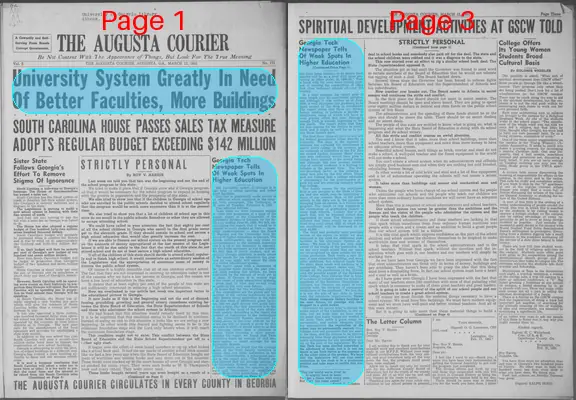
The Augusta Courier
Augusta, Richmond County, Georgia
What is this article about?
A Georgia Tech newspaper editorial from February 6, 1951, critiques the University System of Georgia's deficiencies based on the 1950 Chancellor report, highlighting faculty reductions, low salaries, enrollment drops due to war and school transitions, and inadequate facilities, calling for increased state funding.
Merged-components note: Continuation of the article on the University System of Georgia from page 1 to page 3.
Clippings
1 of 2
OCR Quality
Full Text
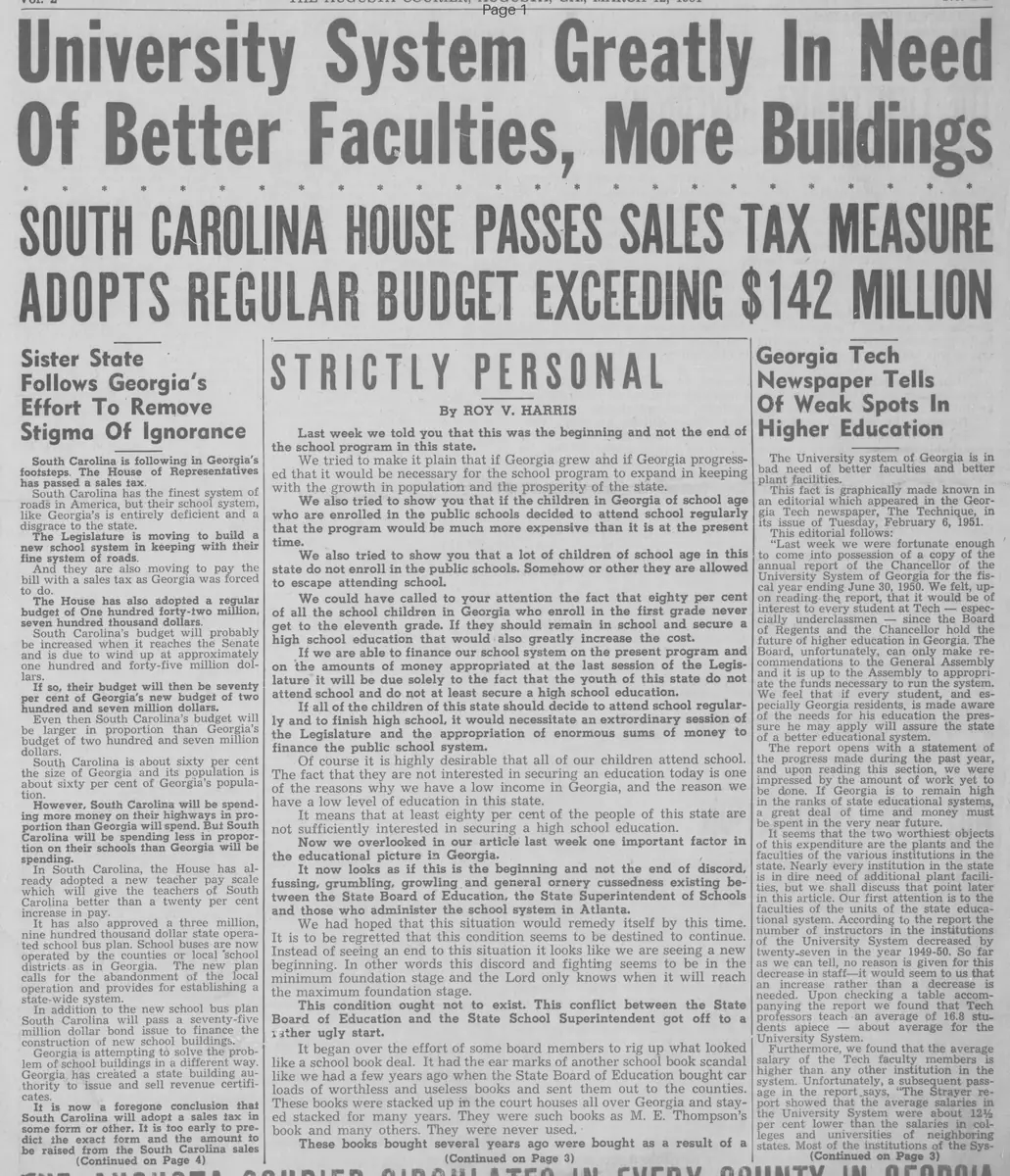
Of Better Faculties,
More Buildings
Georgia Tech Newspaper Tells Of Weak Spots In Higher Education
The University system of Georgia is in bad need of better faculties and better plant facilities.
This fact is graphically made known in an editorial which appeared in the Georgia Tech newspaper, The Technique, in its issue of Tuesday, February 6, 1951.
This editorial follows:
"Last week we were fortunate enough to come into possession of a copy of the annual report of the Chancellor of the University System of Georgia for the fiscal year ending June 30, 1950.
We felt, upon reading the report, that it would be of interest to every student at Tech - especially underclassmen - since the Board of Regents and the Chancellor hold the future of higher education in Georgia.
The Board, unfortunately, can only make recommendations to the General Assembly and it is up to the Assembly to appropriate the funds necessary to run the system.
We feel that if every student, and especially Georgia residents, is made aware of the needs for his education the pressure he may apply will assure the state of a better educational system.
The report opens with a statement of the progress made during the past year, and upon reading this section, we were impressed by the amount of work yet to be done.
If Georgia is to remain high in the ranks of state educational systems, a great deal of time and money must be spent in the very near future.
It seems that the two worthiest objects of this expenditure are the plants and the faculties of the various institutions in the state.
Nearly every institution in the state is in dire need of additional plant facilities, but we shall discuss that point later in this article.
Our first attention is to the faculties of the units of the state educational system.
According to the report the number of instructors in the institutions of the University System decreased by twenty-seven in the year 1949-50.
So far as we can tell, no reason is given for this decrease in staff.
It would seem to us that an increase rather than a decrease is needed.
Upon checking a table accompanying the report we found that Tech professors teach an average of 16.8 students apiece — about average for the University System.
Furthermore, we found that the average salary of the Tech faculty members is higher than any other institution in the system.
Unfortunately, a subsequent passage in the report says, The Strayer report showed that the average salaries in the University System were about 12 1/2 per cent lower than the salaries in colleges and universities of neighboring states.
Most of the institutions of the System
(Continued on Page 3)"
Georgia Tech Newspaper Tells Of Weak Spots In Higher Education
(Continued From Page 1)
Most of them have some distance to go before their salaries will be on a level with those prevailing in other states in 1948-49. Tech is faced with the even more critical problem of meeting the competition of other first class technical schools all over the country.
In a later passage, the report goes at some length into the enrollment problem, and although it was written as of June, 1950, it well illustrates the problems to be faced caused by the drop in enrollment.
The report states that there are several factors tending to produce a decline in enrollment, many of which will have an even greater effect this year. Strangely enough Tech is already beginning to feel this pinch. The report states that there are four reasons for the decline in enrollment, and it might be well for us to outline these factors here.
The first three items all involve war and the federal government either directly or indirectly. The drop in the number of veterans has curtailed the enrollment at nearly every college in the country, and the outbreak of hostilities in the Far East has caused further declines. Many young men who ordinarily would have gone to college have enlisted in the armed forces, and although this may produce another crop of veteran students, it is hurting the colleges at the present time. The third war-provoked factor is the creating of many new jobs by the war effort. Young men are finding that a college education is unnecessary for the procurement of a good job and are entering industry rather than college.
The fourth reason for the enrollment drop is one peculiar to the State of Georgia and one which may be unfamiliar to many of our readers. Most of the public schools in the state are in the process of changing from an eleven- to a twelve-year program. The result of this transition is the elimination of graduating classes in many high schools. Luckily this is one pinch that will be lessened rather than aggravated by time. The Strayer report predicted that there would be an enrollment drop until about 1955, at which time the enrollment will be increased to exceed 44,000.
The third and probably most pertinent section of the report on which we shall comment is the need for additional plant facilities in the University System as a whole. We here at Tech are very much aware of the needs of the institution, but we are very much afraid that our needs are unrecognized by those outside the education profession. Tech needs a new library, a new classroom building, and many other additions, but without funds from the state, these needs will continue to be unsatisfied. The report states that, "Although all the institutions of the System, with the possible except of the Savannah State College, have libraries that in terms of numbers of volumes meet the minimum standards of the Southern Association of Colleges, our libraries are small in comparison with the libraries of comparable institutions of the southeast." We feel that it is not the aim of any state to barely meet the minimum requirements. Unless Tech obtains adequate library facilities in the near future, its prestige will have dropped to a great extent.
Obviously we cannot hope to discuss the entire report of the Chancellor, in one article, but we hope that we have made the point that many things are needed in the state. Tech needs a great many improvements, and unless adequate funds are appropriated the reputation of the school may be permanently marred. Good colleges turn out graduates that are assets to the state, and the income to be derived indirectly from these graduates will eventually compensate for any immediate outlay on the part of the legislature. We feel that Tech has been shorted somewhat in the allotment of funds, but it is not our desire to see Tech thrive at the expense of all the other units of the systems. We hope that the legislature will see that every institution in the state is in a precarious position and take steps to rectify this condition.
"This old world we're livin' in
Is mighty hard to beat;
You get a thorn with every rose,
But ain't the roses sweet."
—Frank L. Stanton.
What sub-type of article is it?
What keywords are associated?
Where did it happen?
Story Details
Location
Georgia
Event Date
February 6, 1951
Story Details
Editorial in The Technique discusses the Chancellor's 1950 report, noting faculty decrease by 27, salaries 12.5% below regional averages, enrollment decline due to post-war factors and Georgia's school transition to 12-year program until 1955, and urgent need for plant facilities like libraries and classrooms at Georgia Tech and other institutions, urging student pressure on the legislature for appropriations.