Thank you for visiting SNEWPapers!
Sign up free
Baptist Courier
Greenville, Columbia, Greenville County, Richland County, South Carolina
What is this article about?
Sermon by Rev. D. M. Ramsey at Citadel Square church, Charleston, on February's first Sunday, titled 'What About the Theatre?'. Using 1 Thessalonians 5:21, he argues the theatre is primarily for amusement but historically corrupts morals, cites pagan and Christian opposition, analyzes modern plays' immorality, and urges Christians to avoid it to protect youth, align with Bible, and maintain influence.
Merged-components note: These two components are a direct continuation of the same article on the theatre, with the second starting mid-sentence; merge into single literary component.
Clipping
OCR Quality
Full Text
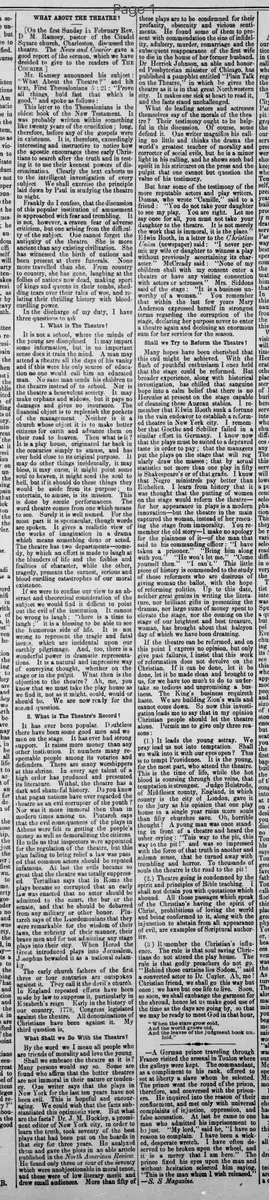
[On the first Sunday in February Rev. D. M. Ramsey, pastor of the Citadel Square church, Charleston, discussed the theatre. The News and Courier gave a good report of the sermon, which we have decided to give to the readers of THE COURIER.]
Mr. Ramsey announced his subject: "What About the Theatre?" and his text, First Thessalonians 5:21: "Prove all things; hold fast that which is good," and spoke as follows:
This letter to the Thessalonians is the oldest book of the New Testament. It was probably written within something like twenty years of the crucifixion; long, therefore, before any of the gospels were in existence. It is, therefore, exceedingly interesting and instructive to notice how the apostle encourages these early Christians to search after the truth and in testing it to use their keenest powers of discrimination. Clearly the text exhorts us to the intelligent investigation of every subject. We shall exercise the principle laid down by Paul in studying the theatre tonight.
Frankly do I confess, that the discussion of this popular institution of amusement is approached with fear and trembling. It is not, however, a craven fear of adverse criticism, but one arising from the difficulty of the subject. One cannot forget the antiquity of the theatre. She is more ancient than any existing civilization. She has witnessed the birth of nations and been present at their funerals. None more travelled than she. From country to country, she has gone, laughing at the follies of nations now dead, making sport of kings and queens in their tombs, shedding tears over their tales of woe, and relating their thrilling history with blood curdling power.
In the discharge of my duty, I have three questions to ask:
1. What is The Theatre?
It is not a school, where the minds of the young are disciplined. It may impart some information, but in no important sense does it train the mind. A man may attend a theatre all the days of his vanity and if this were his only source of education no one would call him an educated man. No sane man sends his children to the theatre instead of to school. Nor is the theatre a benevolent society. It may make orphans and widows, but it pays no damages and gives no insurance. The financial object is to replenish the pockets of the management. Neither is it a church whose object it is to make better citizens for earth and advance them on their road to heaven. Then what is it? It is a play house, originated far back in the centuries simply to amuse, and has ever held close to its original purpose. It may do other things incidentally, it may bless, it may curse, it might point some soul to heaven, it might send the soul to hell, but if it should do these things they would be aside from its purpose; to entertain, to amuse, is its mission. This is done by scenic performances. The word theatre comes from one which means to see. Surely it is well named. For the most part it is spectacular, though words are spoken. It gives a realistic view of the works of imagination in a drama which means something done or acted. The theatre has two departments—comedy, by which an effort is made to laugh at the blunders of life and the foibles and frailties of character, while the other, tragedy, presents the earnest, serious and blood curdling catastrophes of our moral existence.
If we were to confine our view to an abstract and theoretical consideration of the subject we would find it difficult to point out the evil of the institution. It cannot be wrong to laugh; "there is a time to laugh;" it is a blessing to be able to see the humorous side of life. It is not wrong to represent the tragic and fatal issues, which are incidental upon our earthly pilgrimage. And, too, there is a wonderful power in dramatic representations. It is a natural and impressive way of conveying thought, whether on the stage or in the pulpit. What then is the objection to the theatre? Ah, me, you know that we must take the play house as we find it, not as it might, could, would or should be. We are now ready for the second question.
2. What is The Theatre's Record?
It has ever been popular. Doubtless there have been some good men and women on the stage. It has ever had strong support. It raises more money than any other institution. It numbers many respectable people among its votaries and defenders. There are many worshippers at this shrine. In every age talent of a high order has produced and presented its literature. Withal, the theatre has a dark and shameful history. Do you know that pagan nations have ever regarded the theatre as an evil corrupter of the youth? Nor was it more immoral then than in modern times among us. Plutarch says that the evil consequences of the plays in Athens were felt in getting the people's money as well as demoralizing the citizens. He tells us that inspectors were appointed for the regulation of the theatre, but this plan failing to bring relief a law was passed that common actors should be reputed infamous. At last the evils became so great that the theatre was totally suppressed. Tertullian says that in Rome the plays became so corrupted that an early law was enacted that no actor should be admitted to the court, the bar or the senate, and that he should be debarred from any military or other honor. Plutarch says of the Lacedemonians that they were remarkable for the wisdom of their laws, the sobriety of their manner, their brave men and for not admitting any stage plays into their city. When Herod the Great introduced plays into Jerusalem, Josephus bewailed it as a national calamity. The early church fathers of the first three or four centuries are outspoken against it. They call it the devil's church. In England repeated efforts have been made by law to suppress it, particularly in Elizabeth's reign. Early in the history of our country, 1778, Congress legislated against the theatre. All denominations of Christians have been against it. My third question is,
What Shall we Do With the Theatre?
By the word we I mean all people who are friends of morality and love the young. Shall we embrace the theatre as it is? Many persons would say so. Some are found who affirm that the better theatres are not immoral in their nature or tendency. One writer says that the plays in New York for the last ten years have not been evil. This is hopeful and encouraging. We could wish that the facts substantiated this optimistic view. But what are the facts? Dr. J. M. Buckley, a prominent editor of New York city, in order to learn the truth, took seventy of the best plays that had been put on the boards in that city for three years. He analyzed them and gave the plots in an able article published in the North American Review. He found only three or four of the seventy which were unobjectionable in moral tenor, and these were of low literary merit and drew small audiences. More than fifty of these plays are to be condemned for their profanity, obscenity and vicious sentiments. He found some of them to present with commendation the sins of infidelity, adultery, murder, remarriage and the subsequent reappearance of the first wife to die in the house of her former husband. Dr. Herrick Johnson, an able and honored Presbyterian minister of Chicago, has published a pamphlet entitled "Plain Talk on the Theatre," in which he gives the theatre as it is in that great Northwestern city. It makes one sick at heart to read it, and the facts stand unchallenged.
What do leading actors and actresses themselves say of the morals of the theatre? Their testimony ought to be helpful in this discussion. Of course, some defend it. One writer magnifies his calling no little and thinks the drama the world's greatest teacher of morality and corrector of social evils, but he is a minor light in his calling, and he shows such bad spirit in his strictures on the press and the pulpit that one cannot but question the value of his testimony. But hear some of the testimony of the more reputable actors and play writers. Dumas, who wrote "Camille," said to a friend: "You do not take your daughter to see my play. You are right. Let me say once for all, you must not take your daughter to the theatre. It is not merely the work that is immoral, it is the place." Edwin Booth, in a letter to the Christian Union (newspaper) said: "I never permit my wife or daughter to witness a play without previously ascertaining its character." McCready said: "None of my children shall with my consent enter a theatre or have any visiting connection with actors or actresses." Mrs. Siddons said of the stage: "It is a business unworthy of a woman." You remember that within the last few years Mary Anderson expressed herself in strongest terms regarding the corruption of the stage, declaring her purpose never to enter a theatre again and declining an enormous sum for her services for the season.
Shall we Try to Reform the Theatre?
Many hopes have been cherished that this end might be achieved. With the flush of youthful enthusiasm I once held that the stage could be reformed. But broader experience, along with historical investigation, has chilled that sanguine hope into a calm belief that there is no Hercules at present on the stage capable of cleansing these Augean stables. I remember that Edwin Booth sunk a fortune in the vain endeavor to establish a reformed theatre in New York city. I remember that Goethe and Schiller failed in a similar effort in Germany. I know now that the plays must be suited to a depraved taste in order to pay; that the managers put the plays on the stage that will regularly draw the masses; that by actual statistics not more than one play in fifty is Shakespeare's or of that grade. I know that Negro minstrels pay better than Richelieu. I learn from history that it was thought that the putting of women on the stage would reform the theatre—for her appearance in plays is a modern innovation—but the theatre in the main captured the woman, instead of her rescuing the stage from immorality. You remember the old story—I make no apology for the plainness of it—of the man that said to his commanding officer: "I have taken a prisoner." "Bring him along with you." "He won't let me." "Come yourself then." "I can't." This little piece of history is commended to the study of those reformers who are desirous of giving woman the ballot, with the hope of reforming politics. Up to this date, neither great genius in writing the literature, nor brilliant gifts in presenting the dramas, nor large sums of money spent to elevate the stage, nor the coming on the stage of our brightest and best treasure, woman, has brought about that halcyon day of which we have been dreaming. If the theatre can be reformed, and on this point I express no opinion, but only give past failures, I insist that this work of reformation does not devolve on the Christian. If it can be done, let it be done, let it be made clean and brought to us, for we have too much to do to undertake so tedious and unpromising a business. The King's business requireth haste. We are building Zion's walls and cannot come down. So now this investigation leads me to say that in my opinion Christian people should let the theatre alone. Permit me to give only three reasons:
(1) It leads the young astray.
We pray "lead us not into temptation." Shall we walk into it with our eyes open? This is to tempt Providence. It is the young, for the most part, who attend the theatre. This is the time of life, while the hot blood is coursing through the veins, that temptation is strongest. Judge Bulstrode, of Middlesex county, England, in which county is the city of London, gave it to the jury as his opinion that one play house in a single year ruins more souls than fifty churches save. Oh, horrible thought! A young man was once standing in front of a theatre and heard the usher crying: "This way to the pit, this way to the pit!" and was so impressed with the force of that truth in another and solemn sense, that he turned away with trembling and horror. To thousands of souls the theatre is the road to the pit!
(2) Theatre going is condemned by the spirit and principles of Bible teaching. I shall not detain you with quotations which abound. All those passages which speak of the Christian's having the spirit of Christ, prohibitions of loving the world and being conformed to it, along with the injunction to abstain from all appearance of evil, are examples of Scriptural authority.
(3) Remember the Christian's influence. The rule is that soul saving Christians do not attend the play house. The rule is that godly preachers do not go. "Behind those curtains lies Sodom," said a converted actor to Dr. Cuyler. Ah, me! Christian friend, we shall go this way but once; we have but one life to live. Soon, so soon, we shall exchange the garment for the shroud, hence let us make good use of the time as the days are going by, so that we may be ready to meet God in that hour,
"When the stars grow cold,
And the world grows old,
And the leaves of the judgment book unfold."
What sub-type of article is it?
What themes does it cover?
What keywords are associated?
What entities or persons were involved?
Literary Details
Title
What About The Theatre?
Author
Rev. D. M. Ramsey
Subject
Sermon On The Theatre, Text From First Thessalonians 5:21
Form / Style
Prose Sermon With Argumentative Structure
Key Lines