Thank you for visiting SNEWPapers!
Sign up free
The Virginia Gazette
Williamsburg, Virginia
What is this article about?
Edmund Burke's speech to Bristol electors on October 24, soliciting their vote amid the crisis with America. He pledges impartial consideration of American affairs, upholds British constitutional superiority while supporting American liberties, and emphasizes his commitment to commerce and constitution.
Merged-components note: Continuation of Mr. Edmund Burke's speech to the electors of Bristol, reported from London.
Clipping
OCR Quality
Full Text
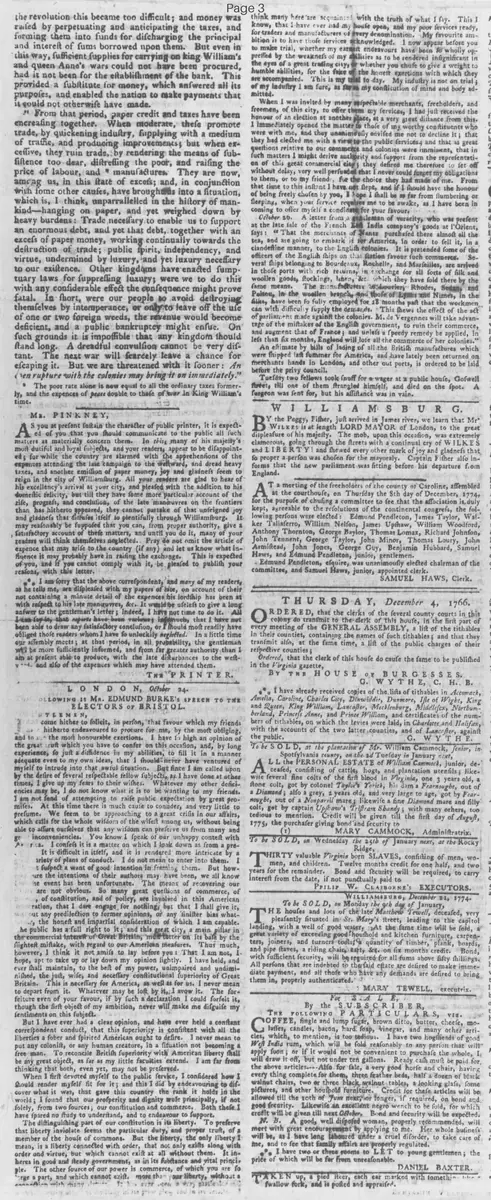
The following is Mr. Edmund Burke's speech to the electors of Bristol.
GENTLEMEN,
I have come hither to solicit, in person, that favour which my friends have hitherto endeavoured to procure for me, by the most obliging, and to me the most honourable exertions. I have so high an opinion of the great trust which you have to confer on this occasion, and, by long experience, so just a diffidence in my abilities, to fill it in a manner adequate even to my own ideas, that I should never have ventured of myself to intrude into that awful situation. But since I am called upon by the desire of several respectable fellow subjects, as I have done at other times, I give up my fears to their wishes. Whatever my other deficiencies may be, I do not know what it is to be wanting to my friends. I am not fond of attempting to raise public expectation by great promises. At this time there is much cause to consider, and very little to presume. We seem to be approaching to a great crisis in our affairs, which calls for the whole wisdom of the wisest among us, without being able to assure ourselves that any wisdom can preserve us from many and great inconveniences. You know I speak of our unhappy contest with America. I confess it is a matter on which I look down as from a precipice. It is difficult in itself, and it is rendered more intricate by a variety of plans of conduct. I do not mean to enter into them. I suspect a want of good intention in framing them. But however pure the intentions of their authors may have been, we all know the event has been unfortunate. The means of recovering our affairs are not obvious. So many great questions of commerce, of revenue, of constitution, and of policy, are involved in this American question, that I dare engage for nothing; but that I shall give it, without any predilection to former opinions, or any sinister bias whatever, the honest and impartial consideration of which I am capable. The public has a full right to it; and this great city, a main pillar in the commercial interest of Great Britain, must totter on its base by the slightest mistake, with regard to our American measures. Thus much, however, I think it not amiss to lay before you: That I am not, I hope, apt to take up or lay down my opinion lightly. I have held, and ever shall maintain, to the best of my power, unimpaired and undiminished, the just, wise, and necessary constitutional superiority of Great Britain. This is necessary for America, as well as for us. I never mean to depart from it. Whatever may be lost by it, I avow it. The forfeiture even of your favour, if by such a declaration I could forfeit it, though the first object of my ambition, never will make me disguise my sentiments on this subject.
But I have ever had a clear opinion, and have ever held a constant correspondent conduct, that this superiority is consistent with all the liberties a sober and spirited American ought to desire. I never mean to put any colonist, or any human creature, in a situation not becoming a free man. To reconcile British superiority with American liberty shall be my great object, as far as my little faculties extend. I am far from thinking that both, even yet, may not be preserved.
When I first devoted myself to the public service, I considered how I should render myself fit for it; and this I did by endeavouring to discover what it was, that gave this country the rank it holds in the world; I found that our prosperity and dignity arose principally, if not solely, from two sources; our constitution and commerce. Both these I have spared no study to understand, and to endeavour to support.
The distinguishing part of our constitution is its liberty. To preserve that liberty inviolate seems the particular duty, and proper trust, of a member of the house of commons. But the liberty, the only liberty I mean, is a liberty connected with order, that not only exists along with order and virtue, but which cannot exist at all without them. It inheres in good and steady government, as in its substance and vital principle. The other source of our power is commerce, of which you are so large a part, and which cannot exist, more than your liberty, without a connection with the wisdom and strength of the whole; and this I think many here are acquainted with the truth of what I say. This I know, that I have ever had my house open, and my poor services ready, for traders and manufacturers of every denomination. My favourite ambition is to have those services acknowledged. I now appear before you to make trial, whether my earnest endeavours have been so wholly oppressed by the weakness of my abilities as to be rendered insignificant in the eyes of a great trading city, or whether you chuse to give a weight to humble abilities, or the size of the honest exertions with which they are accompanied. This is my trial to-day. My industry is not on trial; of my industry I am sure, as far as my constitution of mind and body admitted.
When I was invited by many respectable merchants, freeholders, and freemen, of this city, to offer them my services, I had just received the honour of an election at another place, at a very great distance from this. I immediately opened the matter to those of my worthy constituents who were with me, and they unanimously advised me not to decline it; that they had elected me with a view to the public services; and that as great questions relative to our commerce and colonies were imminent, that in such matters I might derive authority and support from the representation of this great commercial city; they desired me therefore to set off without delay, very well persuaded that I never could forget my obligations to them, or to my friend, for the choice they had made of me. From that time to this instant I have not slept, and if I should have the honour of being freely chosen by you, I hope I shall be as far from slumbering or sleeping, when your service requires me to be awake, as I have been in coming to offer myself a candidate for your favour.
What sub-type of article is it?
What keywords are associated?
What entities or persons were involved?
Where did it happen?
Foreign News Details
Primary Location
America
Event Date
October 24
Key Persons
Event Details
Edmund Burke delivers a speech to the electors of Bristol soliciting their vote for Parliament. He expresses diffidence in his abilities but commits to impartial consideration of the American question, upholding British constitutional superiority while advocating for reconciliation with American liberties. He emphasizes the importance of constitution and commerce to Britain's prosperity and his service to traders and manufacturers.