Thank you for visiting SNEWPapers!
Sign up free
The Hillsborough Recorder
Hillsboro, Orange County, North Carolina
What is this article about?
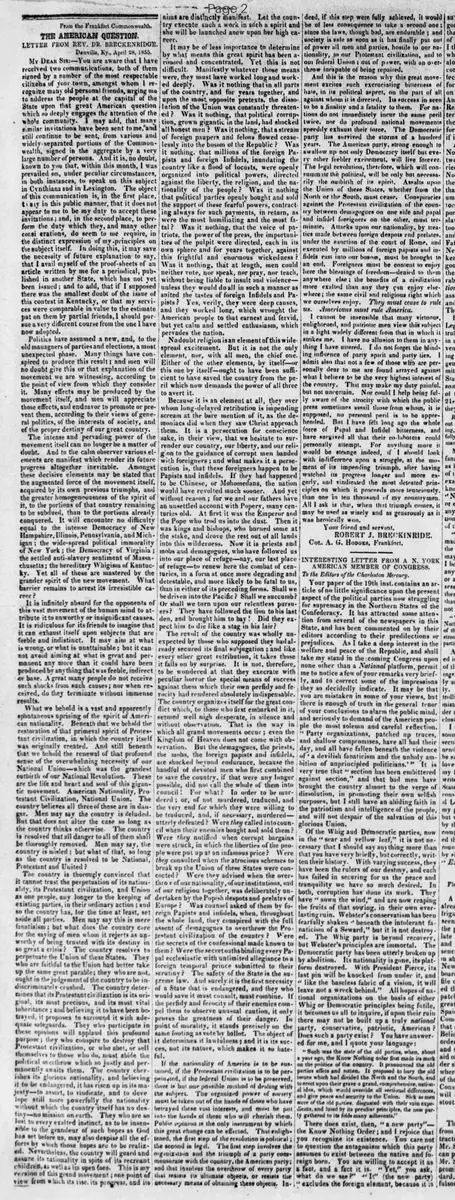
Robert J. Breckinridge declines invitations to speak at the Kentucky capital on the 'great American question' but publicly affirms his support for the American movement, emphasizing the need to preserve American nationality, Protestant civilization, and national union against threats from foreign Papists, infidels, and corrupt parties.
Clipping
OCR Quality
Full Text
Politics have assumed a new, and, to the old managers of parties and elections, a most unexpected phase. Many things have conspired to produce this result; and men will no doubt give this or that explanation of the movement we are witnessing, according to the point of view from which they consider it. Many effects may be produced by the movement itself, and men will appreciate those effects, and endeavor to promote or prevent them, according to their views of general politics, of the interests of society, and of the proper destiny of our great country.
The intense and pervading power of the movement itself can no longer be a matter of doubt. And to the calm observer various elements are manifest which render its future progress altogether inevitable. Amongst these decisive elements may be stated that the augmented force of the movement itself, acquired by its own previous triumphs, and the greater homogeneousness of the spirit of it, to the portions of that country remaining to be subdued, than to the portions already conquered. It will encounter no difficulty equal to the intense Democracy of New Hampshire, Illinois, Pennsylvania, and Michigan; the wide-spread political immorality of New York; the Democracy of Virginia; the settled anti-slavery sentiment of Massachusetts; the hereditary Whigism of Kentucky. Yet all of these are mastered by the grander spirit of the new movement. What barrier remains to arrest its irresistible career?
It is infinitely absurd for the opponents of this vast movement of the human mind to attribute it to unworthy or insignificant causes. It is ridiculous for its friends to imagine that it can exhaust itself upon subjects that are feeble and indistinct. It may aim at what is wrong, or what is unattainable; but it cannot avoid aiming at what is great and permanent any more than it could have been produced by anything that was feeble, indirect or base. A great many people do not receive such shocks from such causes; nor when received, do they terminate without immense results.
What we behold is a vast and apparently spontaneous uprising of the spirit of American nationality. Beneath that we behold the restoration of that primeval spirit of Protestant civilization, in which the country itself was originally created. And still beneath that we behold the renewal of that profound sense of the overwhelming necessity of our National Union—which was the grandest outbirth of our National Revolution. These are the life and heart and soul of this gigantic movement. American Nationality, Protestant Civilization, National Union. The country believes all three of these are in danger. Men may say the country is deluded. But that does not alter the case so long as the country thinks otherwise. The country is resolved that all danger to all of them shall be thoroughly removed. Men may say, the country is misled; but what of that, so long as the country is resolved to be National, Protestant and United.
The country is thoroughly convinced that it cannot trust the perpetuation of its nationality, its Protestant civilization, and Union as one people, any longer to the keeping of existing parties, in their ordinary action; and so the country has, for the time at least, set aside all parties. Men may say this is mere fanaticism; but what does the country care for the saying of men whom it rejects as unworthy of being trusted with its destiny in so great a crisis? The country resolves to perpetuate the Union of these States. They who are faithful to the Union had better take up the same great parable; they who are not, ought in the judgement of the country to be indiscriminately crushed. The country determines that its Protestant civilization is its original, its most precious, and its most vital inheritance; and believing it to have been betrayed, it proposes to surround it with adequate safeguards. They who participate in these opinions will applaud this profound purpose; they who conspire to destroy that Protestant civilization, or who abet, or sell themselves to those who do, must abide the political overthrow which so justly and permanently awaits them. The country cherishes its glorious nationality, and believing it to be endangered, it has risen up in its majesty—to assert, to vindicate, and to develop still more powerfully the nationality without which the country itself has no destiny—no mission on earth. They who are so lost to every exalted instinct, as to be insensible to the grandeur of such hopes as God has set before us, may also despise all the efforts by which those hopes are to be realized. Nevertheless, the country will guard and assure its nationality in spite of its recreant children, as well as its open foes. This is my version of this grand movement; one point of view from which its size, its progress, and its aims are distinctly manifest. Let the country execute such a work in such a spirit and she will be launched anew upon her high career.
It may be of less importance to determine by what means this great spirit has been aroused—and concentrated. Yet this is not difficult. Manifestly whatever those means were, they must have worked long and worked deeply. Was it nothing that in all parts of the country, and for years together, and upon the most opposite pretexts, the dissolution of the Union was constantly threatened? Was it nothing, that political corruption, grown gigantic in the land, had shocked all honest men? Was it nothing, that a stream of foreign paupers and felons flowed ceaselessly into the bosom of the Republic? Was it nothing, that millions of the foreign Papists and foreign Infidels, inundating the country like a flood of locusts, were openly organized into political powers, directed against the liberty, the religion, and the nationality of the people? Was it nothing that political parties openly bought and sold the support of these fearful powers, contracting always for such payments, in return, as were the most humiliating and the most fatal? Was it nothing, that the voice of patriots, the power of the press, the importunities of the pulpit were directed, each in its own sphere and for years together, against this frightful and enormous wickedness? Was it nothing, that at length, men could neither vote, nor speak, nor pray, nor teach, without being liable to insult and violence—unless they would do all in such a manner as suited the tastes of foreign Infidels and Papists? Yes, verily, they were deep causes, and they worked long, which wrought the American people to that earnest and fervid, but yet calm and settled enthusiasm, which pervades the nation.
No doubt religion is an element of this wide-spread excitement. But it is not the only element, nor, with all men, the chief one. Either of the other elements, by itself or this one by itself—ought to have been sufficient to have saved the country from the peril which now demands the power of all three to avert it.
Because it is an element at all, they over whom long-delayed retribution is impending scream at the bare mention of it, as the demoniacs did when they saw Christ approach them. It is a persecution for conscience sake, in their view, that we hesitate to surrender our country, our liberty, and our religion to the guidance of corrupt men banded with foreigners; and what makes it a persecution is, that these foreigners happen to be Papists and infidels. If they had happened to be Chinese, or Mohammedans, the nation would have revolted much sooner. And yet without reason; for we and our fathers have an unsettled account with Popery, many centuries old. At first it was the Emperor and the Pope who trod us into the dust. Then it was kings and bishops, who burned some at the stake, and drove the rest out of all lands into this wilderness. Now it is priests and mobs and demagogues, who have followed us into our place of refuge—nay, our last place of refuge—to renew here the combat of centuries, in a form at once more degrading and detestable, and more likely to be fatal to us, than in either of its preceding forms. Shall we be driven into the Pacific? Shall we succumb? Or shall we turn upon our relentless pursuers? They have followed the lion to his last den, and brought him to bay! Did they expect him to die like a stag in his lair?
The revolt of the country was wholly unexpected by those who supposed they had already secured its final subjugation; and like every other great retribution, it takes those it falls on by surprise. It is not, therefore, to be wondered at that they execrate with peculiar horror the special means of success against them which their own perfidy and ferocity had rendered absolutely indispensable. The country organizes itself for the great conflict which, to those who first embarked in it, seemed well nigh desperate, in silence and without observation. That is the way in which all grand movements occur; even the Kingdom of Heaven does not come with observation. But the demagogues, the priests, the mobs, the foreign papists and infidels, are shocked beyond endurance, because the handful of devoted men who first combined to save the country, if that were any longer possible, did not call the whole of them into council! For what? In order to be murdered: or, if not murdered, traduced, and the very end for which they were willing to be traduced, and, if necessary, murdered utterly defeated? Were they called into council when their enemies bought and sold them? Were they notified when corrupt bargains were struck, in which the liberties of the people were put up at an infamous price? Were they consulted when the atrocious schemes to break up the Union of these States were concocted? Were they advised when the overthrow of our nationality, of our institutions, and of our religion together, was deliberately undertaken by the Popish despots and prelates of Europe? Was counsel asked of them by foreign Papists and infidels, when, throughout the whole land, they conspired with the full assent of demagogues to overthrow the Protestant civilization of the country? Were the secrets of the confessional made known to them? Were the secret oaths binding every Papal ecclesiastic with unlimited allegiance to a foreign temporal prince submitted to their scrutiny? The safety of the State is the supreme law. And surely it is the first necessity of a State that is endangered, and they who would save it must consult, must combine. If the perfidy and ferocity of their enemies compel them to observe unusual caution, it only proves the greatness of their danger. In point of morality, it stands precisely on the same footing as vote by ballot. The object of it determines its lawfulness; and it is its success, not its nature, which makes it so hateful.
If the nationality of America is to be sustained, if the Protestant civilization is to be perpetuated, if the federal Union is to be preserved, there is but one possible method of dealing with the subject. The organized power of society must be taken out of the hands of those who have betrayed these vast interests, and must be put into the hands of those who will cherish them. Public opinion is the only instrument by which this great change can be effected. That enlightened, the first step of the revolution is political; the second is legal. The first step involves the organization and the triumph of a party commensurate with the country, the American party: and that involves the overthrow of every party that resists its ultimate objects, or resists the necessary means of obtaining these objects. Indeed, if this step were fully achieved, it would be of less consequence to take a second one; since the laws, though bad, are endurable; and society is safe as soon as it has finally put out of power all men and parties, hostile to our nationality, to our Protestant civilization, and to our federal Union: out of power, with an overthrow incapable of being repaired.
And this is the reason why this great movement excites such excruciating bitterness of hate, in its political aspect, on the part of all against whom it is directed. Its success is seen to be a finality and a fatality to them. For nations do not immediately incur the same peril twice, nor do profound national movements speedily exhaust their force. The Democratic party has survived the storms of a hundred years. The American party, strong enough to swallow up not only Democracy itself but every other feebler excitement, will live forever. The legal revolution, therefore, which will consummate the political, will be only but necessarily the outbirth of its spirit. Assaults upon the Union of these States, whether from the North or the South, must cease. Conspiracies against the Protestant civilization of the country between demagogues on one side and papal and infidel foreigners on the other, must terminate. Attacks upon our nationality, by treaties made between foreign despots and prelates, under the sanction of the court of Rome, and executed by millions of foreign papists and infidels cast into our bosom, must be brought to an end. Foreigners must be content to enjoy here the blessings of freedom—denied to them anywhere else: the benefits of a civilization more exalted than any they can enjoy elsewhere; the same civil and religious right which we ourselves enjoy. They must cease to rule us. Americans must rule America.
I cannot be insensible that many virtuous, enlightened, and patriotic men view this subject in a light widely different from that in which it strikes me. I have no allusion to them in anything I have uttered. I do not forget the blinding influence of party spirit and party lies. I admit also that not a few of those who are personally dear to me are found arrayed against what I believe to be the very highest interest of the country. That may make my duty painful, but not uncertain. Nor could I help being fully aware of the atrocity with which the public press sometimes assail those from whom, it is supposed, no personal peril is to be apprehended. But I have felt long ago the whole force of Papal and Infidel bitterness, and have survived all that their co-laborers could personally attempt. For anything more it would be strange indeed, if I should look with indifference upon a struggle, at the moment of its impending triumph, after having watched its progress longer and more eagerly, and vindicated the most detested principles on which it proceeds more tenaciously, than one in ten thousand of my countrymen. All I ask is that, when that triumph comes, it may be used as wisely and as generously as it was heroically won.
Your friend and servant,
ROBERT J. BRECKINRIDGE.
Col. A. G. Hodges, Frankfort.
What sub-type of article is it?
What themes does it cover?
What keywords are associated?
What entities or persons were involved?
Letter to Editor Details
Author
Robert J. Breckinridge.
Recipient
Col. A. G. Hodges, Frankfort.
Main Argument
the author declines invitations to speak but expresses his principles supporting the american movement as essential to preserve american nationality, protestant civilization, and national union from threats posed by foreign papists, infidels, political corruption, and existing parties, advocating for the triumph of the american party.
Notable Details