Thank you for visiting SNEWPapers!
Sign up free
Story
June 18, 1862
Prescott Journal
Prescott, Pierce County, Saint Croix County, Wisconsin
What is this article about?
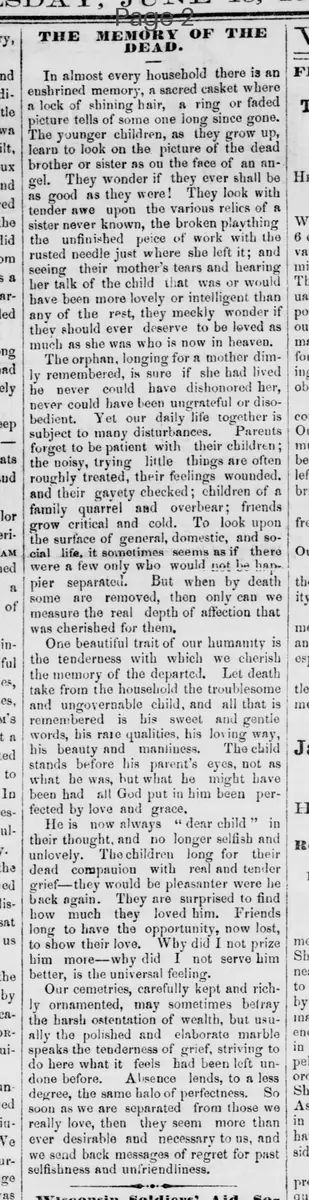
Reflective essay on how death transforms memories of loved ones, idealizing the deceased and evoking regret for past impatience and lack of affection in family and social life, emphasizing human tenderness toward the departed.
Clipping
OCR Quality
95%
Excellent
Full Text
THE
MEMORY OF THE
DEAD.
In almost every household there is an
enshrined memory, a sacred casket where
a lock of shining hair, a ring or faded
picture tells of some one long since gone.
The younger children, as they grow up,
learn to look on the picture of the dead
brother or sister as on the face of an angel.
They wonder if they ever shall be
as good as they were! They look with
tender awe upon the various relics of a
sister never known, the broken plaything
the unfinished piece of work with the
rusted needle just where she left it; and
seeing their mother's tears and hearing
her talk of the child that was or would
have been more lovely or intelligent than
any of the rest, they meekly wonder if
they should ever deserve to be loved as
much as she was who is now in heaven.
The orphan, longing for a mother dimly
remembered, is sure if she had lived
he never could have dishonored her.
never could have been ungrateful or disobedient.
Yet our daily life together is
subject to many disturbances. Parents
forget to be patient with their children;
the noisy, trying little things are often
roughly treated, their feelings wounded.
and their gayety checked; children of a
family quarrel and overbear; friends
grow critical and cold. To look upon
the surface of general, domestic, and so-
cial life, it sometimes seems as if there
were a few only who would not be happier
separated. But when by death
some are removed, then only can we
measure the real depth of affection that
was cherished for them.
One beautiful trait of our humanity is
the tenderness with which we cherish
the memory of the departed. Let death
take from the household the troublesome
and ungovernable child, and all that is
remembered is his sweet and gentle
words, his rare qualities, his loving way,
his beauty and manliness.
The child
stands before his parent's eyes, not as
what he was, but what he might have
been had all God put in him been per-
fected by love and grace.
He is now always "dear child" in
their thought, and no longer selfish and
unlovely. The children long for their
dead companion with real and tender
grief—they would be pleasanter were he
back again. They are surprised to find
how much they loved him. Friends
long to have the opportunity, now lost,
to show their love. Why did I not prize
him more—why did I not serve him
better, is the universal feeling.
Our cemeteries, carefully kept and richly
ornamented, may sometimes betray
the harsh ostentation of wealth, but usu-
ally the polished and elaborate marble
speaks the tenderness of grief, striving to
do here what it feels had been left un-
done before. Absence lends, to a less
degree, the same halo of perfectness. So
soon as we are separated from those we
really love, then they seem more than
ever desirable and necessary to us, and
we send back messages of regret for past
selfishness and unfriendliness.
MEMORY OF THE
DEAD.
In almost every household there is an
enshrined memory, a sacred casket where
a lock of shining hair, a ring or faded
picture tells of some one long since gone.
The younger children, as they grow up,
learn to look on the picture of the dead
brother or sister as on the face of an angel.
They wonder if they ever shall be
as good as they were! They look with
tender awe upon the various relics of a
sister never known, the broken plaything
the unfinished piece of work with the
rusted needle just where she left it; and
seeing their mother's tears and hearing
her talk of the child that was or would
have been more lovely or intelligent than
any of the rest, they meekly wonder if
they should ever deserve to be loved as
much as she was who is now in heaven.
The orphan, longing for a mother dimly
remembered, is sure if she had lived
he never could have dishonored her.
never could have been ungrateful or disobedient.
Yet our daily life together is
subject to many disturbances. Parents
forget to be patient with their children;
the noisy, trying little things are often
roughly treated, their feelings wounded.
and their gayety checked; children of a
family quarrel and overbear; friends
grow critical and cold. To look upon
the surface of general, domestic, and so-
cial life, it sometimes seems as if there
were a few only who would not be happier
separated. But when by death
some are removed, then only can we
measure the real depth of affection that
was cherished for them.
One beautiful trait of our humanity is
the tenderness with which we cherish
the memory of the departed. Let death
take from the household the troublesome
and ungovernable child, and all that is
remembered is his sweet and gentle
words, his rare qualities, his loving way,
his beauty and manliness.
The child
stands before his parent's eyes, not as
what he was, but what he might have
been had all God put in him been per-
fected by love and grace.
He is now always "dear child" in
their thought, and no longer selfish and
unlovely. The children long for their
dead companion with real and tender
grief—they would be pleasanter were he
back again. They are surprised to find
how much they loved him. Friends
long to have the opportunity, now lost,
to show their love. Why did I not prize
him more—why did I not serve him
better, is the universal feeling.
Our cemeteries, carefully kept and richly
ornamented, may sometimes betray
the harsh ostentation of wealth, but usu-
ally the polished and elaborate marble
speaks the tenderness of grief, striving to
do here what it feels had been left un-
done before. Absence lends, to a less
degree, the same halo of perfectness. So
soon as we are separated from those we
really love, then they seem more than
ever desirable and necessary to us, and
we send back messages of regret for past
selfishness and unfriendliness.
What sub-type of article is it?
Family Drama
Tragedy
What themes does it cover?
Family
Moral Virtue
Tragedy
What keywords are associated?
Memory Of Dead
Family Grief
Idealization
Regret
Human Tenderness
Death And Affection
Story Details
Story Details
Essay reflects on idealization of the deceased in family memories, regrets over past familial discord and impatience, and the tenderness that death evokes in cherishing loved ones' potentials.