Thank you for visiting SNEWPapers!
Sign up free
The Enquirer
Richmond, Henrico County, Virginia
What is this article about?
Historical account of past English proposals for expeditions against Spanish South American colonies, particularly 1780 plans by Sir John Dalrymple and Mr. Fullarton involving troops, ships, and routes via India, not executed due to war with Holland; speculates on a current similar expedition.
Merged-components note: The table lists ships for the described expedition; directly part of the historical foreign news article on South American plans.
Clipping
OCR Quality
Full Text
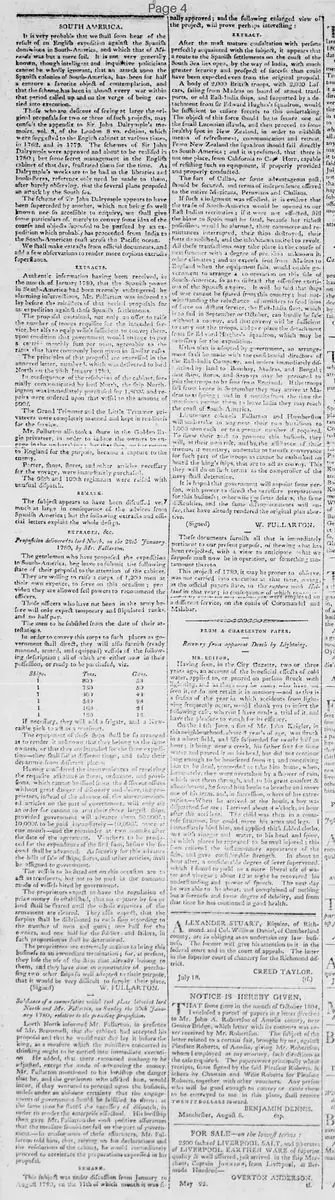
It is very probable that we shall soon hear of the result of an English expedition against the Spanish dominions in South-America, and which that of Miranda's was but a mere foil. It is not very generally known, though intelligent and inquisitive politicians cannot be wholly ignorant, that an attack upon the Spanish colonies of South-America, has been for half a century a favorite object of contemplation, and that the scheme has been in almost every war within that period called up and on the verge of being carried into execution.
Those who are desirous of seeing at large the original proposals for two or three of such projects, may consult the appendix to Sir John Dalrymple's memoirs, vol. 3. of the London 8vo. edition, which were suggested to the English cabinet at various times, in 1762, and in 1779. The schemes of Sir John Dalrymple were approved and about to be realized in 1780; but some secret management in the English cabinet of that day, frustrated them for the time. As Dalrymple's works are to be had in the libraries and book-stores, reference only need be made to them, after barely observing, that the several plans proposed an attack by the South Sea.
The Scheme of Sir John Dalrymple appears to have been superseded by another, which not being so well known nor so accessible to enquiry, we shall give some particulars of, merely to convey some idea of the course and objects supposed to be pursued by an expedition which probably has proceeded from India to the South-American coast across the Pacific ocean.
We shall make extracts from official documents and add a few observations to render more copious extracts superfluous.
EXTRACTS.
Authentic information having been received, in the month of January 1780, that the Spanish power in South-America had been recently endangered by alarming insurrections. Mr. Fullarton was induced to lay before the ministers of that period proposals for an expedition against those Spanish settlements.
The proposal contained, not only an offer to raise the number of troops requisite for the intended service, but also to equip vessels sufficient to convey them, upon condition that government would engage to pay a certain monthly sum per man, agreeably to the rates that have commonly been given in similar cases.
The principles of this proposal are expressed in the annexed letter, number I. which was delivered to lord North on the 28th January 1780.
In consequence of the resolution of the cabinet, formally communicated by lord North, the ship Northington was immediately purchased for 15,000l. and repairs were ordered upon that vessel to the amount of 900l.
The Grand Trimmer and the Little Trimmer privateers were completely manned and kept in readiness for the service.
Mr. Fullarton also took a share in the Golden Eagle privateer, in order to induce the owners to engage in the measure; but that ship on her return to England for the purpose, became a capture to the enemy.
Powder, shoes, stores, and other articles necessary for the voyage, were immediately purchased.
The 95th and 100th regiments were raised with unusual dispatch.
REMARK.
The subject appears to have been discussed very much at large in consequence of the advices from Spanish America; but the following extracts and official letters explain the whole design.
EXTRACTS, &c.
Proposition delivered to lord North, on the 28th February 1780, by Mr. Fullarton.
The gentlemen who have proposed the expedition to South-America, beg leave to submit the following state of their proposal to the attention of the cabinet.
They are willing to raise a corps of 1,200 men at their own expense, to serve on this occasion; provided they are allowed full powers to recommend the officers.
Those officers who have not been in the army before will only expect temporary and stipulated ranks, and no half pay.
The men to be subsisted from the date of their attestation.
In order to convey this corps to such places as government shall direct, they will also furnish (ready manned, armed, and equipped) vessels of the following description: all of which are either now in their possession, or ready to be purchased, viz.
If necessary, they will add a frigate, and a Newcastle pink to act as a transport.
The equipment of those ships shall be so arranged as to render it unknown that they belong to the same owners, or that they are intended for the English expedition--they shall sail at different times, and take their departure from different places.
Having considered the inconveniences of receiving the requisite assistance in stores, ordnance, and provisions, which cannot be issued from the different offices without great danger of discovery and delay, the proprietors, instead of the advance of the above-mentioned articles on the part of government, will only ask an order for cannon to arm their three largest ships, provided government will advance them: 50,000l.
10,000l. to be paid immediately--10,000l. more at one month--and the remainder at two months after the date of the agreement. Vouchers to be produced for the expenditure of the first sum, before the second shall be advanced. As security for this advance the bills of sale of ships, stores, and other articles, shall be assigned to government.
The vessels to be fitted out on this occasion are to act as transports, but not to be rated in the common mode of vessel, hired by government.
The proprietors expect to have the regulation of prize money so established, that no capture by sea or land shall be shared until the whole expenses of the armament are cleared. They also expect, that the surplus shall be distributed to each ship according to the number of men and guns; one half for the owners, and one half for the soldiers and sailors, in such proportion as shall be determined.
The proprietors are extremely anxious to bring this business to an immediate termination; for, at present, they lose the use of the ships that already belong to them, and they have now an opportunity of purchasing two other ships so well adapted to their purpose that it would be very difficult to supply their place.
(Signed)
W. FULLARTON.
Substance of a conversation which took place between lord North and Mr. Fullarton, on Sunday the 30th January 1780, relative to the preceding proposition.
Lord North informed Mr. Fullarton, in presence of Mr. Brummell, that the cabinet had accepted his proposal and that he would next day lay it before the king, as a measure which the ministers concurred in thinking ought to be carried into immediate execution. He added, that there remained nothing to be adjusted, except the mode of advancing the money.
Mr. Fullarton mentioned to his lordship the danger that he, and the gentlemen who assisted him, would incur, if they ventured to proceed upon the business, unless under an absolute certainty that the engagements of government should be fulfilled to them: at the same time he stated the necessity of dispatch, in order to render the enterprise effectual. His lordship then gave Mr. Fullarton the most positive assurances that the measure should not fail on the part of government.--In consequence of these assurances, Mr. Fullarton told him, that, relying on his declarations and the resolutions of the cabinet, he would immediately proceed to accelerate the preparations expressed in his proposal.
REMARK.
This subject was under discussion from January to August 1780, on the 11th of which month it was finally approved; and the following enlarged view of the project, will prove perhaps interesting :
EXTRACT.
After the most mature consultation with persons perfectly acquainted with the subject, it appears that a route to the Spanish settlements on the coast of the South Sea lies open, by the way of India, with much greater security and prospect of success than could have been expected even from the original proposal.
A body of 5,000 British troops, with 2,000 Lascars, sailing from Madras on board of armed transports, or old East-India ships, and supported by a detachment from sir Edward Hughes's squadron, would be sufficient to ensure success to this undertaking.
The object of this force should be to secure one of the small Luconian islands, and then proceed to some healthy spot in New Zealand, in order to establish means of refreshment, communication and retreat.
From New Zealand the squadron should sail directly to South-America; and it is presumed, that there is not one place, from California to Cape Horn, capable of resisting such an equipment, if properly provided and properly conducted.
The fort of Callao, or some advantageous post, should be secured, and terms of independence offered to the native Mexicans, Peruvians and Chilians.
If such a lodgment was effected, it is evident that the trade of South-America would be opened to our East Indian territories: if it were not effected, still the blow to Spain must be fatal, because her richest possession would be alarmed, their commerce and remittances interrupted, their ships destroyed, their forts demolished, and the inhabitants incited to revolt.
All these transactions may take place in the course of next summer with a degree of precision unknown in other climates: and an express sent from Madras to England when the equipment sails, would enable government to arrange a co-operation on this side of South-America, so as to distract the offensive exertions of the Spanish empire. It will be said that ships of war cannot be spared from this country: but notwithstanding the reluctance of ministers to send ships of force on distant service, the East-India fleet, which is to sail in September or October, can hardly be safe without a convoy, and that convoy will be sufficient to carry out the troops, and to place the detachment from sir Edward Hughes's squadron, which may be necessary for the expedition.
If this plan is adopted by government, an arrangement shall be made with the confidential directors of the East-India Company, and orders immediately dispatched by land to Bombay, Madras, and Bengal; that ships, stores, and sepoys may be prepared to join the troops to be sent from England. If the troops sail from hence in September they may arrive at Madras next spring; and in 4 months from the time the monsoons permit them to leave India they may reach the coast of South-America.
Lieutenant colonels Fullarton and Humberston will undertake to augment their two battalions to 1,000 men each or to a greater number if required.
To show their zeal to promote this business, they will, at their own risk, and by the assistance of their friends, if necessary, undertake to furnish conveyance for such part of the troops as cannot be embarked on board the king's ships, that are to act as convoy. This they will do on such terms as the comptroller of the navy shall determine.
It is hoped that government will appoint some person, with power to direct the necessary preparations for this business; otherwise the same delays, the same difficulties, and the same disappointments will ensue, that have already rendered the original plan abortive.
(Signed)
W. FULLARTON.
These documents furnish all that is immediately pertinent to our present purpose, of showing what has been projected, with a view to anticipate what we suppose must now be in operation, or something tantamount thereto.
This project of 1780, it may be proper to observe, was not carried into execution at that time, owing, as the official papers state, to the rupture with Holland in that year; in consequence of which our forces were employed on a different service, on the coasts of Coromandel and Malabar.
| Slips. | Tons. | Guns. |
| 1 | 800 | 50 |
| 1 | 750 | 50 |
| 1 | 400 | 40 |
| 1 | 380 | 28 |
| 1 | 160 | 21 |
| 1 | 130 | 16 |
What sub-type of article is it?
What keywords are associated?
What entities or persons were involved?
Where did it happen?
Foreign News Details
Primary Location
South America
Event Date
1780
Key Persons
Outcome
the project of 1780 was not carried into execution owing to the rupture with holland; forces employed elsewhere.
Event Details
Proposals for English expeditions against Spanish South American colonies, including 1780 plans by Fullarton to raise 1,200 men, equip ships, route via India, secure posts like Callao, offer independence to natives; involved purchasing ships, raising regiments, but ultimately aborted.