Thank you for visiting SNEWPapers!
Sign up free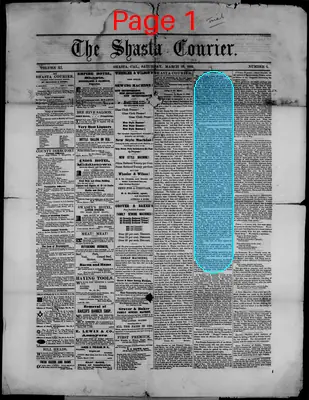
The Shasta Courier
Shasta, Shasta County, California
What is this article about?
At London's Old Bailey, portrait painter George Hammond is tried for the murder of mountebank George Baldwin, whom he killed upon discovering Baldwin had abducted and corrupted his long-lost four-year-old daughter. Hammond admits the killing but pleads justification; the jury acquits him amid public acclaim.
Clipping
OCR Quality
Full Text
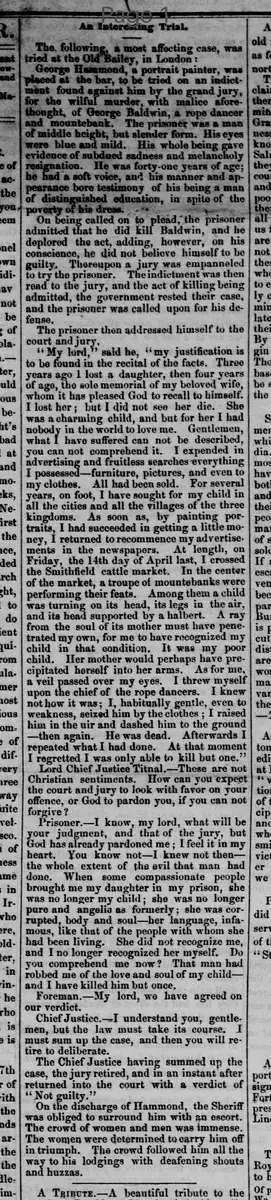
George Hammond, a portrait painter, was placed at the bar, to be tried on an indictment found against him by the grand jury, for the wilful murder, with malice aforethought, of George Baldwin, a rope dancer and mountebank. The prisoner was a man of middle height, but slender form. His eyes were blue and mild. His whole being gave evidence of subdued sadness and melancholy resignation. He was forty-one years of age; he had a soft voice, and his manner and appearance bore testimony of his being a man of distinguished education, in spite of the poverty of his dress.
On being called on to plead, the prisoner admitted that he did kill Baldwin, and he deplored the act, adding, however, on his conscience, he did not believe himself to be guilty. Thereupon a jury was empanneled to try the prisoner. The indictment was then read to the jury, and the act of killing being admitted, the government rested their case, and the prisoner was called upon for his defense.
The prisoner then addressed himself to the court and jury.
"My lord," said he, "my justification is to be found in the recital of the facts. Three years ago I lost a daughter, then four years of age, the sole memorial of my beloved wife, whom it has pleased God to recall to himself. I lost her; but I did not see her die. She was a charming child, and but for her I had nobody in the world to love me. Gentlemen, what I have suffered can not be described, you can not comprehend it. I expended in advertising and fruitless searches everything I possessed—furniture, pictures, and even to my clothes. All had been sold. For several years, on foot, I have sought for my child in all the cities and all the villages of the three kingdoms. As soon as, by painting portraits, I had succeeded in getting a little money, I returned to recommence my advertisements in the newspapers. At length, on Friday, the 14th day of April last, I crossed the Smithfield cattle market. In the center of the market, a troupe of mountebanks were performing their feats. Among them a child was turning on its head, its legs in the air, and its head supported by a halbert. A ray from the soul of its mother must have penetrated my own, for me to have recognized my child in that condition. It was my poor child. Her mother would perhaps have precipitated herself into her arms. As for me, a veil passed over my eyes. I threw myself upon the chief of the rope dancers. I knew not how it was; I, habitually gentle, even to weakness, seized him by the clothes; I raised him in the air and dashed him to the ground—then again. He was dead. Afterwards I repeated what I had done. At that moment I regretted I was only able to kill but one."
Lord Chief Justice Tindal,—These are not Christian sentiments. How can you expect the court and jury to look with favor on your offence, or God to pardon you, if you can not forgive?
Prisoner.—I know, my lord, what will be your judgment, and that of the jury, but God has already pardoned me; I feel it in my heart. You know not—I knew not then— the whole extent of the evil that man had done. When some compassionate people brought me my daughter in my prison, she was no longer my child; she was no longer pure and angelic as formerly; she was corrupted, body and soul—her language, infamous, like that of the people with whom she had been living. She did not recognize me, and I no longer recognized her myself. Do you comprehend me now? That man had robbed me of the love and soul of my child—and I have killed him but once,
Foreman.—My lord, we have agreed on our verdict.
Chief Justice.—I understand you, gentlemen, but the law must take its course. I must sum up the case, and then you will retire to deliberate.
The Chief Justice having summed up the case, the jury retired, and in an instant after returned into the court with a verdict of
"Not guilty."
On the discharge of Hammond, the Sheriff was obliged to surround him with an escort. The crowd of women and men was immense. The women were determined to carry him off in triumph. The crowd followed him all the way to his lodgings with deafening shouts and huzzas.
What sub-type of article is it?
What themes does it cover?
What keywords are associated?
What entities or persons were involved?
Where did it happen?
Story Details
Key Persons
Location
Old Bailey, London
Event Date
Friday, The 14th Day Of April Last
Story Details
George Hammond, searching for his lost daughter, recognizes her performing with mountebanks at Smithfield market and kills their leader, George Baldwin, in rage. Tried for murder at Old Bailey, he explains the abduction and corruption of his child; the jury acquits him, and the public cheers his release.