Thank you for visiting SNEWPapers!
Sign up free
Story
December 12, 1792
National Gazette
Philadelphia, Philadelphia County, Pennsylvania
What is this article about?
Conclusion of Mr. Ames's speech in US Congress advocating reference to the Secretary of the Treasury for plans on reducing public debt, arguing its constitutionality, precedent, and benefits for informed legislation over committee alternatives.
Clipping
OCR Quality
95%
Excellent
Full Text
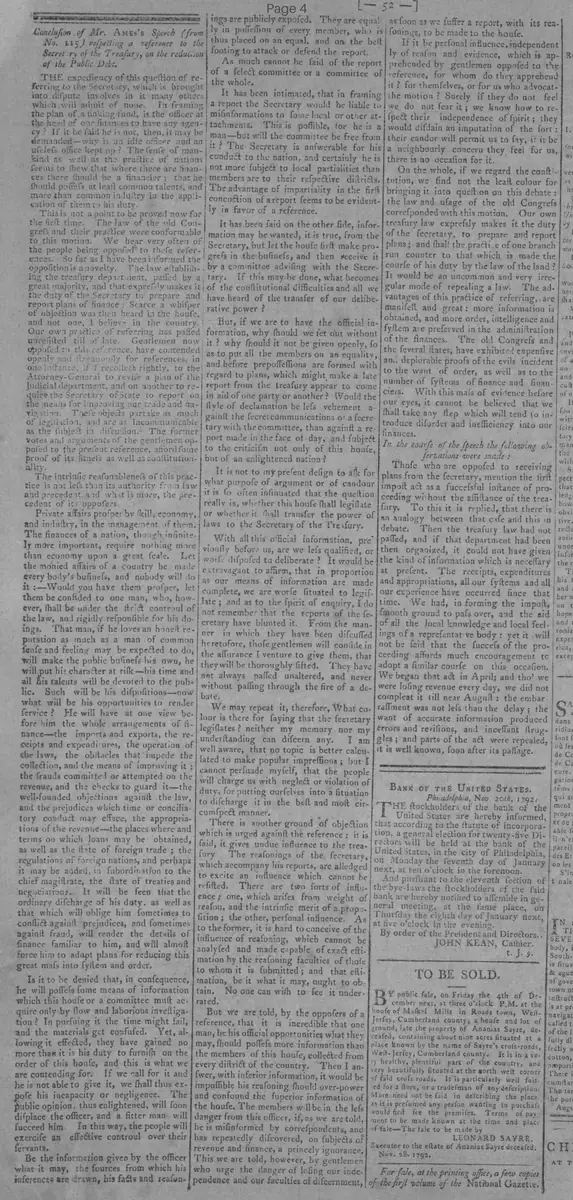
Conclusion of Mr. Ames's Speech (from No. 115) respecting a reference to the Secretary of the Treasury, on the reduction of the Public Debt.
THE expediency of this question of referring to the Secretary, which is brought into dispute involves in it many others which will admit of none. In framing the plan of a sinking fund, is the officer at the head of our finances to have any agency? If it be said he is not, then, it may be demanded—why is an idle officer and a useless office kept up? The end of mankind as well as the practice of nations seems to show that where there are finances there should be a financier; that he should possess at least common talents, and more than common industry in the application of them to his duty.
This is not a point to be proved now for the first time. The law of the old Congress and their practice were conformable to this motion. We hear very often of the people being opposed to these references. So far as I have been informed the opposition is a novelty. The law establishing the treasury department, passed by a great majority, and that expressly makes it the duty of the Secretary to prepare and report plans of finance: Scarce a whisper of objection was then heard in the house, and not one, I believe in the country.
Our own practice of referring has passed unquestioned till of late. Gentlemen now opposed to this reference, have contended openly and strenuously for references, in one instance, if I recollect rightly, to the Attorney-General to revise a plan of the judicial department, and on another to require the Secretary of State to report on the means for improving our trade and navigation. These objects partake as much of legislation, and are as incommunicable as the subject in discussion. The former votes and arguments of the gentlemen opposed to the present reference, afford some proof of its fitness as well as constitutionality.
The intrinsic reasonableness of this practice is not less than its authority from law and precedent, and what is more, the precedent of its opposers.
Private affairs proper by skill, economy, and industry, in the management of them. The finances of a nation, though infinitely more important, require nothing more than economy upon a great scale. Let the monied affairs of a country be made everybody's business, and nobody will do it:—Would you have them properly, let them be confided to one man, who, however, shall be under the strict control of the law, and rigidly responsible for his doings. That man, if he loves an honest reputation as much as a man of common sense and feeling may be expected to do, will make the public business his own, he will put his character at risk—his time and all his talents will be devoted to the public. Such will be his dispositions—now what will be his opportunities to render service? He will have at one view before him the whole arrangements of finance—the imports and exports, the receipts and expenditures, the operation of the laws, the obstacles that impede the collection, and the means of improving it; the frauds committed or attempted on the revenue, and the checks to guard it—the well-founded objections against the law, and the prejudices which time or conciliatory conduct may efface, the appropriations of the revenue—the places where and terms on which loans may be obtained, as well as the state of foreign trade; the regulations of foreign nations, and perhaps it may be added, in subordination to the chief magistrate, the state of treaties and negotiations. It will be seen that the ordinary discharge of his duty, as well as that which will oblige him sometimes to conflict against prejudices, and sometimes against fraud, will render the details of finance familiar to him, and will almost force him to adopt plans for reducing this great mass into system and order.
Is it to be denied that, in consequence, he will possess some means of information which this house or a committee must acquire only by slow and laborious investigation? In pursuing it the time might fail, and the materials get confused. Yet, allowing it effected, they have gained no more than it is his duty to furnish on the order of this house, and this is what we are contending for. If we call for it and he is not able to give it, we shall thus expose his incapacity or negligence. The public opinion, thus enlightened, will soon displace the officer, and a fitter man will succeed him. In this way, the people will exercise an effective control over their servants.
Be the information given by the officer what it may, the sources from which his inferences are drawn, his facts and reasonings are publicly exposed. They are equally in possession of every member, who is thus placed on an equal, and on the best footing to attack or defend the report.
As much cannot be said of the report of a select committee or a committee of the whole.
It has been intimated, that in framing a report the Secretary would be liable to misinformations to some local or other attachments. This is possible, for he is a man—but will the committee be free from it? The Secretary is answerable for his conduct to the nation, and certainly he is not more subject to local partialities than members are to their respective districts.
The advantage of impartiality in the first concoction of a report seems to be evidently in favor of a reference.
It has been said on the other side, information may be wanted, it is true, from the Secretary, but let the house first make progress in the business, and then receive it by a committee advising with the Secretary. If this may be done, what becomes of the constitutional difficulties and all we have heard of the transfer of our deliberative power?
But, if we are to have the official information, why should we set out without it? why should it not be given openly, so as to put all the members on an equality, and before prepossessions are formed with regard to plans, which might make a late report from the treasury appear to come in aid of one party or another? Would the style of declamation be less vehement against the secret communications of a secretary with the committee, than against a report made in the face of day, and subject to the criticism not only of this house, but of an enlightened nation?
It is not to my present design to ask for what purpose of argument or of candor it is so often insinuated that the question really is, whether this house shall legislate or whether it shall transfer the power of laws to the Secretary of the Treasury.
With all this official information, previously before us, are we less qualified, or worse disposed to deliberate? It would be extravagant to affirm, that in proportion as our means of information are made complete, we are worse situated to legislate: and as to the spirit of enquiry, I do not remember that the reports of the secretary have blunted it. From the manner in which they have been discussed heretofore, those gentlemen will confide in the assurance I venture to give them, that they will be thoroughly sifted. They have not always passed unaltered, and never without passing through the fire of a debate.
We may repeat it, therefore, What colour is there for saying that the secretary legislates? neither my memory nor my understanding can discern any. I am well aware, that no topic is better calculated to make popular impressions; but I cannot persuade myself, that the people will charge us with neglect or violation of duty, for putting ourselves into a situation to discharge it in the best and most circumspect manner.
There is another ground of objection which is urged against the reference: it is said, it gives undue influence to the treasury The reasonings of the secretary, which accompany his reports, are alledged to excite an influence which cannot be resisted. There are two sorts of influence; one, which arises from weight of reason, and the intrinsic merit of a proposition; the other, personal influence. As to the former, it is hard to conceive of the influence of reasoning, which cannot be analysed and made capable of exact estimation by the reasoning faculties of those to whom it is submitted; and that estimation, be it what it may, ought to obtain. No one can wish to see it underrated.
But we are told, by the opposers of a reference, that it is incredible that one man, be his official opportunities what they may, should possess more information than the members of this house, collected from every district of the country. Then I answer, with inferior information, it would be impossible his reasoning should over-power and confound the superior information of the house. The members will be in the less danger from this officer, if, as we are told, he is misinformed by correspondents, and has repeatedly discovered, on subjects of revenue and finance, a princely ignorance.
This we are told, however, by gentlemen who urge the danger of losing our independence and our faculties of discernment, as soon as we suffer a report, with its reasonings, to be made to the house.
If it be personal influence, independent ly of reason and evidence, which is apprehended by gentlemen opposed to the reference, for whom do they apprehend it? for themselves, or for us who advocate the motion? Surely if they do not feel we do not fear it: we know how to respect their independence of spirit; they would disdain an imputation of the sort : their candor will permit us to say, if it be a neighbourly concern they feel for us, there is no occasion for it.
On the whole, if we regard the constitution, we find not the least colour for bringing it into question on this debate : the law and usage of the old Congress corresponded with this motion. Our own treasury law expressly makes it the duty of the secretary, to prepare and report plans; and shall the practice of one branch run counter to that which is made the course of his duty by the law of the land? It would be an uncommon and very irregular mode of repealing a law, The advantages of this practice of referring, are manifest and great: more information is obtained, and more order, intelligence and system are preserved in the administration of the finances. The old Congress and the several states, have exhibited expensive and deplorable proofs of the evils incident to the want of order, as well as to the number of systems of finance and financiers. With this mass of evidence before our eyes, it cannot be believed that we shall take any step which will tend to introduce disorder and inefficiency into our finances.
In the course of the speech the following observations were made :
Those who are opposed to receiving plans from the secretary, mention the first impost act as a successful instance of proceeding without the assistance of the treasury. To this it is replied, that there is an analogy between that case and this in debate. Then the treasury law had not passed, and if that department had been then organized, it could not have given the kind of information which is necessary at present. The receipts, expenditures and appropriations, all our systems and all our experience have occurred since that time. We had, in forming the impost, smooth ground to pass over, and the aid of all the local knowledge and local feelings of a representative body: yet it will not be said that the success of the proceeding affords much encouragement to adopt a similar course on this occasion.
We began that act in April; and tho' we were losing revenue every day, we did not complete it till near August : the embarrassment was not less than the delay; the want of accurate information produced errors and revisions, and incessant struggles; and parts of the act were repealed, it is well known, soon after its passage.
THE expediency of this question of referring to the Secretary, which is brought into dispute involves in it many others which will admit of none. In framing the plan of a sinking fund, is the officer at the head of our finances to have any agency? If it be said he is not, then, it may be demanded—why is an idle officer and a useless office kept up? The end of mankind as well as the practice of nations seems to show that where there are finances there should be a financier; that he should possess at least common talents, and more than common industry in the application of them to his duty.
This is not a point to be proved now for the first time. The law of the old Congress and their practice were conformable to this motion. We hear very often of the people being opposed to these references. So far as I have been informed the opposition is a novelty. The law establishing the treasury department, passed by a great majority, and that expressly makes it the duty of the Secretary to prepare and report plans of finance: Scarce a whisper of objection was then heard in the house, and not one, I believe in the country.
Our own practice of referring has passed unquestioned till of late. Gentlemen now opposed to this reference, have contended openly and strenuously for references, in one instance, if I recollect rightly, to the Attorney-General to revise a plan of the judicial department, and on another to require the Secretary of State to report on the means for improving our trade and navigation. These objects partake as much of legislation, and are as incommunicable as the subject in discussion. The former votes and arguments of the gentlemen opposed to the present reference, afford some proof of its fitness as well as constitutionality.
The intrinsic reasonableness of this practice is not less than its authority from law and precedent, and what is more, the precedent of its opposers.
Private affairs proper by skill, economy, and industry, in the management of them. The finances of a nation, though infinitely more important, require nothing more than economy upon a great scale. Let the monied affairs of a country be made everybody's business, and nobody will do it:—Would you have them properly, let them be confided to one man, who, however, shall be under the strict control of the law, and rigidly responsible for his doings. That man, if he loves an honest reputation as much as a man of common sense and feeling may be expected to do, will make the public business his own, he will put his character at risk—his time and all his talents will be devoted to the public. Such will be his dispositions—now what will be his opportunities to render service? He will have at one view before him the whole arrangements of finance—the imports and exports, the receipts and expenditures, the operation of the laws, the obstacles that impede the collection, and the means of improving it; the frauds committed or attempted on the revenue, and the checks to guard it—the well-founded objections against the law, and the prejudices which time or conciliatory conduct may efface, the appropriations of the revenue—the places where and terms on which loans may be obtained, as well as the state of foreign trade; the regulations of foreign nations, and perhaps it may be added, in subordination to the chief magistrate, the state of treaties and negotiations. It will be seen that the ordinary discharge of his duty, as well as that which will oblige him sometimes to conflict against prejudices, and sometimes against fraud, will render the details of finance familiar to him, and will almost force him to adopt plans for reducing this great mass into system and order.
Is it to be denied that, in consequence, he will possess some means of information which this house or a committee must acquire only by slow and laborious investigation? In pursuing it the time might fail, and the materials get confused. Yet, allowing it effected, they have gained no more than it is his duty to furnish on the order of this house, and this is what we are contending for. If we call for it and he is not able to give it, we shall thus expose his incapacity or negligence. The public opinion, thus enlightened, will soon displace the officer, and a fitter man will succeed him. In this way, the people will exercise an effective control over their servants.
Be the information given by the officer what it may, the sources from which his inferences are drawn, his facts and reasonings are publicly exposed. They are equally in possession of every member, who is thus placed on an equal, and on the best footing to attack or defend the report.
As much cannot be said of the report of a select committee or a committee of the whole.
It has been intimated, that in framing a report the Secretary would be liable to misinformations to some local or other attachments. This is possible, for he is a man—but will the committee be free from it? The Secretary is answerable for his conduct to the nation, and certainly he is not more subject to local partialities than members are to their respective districts.
The advantage of impartiality in the first concoction of a report seems to be evidently in favor of a reference.
It has been said on the other side, information may be wanted, it is true, from the Secretary, but let the house first make progress in the business, and then receive it by a committee advising with the Secretary. If this may be done, what becomes of the constitutional difficulties and all we have heard of the transfer of our deliberative power?
But, if we are to have the official information, why should we set out without it? why should it not be given openly, so as to put all the members on an equality, and before prepossessions are formed with regard to plans, which might make a late report from the treasury appear to come in aid of one party or another? Would the style of declamation be less vehement against the secret communications of a secretary with the committee, than against a report made in the face of day, and subject to the criticism not only of this house, but of an enlightened nation?
It is not to my present design to ask for what purpose of argument or of candor it is so often insinuated that the question really is, whether this house shall legislate or whether it shall transfer the power of laws to the Secretary of the Treasury.
With all this official information, previously before us, are we less qualified, or worse disposed to deliberate? It would be extravagant to affirm, that in proportion as our means of information are made complete, we are worse situated to legislate: and as to the spirit of enquiry, I do not remember that the reports of the secretary have blunted it. From the manner in which they have been discussed heretofore, those gentlemen will confide in the assurance I venture to give them, that they will be thoroughly sifted. They have not always passed unaltered, and never without passing through the fire of a debate.
We may repeat it, therefore, What colour is there for saying that the secretary legislates? neither my memory nor my understanding can discern any. I am well aware, that no topic is better calculated to make popular impressions; but I cannot persuade myself, that the people will charge us with neglect or violation of duty, for putting ourselves into a situation to discharge it in the best and most circumspect manner.
There is another ground of objection which is urged against the reference: it is said, it gives undue influence to the treasury The reasonings of the secretary, which accompany his reports, are alledged to excite an influence which cannot be resisted. There are two sorts of influence; one, which arises from weight of reason, and the intrinsic merit of a proposition; the other, personal influence. As to the former, it is hard to conceive of the influence of reasoning, which cannot be analysed and made capable of exact estimation by the reasoning faculties of those to whom it is submitted; and that estimation, be it what it may, ought to obtain. No one can wish to see it underrated.
But we are told, by the opposers of a reference, that it is incredible that one man, be his official opportunities what they may, should possess more information than the members of this house, collected from every district of the country. Then I answer, with inferior information, it would be impossible his reasoning should over-power and confound the superior information of the house. The members will be in the less danger from this officer, if, as we are told, he is misinformed by correspondents, and has repeatedly discovered, on subjects of revenue and finance, a princely ignorance.
This we are told, however, by gentlemen who urge the danger of losing our independence and our faculties of discernment, as soon as we suffer a report, with its reasonings, to be made to the house.
If it be personal influence, independent ly of reason and evidence, which is apprehended by gentlemen opposed to the reference, for whom do they apprehend it? for themselves, or for us who advocate the motion? Surely if they do not feel we do not fear it: we know how to respect their independence of spirit; they would disdain an imputation of the sort : their candor will permit us to say, if it be a neighbourly concern they feel for us, there is no occasion for it.
On the whole, if we regard the constitution, we find not the least colour for bringing it into question on this debate : the law and usage of the old Congress corresponded with this motion. Our own treasury law expressly makes it the duty of the secretary, to prepare and report plans; and shall the practice of one branch run counter to that which is made the course of his duty by the law of the land? It would be an uncommon and very irregular mode of repealing a law, The advantages of this practice of referring, are manifest and great: more information is obtained, and more order, intelligence and system are preserved in the administration of the finances. The old Congress and the several states, have exhibited expensive and deplorable proofs of the evils incident to the want of order, as well as to the number of systems of finance and financiers. With this mass of evidence before our eyes, it cannot be believed that we shall take any step which will tend to introduce disorder and inefficiency into our finances.
In the course of the speech the following observations were made :
Those who are opposed to receiving plans from the secretary, mention the first impost act as a successful instance of proceeding without the assistance of the treasury. To this it is replied, that there is an analogy between that case and this in debate. Then the treasury law had not passed, and if that department had been then organized, it could not have given the kind of information which is necessary at present. The receipts, expenditures and appropriations, all our systems and all our experience have occurred since that time. We had, in forming the impost, smooth ground to pass over, and the aid of all the local knowledge and local feelings of a representative body: yet it will not be said that the success of the proceeding affords much encouragement to adopt a similar course on this occasion.
We began that act in April; and tho' we were losing revenue every day, we did not complete it till near August : the embarrassment was not less than the delay; the want of accurate information produced errors and revisions, and incessant struggles; and parts of the act were repealed, it is well known, soon after its passage.
What sub-type of article is it?
Historical Event
What themes does it cover?
Moral Virtue
Justice
What keywords are associated?
Public Debt Reduction
Sinking Fund
Treasury Reference
Congressional Debate
Financial Policy
Secretary Duty
Legislative Precedent
What entities or persons were involved?
Mr. Ames
Secretary Of The Treasury
Attorney General
Secretary Of State
Where did it happen?
Us House Of Representatives
Story Details
Key Persons
Mr. Ames
Secretary Of The Treasury
Attorney General
Secretary Of State
Location
Us House Of Representatives
Story Details
Mr. Ames argues for referring the reduction of public debt to the Secretary of the Treasury, citing precedent, law, efficiency, and countering objections on constitutionality, influence, and impartiality.