Thank you for visiting SNEWPapers!
Sign up free
Alexandria Gazette & Advertiser
Alexandria, Virginia
What is this article about?
Proceedings of the 17th Congress, 1st Session on January 14, 1823, in the Senate and House of Representatives, including petitions, resolutions on Florida territory and post roads, reports on patents and public accounts, and debate on a bill for surveys of national roads and canals, with votes on motions.
Merged-components note: Single coherent report on the US Congress session, spanning Senate and House proceedings.
Clipping
OCR Quality
Full Text
SEVENTEENTH CONGRESS—1ST SESSION,
TUESDAY, JANUARY 14, 1823.
IN SENATE.
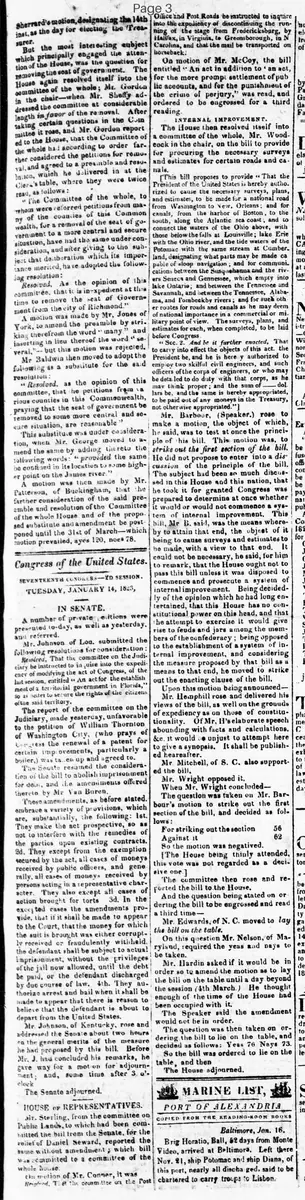
A number of private petitions were presented to-day, as well as yesterday, and referred. Mr. Johnson of La. submitted the following resolutions for consideration: Resolved, That the committee on the Judiciary be instructed to inquire into the expediency of modifying the act of Congress, of the last session, entitled "An act for the establishment of a territorial government in Florida," so as neither to secure the rights of the citizens of the said territory. The report of the committee on the Judiciary, made yesterday, unfavorable to the petition of William Thornton of Washington City, (who prays of Congress the renewal of a patent for certain improvements, particularly a boiler,) was taken up and agreed to. The Senate resumed the consideration of the bill to abolish imprisonment for debt, and the amendments offered thereto by Mr. Van Buren. These amendments, as before stated, embrace a variety of provisions, which are, substantially, the following: 1st. They make the act prospective, so as not to interfere with the remedies of the parties upon existing contracts. 2d. They except from the exemption secured by the act, all cases of moneys received by public officers, and generally, all cases of moneys received by persons acting in a representative character. They also except all cases of action brought for torts. 3d. In the excepted cases the amendments provide, that if it shall be made to appear to the Court, that the money for which the suit is brought was either corruptly received or fraudulently withheld, the defendant shall be subject to actual imprisonment, without the privileges of the jail now allowed, until the debt be paid, or the defendant discharged by due course of law. 4th. They authorize arrest and bail when it shall be made to appear that there is reason to believe that the defendant is about to depart from the United States. Mr. Johnson, of Kentucky, rose and addressed the Senate about two hours on the general merits of the measure he had proposed by this bill. Before Mr. J. had concluded his remarks, he gave way for a motion for adjournment: and, some time after 3 o'clock The Senate adjourned.
HOUSE OF REPRESENTATIVES.
Mr. Sterling, from the committee on Public Lands, to which had been committed the bill from the Senate, for the relief of Daniel Seward, reported the same without amendment: which bill was committed to a committee of the whole house. On motion of Mr. Conner, it was Resolved, That the committee on the Post Office and Post Roads be instructed to inquire into the expediency of discontinuing the running of the stage from Fredericksburg, by Halifax, in Virginia, to Greensborough, in N. Carolina, and that the mail be transported on horseback.
On motion of Mr. McCoy, the bill entitled "An act in addition to 'an act, for the more prompt settlement of public accounts, and for the punishment of the crime of perjury,'" was read, and ordered to be engrossed for a third reading.
INTERNAL IMPROVEMENT.
The House then resolved itself into a committee of the whole, Mr. Woodcock in the chair, on the bill to provide for procuring the necessary surveys and estimates for certain roads and canals. This bill proposes to provide "That the President of the United States is hereby authorized to cause the necessary surveys, plans, and estimates, to be made for a national road from Washington to New Orleans; and for canals, from the harbor of Boston, to the south, along the Atlantic sea coast, and to connect the waters of the Ohio above, with those below the falls at Louisville; lake Erie with the Ohio river, and the tide waters of the Potomac with the same stream at Cumberland, designating what parts may be made capable of sloop navigation; and for communications between the Susquehanna and the rivers Seneca and Genessee, which empty into lake Ontario; and between the Tennessee and Savannah, and between the Tennessee, Alabama, and Tombigbee rivers; and for such other routes for roads and canals as he may deem of national importance in a commercial or military point of view. The surveys, plans, and estimates for each, when completed, to be laid before Congress."
"Sec. 2. And be it further enacted, That to carry into effect the objects of this act, the President be, and he is hereby authorized to employ two skilful civil engineers, and such officers of the corps of engineers, or who may be detailed to do duty with that corps, as he may think proper; and the sum of [blank] dollars be, and the same is hereby appropriated, to be paid out of any moneys in the Treasury, not otherwise appropriated."
Mr. Barbour, (Speaker,) rose to make a motion, the object of which, he said, was to test at once the principle of his bill. This motion was to strike out the first section of the bill. He did not propose to enter into a discussion of the principle of the bill. The subject had been so much discussed in this House and this nation, that he took it for granted Congress was prepared to determine at once whether it would or would not commence a system of internal improvement. This bill, Mr. B. said, was the means whereby to attain that end, the object of it being to cause surveys and estimates to be made, with a view to that end. It could not be necessary, he said, for him to remark, that the House ought not to pass this bill unless it was disposed to commence and prosecute a system of internal improvement. Being decidedly of the opinion which he had long entertained, that this House has no constitutional power on this head, and that the attempt to exercise it would give rise to feuds and jars among the members of the confederacy; being opposed to the establishment of a system of internal improvement, and considering the measure proposed by that bill as a means to that end, he moved to strike out the enacting clause of the bill. Upon this motion being announced— Mr. Hemphill rose and delivered his views of the bill, as well on the grounds of expediency as on those of constitutionality. Of Mr. H.'s elaborate speech abounding with facts and calculations, &c. it would be unjust to attempt here to give a synopsis. It shall be published hereafter. Mr. Mitchell, of S. C. also supported the bill. Mr. Wright opposed it. When Mr. Wright concluded— The question was taken on Mr. Barbour's motion to strike out the first section of the bill, and decided as follows:
For striking out the section 56
Against it 62
So the motion was negatived. [The House being thinly attended, this vote was not regarded as a decisive one.] The committee then rose and reported the bill to the House. And the question being stated on ordering the bill to be engrossed and read a third time— Mr. Edwards, of N. C. moved to lay the bill on the table. On this question Mr. Nelson, of Maryland, required the yeas and nays to be taken. Mr. Hardin asked if it would be in order so to amend the motion as to lay the bill on the table until a day beyond the session (4th March.) He thought enough of the time of the House had been occupied with it. The Speaker said the amendment would not be in order. The question was then taken on ordering the bill to lie on the table, and decided as follows: Yeas 76 Nays 73. So the bill was ordered to lie on the table and then The House adjourned.
What sub-type of article is it?
What keywords are associated?
What entities or persons were involved?
Where did it happen?
Domestic News Details
Primary Location
Washington
Event Date
Tuesday, January 14, 1823
Key Persons
Outcome
senate agreed to unfavorable report on thornton's patent; resumed debate on debt imprisonment bill; house committed seward bill to committee, instructed post office inquiry, ordered public accounts bill engrossed; internal improvements bill motion to strike section negatived 56-62, then laid on table 76-73.
Event Details
Senate proceedings included presentation and referral of private petitions, submission of resolution by Mr. Johnson of La. to modify Florida territorial act, agreement to unfavorable report on William Thornton's patent renewal, and resumption of debate on bill to abolish imprisonment for debt with Mr. Van Buren's amendments, followed by Mr. Johnson's speech and adjournment. House proceedings featured report on Daniel Seward relief bill without amendment, resolution to inquire into discontinuing stage mail route from Fredericksburg to Greensborough, reading and engrossing of public accounts bill, and committee debate on internal improvements bill authorizing presidential surveys for national roads and canals, with speeches by Barbour, Hemphill, Mitchell, Wright, and votes on motions.