Thank you for visiting SNEWPapers!
Sign up free
Editorial
April 4, 1805
The Enquirer
Richmond, Henrico County, Virginia
What is this article about?
This editorial critiques the Federal Party's strategy to regain power by exploiting divisions within the Republican Party, warning Republicans against internal schisms and false alarms about the Constitution. It praises Jefferson's administration and highlights Federalists' failed predictions and divisive tactics.
Clipping
OCR Quality
95%
Excellent
Full Text
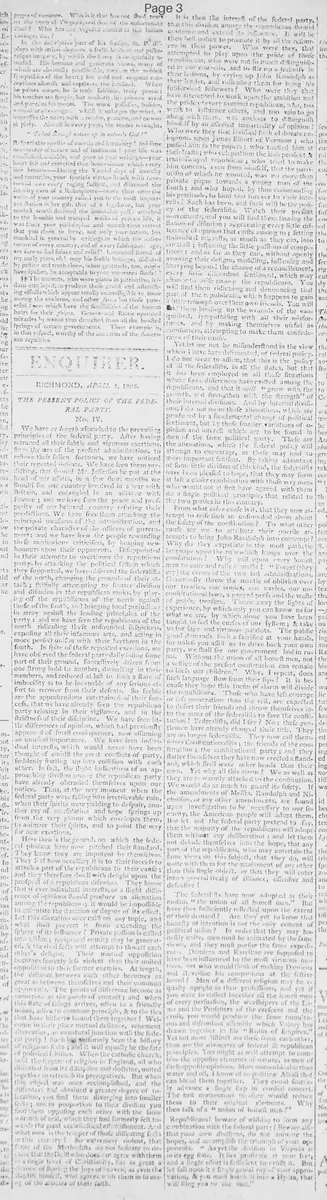
ENQUIRER.
RICHMOND, APRIL 4, 1805.
THE PRESENT POLICY OF THE FEDERAL PARTY.
No. IV.
We have at length ascended to the prevailing principles of the federal party. After having retraced all their subtle and vigorous exertions, since the era of the present administration, to restore their fallen fortunes, we have noticed their repeated defeats. We have seen them predicting, that should Mr. Jefferson be put at the head of our affairs, in a few short months we should see our country involved in a war with Britain, and entangled in an alliance with France; and we have seen the peace and prosperity of our beloved country refuting their predictions. We have seen them attacking the principal measures of the administration, and the private character of the officers of government: and we have seen the people rewarding these meritorious criticisms, by heaping new honours upon their opponents. Disappointed in their attempts to overthrow the republican party, by attacking the political system which they supported, we have observed the federalists of the north, changing the grounds of their attack: artfully attempting to scatter division and disunion in the republican ranks, by playing off the republicans of the north against those of the south, and bringing local prejudices in array against the leading principles of the party: and we have seen the republicans of the north ridiculing these unfounded suspicions, exposing all their infamous arts, and acting in more perfect unison with their brethren in the south. In spite of these repeated exertions, we have observed the federal party daily losing some part of their ground, successively driven from one strong hold to another, dwindling in their numbers, and reduced at last to such a state of imbecility as to be incapable of any serious effort to recover from their defeats. So feeble are the apprehensions entertained of their success, that we have already seen the republican party relaxing in their vigilance, and in the strictness of their discipline. We have seen little differences of opinion, which had previously appeared of small consequence, now assuming an unusual importance. We have seen individual interests, which would never have been thought of amidst the great conflicts of party, suddenly starting up into collision with each other. In fact, the slight indications of an approaching division among the republican party have already obtruded themselves upon our notice. Thus, at the very moment when the federal party were falling into irretrievable ruin, when their spirits were yielding to despair, another ray of consolation and hope springs up from the very gloom which envelopes them, to animate their spirits, and to point the way for new exertions.
Here then is the ground, on which the federal phalanx have now pitched their standard. They know they are impotent by themselves. They see how necessary it is to their success to attach a part of the republicans to their cause; and they therefore dwell with delight upon the prospect of a republican disunion. They know that if ever individual interests, or a slight difference of opinions should produce an alienation among the republicans; it would be impossible to calculate the duration or degree of its effect. Let this alienation once exist on any topic, and what shall prevent it from extending the sphere of its influence? Private passion is called into action: reciprocal enmity may be generated, & their rivals will attempt to thwart each other's designs. Their mutual opposition becomes scarcely less violent than their united opposition to their former enemies. At length, the distance between each other becomes as great as between themselves and their common opponents. The points of difference become as numerous as the points of contact; and when this state of things arrives, adieu to a friendly union, adieu to common principle, & to the ties that have hitherto bound them together! Welcome in their place mutual defiance, vehement altercation, an unnatural junction with the federal party! such has uniformly been the history of religious sects; and it will equally be the fate of political schisms. When the catholic church, held the centre of religion in England, all who dissented from its discipline and doctrine, united together to retrench its prerogatives. But when this object was once accomplished, and the dissenters had obtained a greater degree of toleration, you find them diverging into smaller sects; and in proportion to their division you find them opposing each other with the same warlike, and of zeal, which they had formerly felt towards the great ecclesiastical establishment. And what now is the temper of those dissenting sects in this country? So extremely violent, that some of the Methodists do not hesitate to declare that the Dissenter who does not agree with them in a single tenet of Christianity, has as great a chance of sharing the joys of heaven, as even the Baptist himself, who agrees with them in so many of the doctrines of their faith.
It is then the interest of the federal party, that this division among the republicans should continue and extend its influence. It will be then best policy to promote it by all the resources in their power. Who were they, that attempted to play upon the pride of those republicans, who were not so much distinguished in our councils, and to stir up a jealousy in their bosoms, by crying up John Randolph as their leader, and ridiculing them for being his subservient followers? Who were they that have attempted to work upon the ambition and the pride of every nominal republican, who, too weak to influence others, and too vain to go along with them, was anxious to distinguish himself by an affected impartiality of opinion? Who were they that wished such elaborate eulogiums upon James Elliott of Vermont: who puffed him in the papers; who toasted him at their feasts; who vended him the independent & truth-sworn republican: who tried to make him conceal, even from himself, that he vaunted patriotism of which he vaunted, was no more than private pique towards a young man of the south: and who hoped, by thus commanding his gratitude, to bind him for ever to their interests? Such has been, and such will be the policy of the federalists. Watch their present movements, and you will find them fanning the flames of disunion; aggravating every little difference of opinion that exists among us: setting individual interests, as much as they can, into contrast: inflaming the little passions of competitors: and as far as they can, without openly avowing their designs, meddling, inflaming and hurrying beyond the chance of a reconciliation, every little discordant sentiment, which may chance to arise among the republicans. You will find them ridiculing and denouncing that part of the republicans, which happens to gain a little triumph over their own friends. You will then find them binding up the wounds of the vanquished, sympathising with all their misfortunes, and by making themselves useful as comforters, attempting to make them confederates of their cause.
Yet let me not be misunderstood in the view which I have here delineated, of federal policy. I do not mean to affirm, that this is the policy of all the federalists, in all the states, but that it has been employed in all those situations where some differences have existed among the republicans, and that it will "grow with the growth, and strengthen with the strength" of these internal divisions. And by internal divisions, I do not mean those alienations, which are produced by a fundamental change of political sentiment, but by those smaller variations of opinion and interest which are to be found in men of the same political party. These are the alienations, which the federal policy will attempt to encourage, as these may lead to more important schisms. By taking advantage of some little division of this kind, the federalists have been pleased to hope, that they may form at last a closer combination with those very men, who would not at first have agreed with them on a single political principle, that related to the two parties in this country.
From what other cause is it, that they now attempt to raise such an unfounded alarm about the safety of the constitution? To what other cause are we to attribute their puerile attempts to bring John Randolph into contempt? Why do they expatiate in the most pathetic language upon the ruin which hangs over the constitution? Why call upon every honest man to unite and rally round it! "Forget (they cry) the errors of the two last administrations. Generously throw the mantle of oblivion over our treaties, our armies, our navies, our unconstitutional laws, a gagged press and the waste of public treasure. Throw away the lights of experience, by which only you can know us for what we are, by which alone you have been taught to feel the curses of our system: & take us for sage and virtuous patriots. The public good demands such a sacrifice at your hands, for unless you assist us to drive back your own party, we shall see our government laid in ruins. "Without the union of all honest men, not a vestige of the present constitution can remain to bless our children." Why, I repeat, does such language flow from their lips? It is because they hope this tocsin of alarm will divide the republicans. Those who have less courage or less penetration than the rest, are expected to desert their friends and throw themselves into the arms of the federalists to save the constitution! Federalists, did I say? No: these gentlemen have already changed their title. They are no longer federalists. They now call themselves Constitutionalists; the friends of the constitution: the constitutional party: and they flatter themselves they have now erected a standard, which shall wave over heads than their own. Yet why all this alarm? We as well as they are as warmly attached to the constitution. We would do as much to guard its safety. If the amendments of Messrs. Randolph and Nicholson, or any other amendments, are found upon investigation to be necessary to our security, the American people will adopt them. But let not the federal party pretend to say, that the majority of the republicans will adopt them without any deliberation: and let them not delude themselves into the hope, that any part of the republicans, who may entertain the same views on this subject, that "they do, will unite with them for the attainment of any other than this single object, or that they will enter into general treaty of alliance, offensive and defensive!
The federalists have now adopted as their motto, "the union of all honest men." But have they sufficiently reflected upon the extent of their demand? Are they yet to know that honesty of intention is not the only cement of political union? In order that they may honestly unite, men must be animated by the same view, and they must pursue the same expedient. Damiens and Ravaillac are supposed to have been influenced by the most virtuous motives, yet who would think of making Damiens and Ravaillac his companions at the festive board? Men of a different religion may be equally upright in their professions, and yet if you were to collect together all the honest men of every persuasion, the worshipers of the La- ma and the Proselytes of the crescent and the cross, you would produce the same tumultuous and discordant assembly which Volney has drawn together in his "Ruins of Empires."
Yet not more distinct are these from each other, than are the advocates of federal & republican principles. You might as well attempt to combine the opposite elements of nature, as men of such opposite opinions. More uncombivable than water and oil, I know of no political Alkali that can blend them together. They could scarcely advance a single step in cordial concert. The first momentous measure would reduce them to their original elements. Why then talk of a "union of honest men?"
Republicans! beware of willing to form any combination with the federal party? Beware also that your own divisions, do not animate the hopes, and accomplish the triumph of your opponents. "As yet the division in Virginia is in its egg state. It lies prostrate your feet, and a single effort is sufficient to crush it. But let fall upon it a single genial ray of your approbation, & you must hatch it into a Hydra, that will sing you to the soul."
RICHMOND, APRIL 4, 1805.
THE PRESENT POLICY OF THE FEDERAL PARTY.
No. IV.
We have at length ascended to the prevailing principles of the federal party. After having retraced all their subtle and vigorous exertions, since the era of the present administration, to restore their fallen fortunes, we have noticed their repeated defeats. We have seen them predicting, that should Mr. Jefferson be put at the head of our affairs, in a few short months we should see our country involved in a war with Britain, and entangled in an alliance with France; and we have seen the peace and prosperity of our beloved country refuting their predictions. We have seen them attacking the principal measures of the administration, and the private character of the officers of government: and we have seen the people rewarding these meritorious criticisms, by heaping new honours upon their opponents. Disappointed in their attempts to overthrow the republican party, by attacking the political system which they supported, we have observed the federalists of the north, changing the grounds of their attack: artfully attempting to scatter division and disunion in the republican ranks, by playing off the republicans of the north against those of the south, and bringing local prejudices in array against the leading principles of the party: and we have seen the republicans of the north ridiculing these unfounded suspicions, exposing all their infamous arts, and acting in more perfect unison with their brethren in the south. In spite of these repeated exertions, we have observed the federal party daily losing some part of their ground, successively driven from one strong hold to another, dwindling in their numbers, and reduced at last to such a state of imbecility as to be incapable of any serious effort to recover from their defeats. So feeble are the apprehensions entertained of their success, that we have already seen the republican party relaxing in their vigilance, and in the strictness of their discipline. We have seen little differences of opinion, which had previously appeared of small consequence, now assuming an unusual importance. We have seen individual interests, which would never have been thought of amidst the great conflicts of party, suddenly starting up into collision with each other. In fact, the slight indications of an approaching division among the republican party have already obtruded themselves upon our notice. Thus, at the very moment when the federal party were falling into irretrievable ruin, when their spirits were yielding to despair, another ray of consolation and hope springs up from the very gloom which envelopes them, to animate their spirits, and to point the way for new exertions.
Here then is the ground, on which the federal phalanx have now pitched their standard. They know they are impotent by themselves. They see how necessary it is to their success to attach a part of the republicans to their cause; and they therefore dwell with delight upon the prospect of a republican disunion. They know that if ever individual interests, or a slight difference of opinions should produce an alienation among the republicans; it would be impossible to calculate the duration or degree of its effect. Let this alienation once exist on any topic, and what shall prevent it from extending the sphere of its influence? Private passion is called into action: reciprocal enmity may be generated, & their rivals will attempt to thwart each other's designs. Their mutual opposition becomes scarcely less violent than their united opposition to their former enemies. At length, the distance between each other becomes as great as between themselves and their common opponents. The points of difference become as numerous as the points of contact; and when this state of things arrives, adieu to a friendly union, adieu to common principle, & to the ties that have hitherto bound them together! Welcome in their place mutual defiance, vehement altercation, an unnatural junction with the federal party! such has uniformly been the history of religious sects; and it will equally be the fate of political schisms. When the catholic church, held the centre of religion in England, all who dissented from its discipline and doctrine, united together to retrench its prerogatives. But when this object was once accomplished, and the dissenters had obtained a greater degree of toleration, you find them diverging into smaller sects; and in proportion to their division you find them opposing each other with the same warlike, and of zeal, which they had formerly felt towards the great ecclesiastical establishment. And what now is the temper of those dissenting sects in this country? So extremely violent, that some of the Methodists do not hesitate to declare that the Dissenter who does not agree with them in a single tenet of Christianity, has as great a chance of sharing the joys of heaven, as even the Baptist himself, who agrees with them in so many of the doctrines of their faith.
It is then the interest of the federal party, that this division among the republicans should continue and extend its influence. It will be then best policy to promote it by all the resources in their power. Who were they, that attempted to play upon the pride of those republicans, who were not so much distinguished in our councils, and to stir up a jealousy in their bosoms, by crying up John Randolph as their leader, and ridiculing them for being his subservient followers? Who were they that have attempted to work upon the ambition and the pride of every nominal republican, who, too weak to influence others, and too vain to go along with them, was anxious to distinguish himself by an affected impartiality of opinion? Who were they that wished such elaborate eulogiums upon James Elliott of Vermont: who puffed him in the papers; who toasted him at their feasts; who vended him the independent & truth-sworn republican: who tried to make him conceal, even from himself, that he vaunted patriotism of which he vaunted, was no more than private pique towards a young man of the south: and who hoped, by thus commanding his gratitude, to bind him for ever to their interests? Such has been, and such will be the policy of the federalists. Watch their present movements, and you will find them fanning the flames of disunion; aggravating every little difference of opinion that exists among us: setting individual interests, as much as they can, into contrast: inflaming the little passions of competitors: and as far as they can, without openly avowing their designs, meddling, inflaming and hurrying beyond the chance of a reconciliation, every little discordant sentiment, which may chance to arise among the republicans. You will find them ridiculing and denouncing that part of the republicans, which happens to gain a little triumph over their own friends. You will then find them binding up the wounds of the vanquished, sympathising with all their misfortunes, and by making themselves useful as comforters, attempting to make them confederates of their cause.
Yet let me not be misunderstood in the view which I have here delineated, of federal policy. I do not mean to affirm, that this is the policy of all the federalists, in all the states, but that it has been employed in all those situations where some differences have existed among the republicans, and that it will "grow with the growth, and strengthen with the strength" of these internal divisions. And by internal divisions, I do not mean those alienations, which are produced by a fundamental change of political sentiment, but by those smaller variations of opinion and interest which are to be found in men of the same political party. These are the alienations, which the federal policy will attempt to encourage, as these may lead to more important schisms. By taking advantage of some little division of this kind, the federalists have been pleased to hope, that they may form at last a closer combination with those very men, who would not at first have agreed with them on a single political principle, that related to the two parties in this country.
From what other cause is it, that they now attempt to raise such an unfounded alarm about the safety of the constitution? To what other cause are we to attribute their puerile attempts to bring John Randolph into contempt? Why do they expatiate in the most pathetic language upon the ruin which hangs over the constitution? Why call upon every honest man to unite and rally round it! "Forget (they cry) the errors of the two last administrations. Generously throw the mantle of oblivion over our treaties, our armies, our navies, our unconstitutional laws, a gagged press and the waste of public treasure. Throw away the lights of experience, by which only you can know us for what we are, by which alone you have been taught to feel the curses of our system: & take us for sage and virtuous patriots. The public good demands such a sacrifice at your hands, for unless you assist us to drive back your own party, we shall see our government laid in ruins. "Without the union of all honest men, not a vestige of the present constitution can remain to bless our children." Why, I repeat, does such language flow from their lips? It is because they hope this tocsin of alarm will divide the republicans. Those who have less courage or less penetration than the rest, are expected to desert their friends and throw themselves into the arms of the federalists to save the constitution! Federalists, did I say? No: these gentlemen have already changed their title. They are no longer federalists. They now call themselves Constitutionalists; the friends of the constitution: the constitutional party: and they flatter themselves they have now erected a standard, which shall wave over heads than their own. Yet why all this alarm? We as well as they are as warmly attached to the constitution. We would do as much to guard its safety. If the amendments of Messrs. Randolph and Nicholson, or any other amendments, are found upon investigation to be necessary to our security, the American people will adopt them. But let not the federal party pretend to say, that the majority of the republicans will adopt them without any deliberation: and let them not delude themselves into the hope, that any part of the republicans, who may entertain the same views on this subject, that "they do, will unite with them for the attainment of any other than this single object, or that they will enter into general treaty of alliance, offensive and defensive!
The federalists have now adopted as their motto, "the union of all honest men." But have they sufficiently reflected upon the extent of their demand? Are they yet to know that honesty of intention is not the only cement of political union? In order that they may honestly unite, men must be animated by the same view, and they must pursue the same expedient. Damiens and Ravaillac are supposed to have been influenced by the most virtuous motives, yet who would think of making Damiens and Ravaillac his companions at the festive board? Men of a different religion may be equally upright in their professions, and yet if you were to collect together all the honest men of every persuasion, the worshipers of the La- ma and the Proselytes of the crescent and the cross, you would produce the same tumultuous and discordant assembly which Volney has drawn together in his "Ruins of Empires."
Yet not more distinct are these from each other, than are the advocates of federal & republican principles. You might as well attempt to combine the opposite elements of nature, as men of such opposite opinions. More uncombivable than water and oil, I know of no political Alkali that can blend them together. They could scarcely advance a single step in cordial concert. The first momentous measure would reduce them to their original elements. Why then talk of a "union of honest men?"
Republicans! beware of willing to form any combination with the federal party? Beware also that your own divisions, do not animate the hopes, and accomplish the triumph of your opponents. "As yet the division in Virginia is in its egg state. It lies prostrate your feet, and a single effort is sufficient to crush it. But let fall upon it a single genial ray of your approbation, & you must hatch it into a Hydra, that will sing you to the soul."
What sub-type of article is it?
Partisan Politics
Constitutional
What keywords are associated?
Federal Party Policy
Republican Disunion
Political Intrigue
Constitutional Alarm
Party Divisions
Jefferson Administration
John Randolph
What entities or persons were involved?
Federal Party
Republican Party
Mr. Jefferson
John Randolph
James Elliott Of Vermont
Messrs. Randolph And Nicholson
Editorial Details
Primary Topic
Federal Party's Exploitation Of Republican Divisions To Regain Power
Stance / Tone
Pro Republican Warning Against Federal Tactics And Internal Disunion
Key Figures
Federal Party
Republican Party
Mr. Jefferson
John Randolph
James Elliott Of Vermont
Messrs. Randolph And Nicholson
Key Arguments
Federalists' Predictions Of War Under Jefferson Proven False By Peace And Prosperity
Federalists Attack Administration Measures And Characters But Face Public Rejection
Federalists Shift To Sowing Regional Divisions Among Republicans, Which Fail
Federalists Exploit Minor Republican Differences To Promote Disunion
Analogy To Religious Sects Shows Divisions Lead To Greater Conflicts
Federalists Raise False Constitutional Alarms To Lure Republicans
Republicans Equally Attached To Constitution; Amendments Possible But Not Alliance With Federalists
Union Of Honest Men Impossible Due To Irreconcilable Principles
Warning To Republicans To Crush Internal Divisions In Virginia