Thank you for visiting SNEWPapers!
Sign up free
Vermont Phœnix
Brattleboro, Bellows Falls, Ludlow, Windham County, Windsor County, Vermont
What is this article about?
Detailed report of U.S. congressional proceedings from January 30 to February 3, including Senate and House debates on currency payments, public land preemption rights, abolition and anti-Texas annexation petitions, Indian appropriations and removal policies, army organization, and other bills. Key figures include Clay, Adams, Webster, Calhoun, Cushing, and Everett. Various motions passed, failed, or were tabled.
Merged-components note: Continuation of congressional proceedings report across sequential reading orders.
Clipping
OCR Quality
Full Text
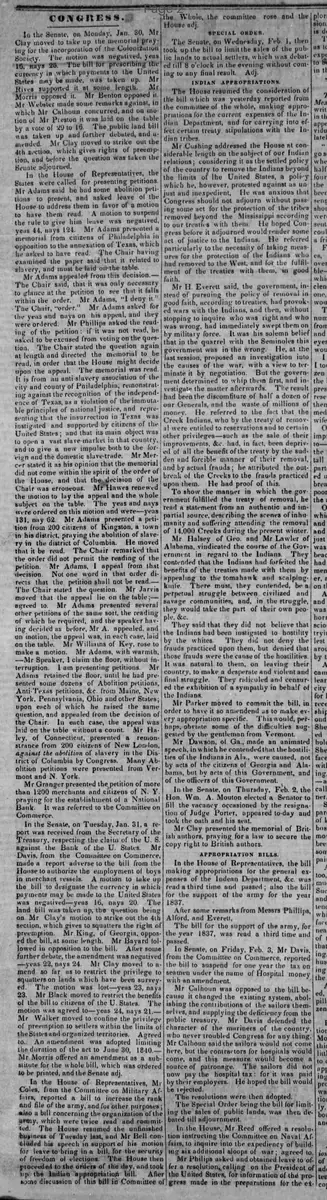
In the Senate, on Monday, Jan. 30, Mr. Clay moved to take up the memorial praying for the incorporation of the Colonization Society. The motion was negatived, yeas 16, nays 26. The bill for prescribing the currency in which payments to the United States may be made, was taken up. Mr. Rives supported it at some length. Mr. Morris opposed it. Mr. Benton opposed it. Mr. Webster made some remarks against it, in which Mr. Calhoun concurred, and on motion of Mr. Preston it was laid on the table by a vote of 29 to 16. The public land bill was taken up and further debated, and amended. Mr. Clay moved to strike out the 4th section, which gives rights of preemption, and before the question was taken the Senate adjourned.
In the House of Representatives, the States were called for presenting petitions. Mr. Adams said he had some abolition petitions to present, and asked leave of the House to address them in favor of a motion to have them read. A motion to suspend the rule to give him leave was negatived, yeas 44, nays 124. Mr. Adams presented a memorial from citizens of Philadelphia in opposition to the annexation of Texas, which he asked to have read. The Chair having examined the paper said that it related to slavery, and must be laid on the table. Mr. Adams appealed from this decision. The Chair said, that it was only necessary to glance at the petition to see that it falls within the order. Mr. Adams, "I deny it." The Chair, "order." Mr. Adams asked for the yeas and nays on his appeal, and they were ordered. Mr. Phillips asked the reading of the petition: if it was not read, he asked to be excused from voting on the question. The Chair stated the question again at length and directed the memorial to be read, in order that the House might decide upon the appeal. The memorial was read. It is from an anti-slavery association of the city and county of Philadelphia, remonstrating against the recognition of the independence of Texas, as a violation of the immutable principles of national justice, and representing that the insurrection in Texas was instigated and supported by citizens of the United States; and that its main object was to open a vast slave-market in that country, and to give a new impulse both to the foreign and the domestic slave-trade. Mr. Mercer stated it as his opinion that the memorial did not come within the spirit of the order of the House, and that the decision of the Chair was erroneous. Mr. Hawes renewed the motion to lay the appeal and the whole subject on the table. The yeas and nays were ordered on this motion and were—yeas 131, nay 62. Mr. Adams presented a petition from 200 citizens of Kingston, a town in his district, praying the abolition of slavery in the District of Columbia. He moved that it be read. The Chair remarked that the order did not permit the reading of the petition. Mr. Adams, I appeal from that decision. Not one word in that order directs that the petition shall not be read. The Chair stated the question. Mr. Jarvis moved that the appeal lie on the table;—agreed to. Mr. Adams presented several other petitions of the same sort, the reading of which he required, and the Speaker having decided as before, Mr. A. appealed, and on motion, the appeal was, in each case, laid on the table. Mr. Williams of Ky., rose to make a motion. Mr. Adams, with warmth,—Mr. Speaker. I claim the floor, without interruption. I am presenting petitions. Mr. Adams retained the floor, until he had presented some dozens of Abolition petitions, Anti-Texas petitions, &c. from Maine, New York, Pennsylvania, Ohio and other States; upon each of which he raised the same question, and appealed from the decision of the Chair. In each case, the appeal was laid on the table without a count. Mr. Haley, of Connecticut, presented a remonstrance from 200 citizens of New London, against the abolition of slavery in the District of Columbia by Congress. Many Abolition petitions were presented from Vermont and N. York. Mr. Granger presented the petition of more than 1200 merchants and citizens of N. Y. praying for the establishment of a National Bank. It was referred to the Committee on Commerce.
In the Senate, on Tuesday, Jan. 31, a report was received from the Secretary of the Treasury, respecting the claim of the U. S. against the Bank of the U. States. Mr. Davis, from the Committee on Commerce made a report adverse to the bill from the House to authorize the employment of boys in merchant vessels. A motion to take up the bill to designate the currency in which payments may be made to the United States was negatived—yeas 16, nays 20. The land bill was taken up, the question being on Mr. Clay's motion to strike out the 4th section, which gives to squatters the right of preemption. Mr. King, of Georgia, opposed the bill, at some length. Mr. Bayard followed in opposition to the bill. After some further debate, the amendment was negatived—yeas 22, nays 24. Mr. Clay moved to amend so far as to restrict the privilege to squatters on lands which have been surveyed. The motion was lost—yeas 23, nays 23. Mr. Black moved to restrict the benefits of the bill to citizens of the U. States. The motion was agreed to—yeas 24, nays 21. Mr. Walker moved to confine the privilege of preemption to settlers within the limits of the States and organized territories. Agreed to. An amendment was adopted limiting the duration of the act to June 30, 1840. Mr. Morris offered an amendment as a substitute for the whole bill, which was ordered to be printed, and the Senate adj.
In the House of Representatives, Mr. Coles, from the Committee on Military Affairs, reported a bill to increase the rank and file of the army, and for other purposes; also a bill concerning the organization of the army, which were twice read and committed. The House resumed the unfinished business of Tuesday last, and Mr. Bell concluded his speech in support of his motion for leave to bring in a bill, for the security of freedom of elections. The House then proceeded to the orders of the day, and took up the Indian appropriation bill. After some discussion of this bill in Committee of the Whole, the committee rose and the House adjourned.
SPECIAL ORDER.
The Senate, on Wednesday, Feb. 1, then took up the bill to limit the sales of the public lands to actual settlers, which was debated till 8 o'clock in the evening without coming to any final result. Adj.
INDIAN APPROPRIATIONS.
The House resumed the consideration of the bill which was yesterday reported from the committee of the whole, making appropriations for the current expenses of the Indian Department, and for carrying into effect certain treaty stipulations with the Indian tribes. Mr. Cushing addressed the House at considerable length on the subject of our Indian relations; considering it as the settled policy of the country to remove the Indians beyond the limits of the United States, a policy which he, however, protested against as unjust and inexpedient. He was anxious that Congress should not adjourn without passing some act for the protection of the tribes removed beyond the Mississippi according to our treaties with them. He hoped Congress before it adjourned would render some act of justice to the Indians. He referred particularly to the necessity of taking measures for the protection of the Indians who had removed to the West, and for the fulfilment of the treaties with them, in good faith.
Mr. H. Everett said, the government, instead of pursuing the policy of removal in good faith, according to treaties, had provoked wars with the Indians, and then, without stopping to inquire who was right and who was wrong, had immediately swept them on by military force. It was his solemn belief that in the quarrel with the Seminoles this government was in the wrong. He, at the last session, proposed an investigation into the causes of the war, with a view to terminate it by negotiation. But the government determined to whip them first, and investigate the matter afterwards. The result had been the discomfiture of half a dozen of our Generals, and the waste of millions of money. He referred to the fact that the Creek Indians, who by the treaty of removal were entitled to reservations and to certain other privileges—such as the sale of their improvements, &c. had, in fact, been deprived of all the benefit of the treaty by the sudden and forcible manner of their removal, and by actual frauds: he attributed the outbreak of the Creeks to the frauds practiced upon them. He had proof of this. To show the manner in which the government fulfilled the treaty of removal, he read a statement from an authentic and impartial source, describing the scenes of inhumanity and suffering attending the removal of 14,000 Creeks during the present winter. Mr. Halsey of Geo., and Mr. Lawler of Alabama, vindicated the course of the Government in regard to the Indians. They contended that the Indians had forfeited the benefits of the treaties made with them by appealing to the tomahawk and scalping-knife. There must, they contended, be a perpetual struggle between civilized and savage communities, and, in the struggle they would take the part of their own people, &c. They said that they did not believe that the Indians had been instigated to hostility by the whites. They did not deny the frauds practiced upon them, but denied that those frauds were the cause of the hostilities. It was natural to them, on leaving their country, to make a desperate and violent and final struggle. They ridiculed and censured the exhibition of a sympathy in behalf of the Indians. Mr. Parker moved to commit the bill, in order to have it so amended as to make every appropriation specific. This would, perhaps, obviate some of the difficulties suggested by the gentleman from Vermont. Mr. Dawson, of Ga., made an animated speech, in which he contended that the hostilities of the Indians in Ala., were caused, not by acts of the citizens of Georgia and Alabama, but by acts of this Government, and of the officers of this Government.
In the Senate, on Thursday, Feb. 2, the Hon. Wm. A. Mouton elected a Senator to fill the vacancy occasioned by the resignation of Judge Porter, appeared to-day and took the oath and his seat. Mr. Clay presented the memorial of British authors, praying for a law to secure the copy right to British authors.
APPROPRIATION BILLS.
In the House of Representatives, the bill making appropriations for the general expenses of the Indian Department, &c. was read a third time and passed; also the bill for the support of the army for the year 1837. After some remarks from Messrs. Phillips, Alford, and Everett, The bill for the support of the army, for the year 1837, was read a third time and passed.
In Senate, on Friday, Feb. 3. Mr. Davis, from the Committee on Commerce, reported the bill to suspend for one year the tax on seamen under the name of Hospital money with an amendment. Mr. Calhoun was opposed to the bill because it changed the existing system, abolishing the contributions of the sailors themselves, and supplying the deficiency from the public treasury. Mr. Davis defended the character of the mariners of the country, who never troubled Congress for any thing. Mr. Calhoun said the sailors would not come here, but the contractors for hospitals would come, and this measure would become a source of patronage. The sailors did not now pay the hospital tax: for it was paid by their employers. He hoped the bill would be rejected. The resolutions were then adopted. The Special Order being the bill for limiting the sales of public lands, was then debated till adjournment.
In the House, Mr. Reed offered a resolution instructing the Committee on Naval Affairs, to inquire into the expediency of building six additional sloops of war; agreed to. Mr. Phillips asked and obtained leave to offer a resolution, calling on the President of the United States, for information of the progress made in the preparations for the exploring expedition authorized at the last session, and the object to which said expedition is destined.
What sub-type of article is it?
What keywords are associated?
What entities or persons were involved?
Domestic News Details
Event Date
Jan. 30 To Feb. 3
Key Persons
Outcome
various bills debated and amended; currency bill laid on table (29-16); land bill amendments passed or failed with votes like 24-21; abolition and anti-texas petitions laid on table (e.g., 131-62); indian appropriations bill passed; army support bill passed; motions on naval and exploring expedition agreed to.
Event Details
U.S. Senate and House sessions debated bills on currency payments, public land preemption for settlers, army organization and support, seamen tax suspension, and naval expansions. House handled numerous abolition petitions and anti-Texas annexation memorials from states like Pennsylvania and Massachusetts, mostly tabled under slavery gag rule. Extended debate on Indian appropriations criticized removal policy, Seminole and Creek conflicts, treaty frauds, and called for protections; bill passed. Senator Mouton seated. Petitions for national bank and copyrights presented.