Thank you for visiting SNEWPapers!
Sign up free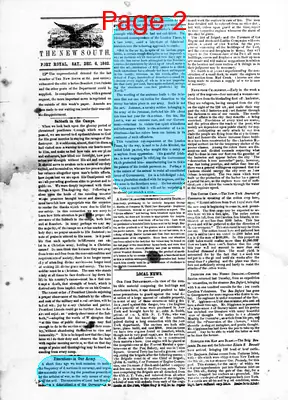
Editorial
December 6, 1862
The New South
Beaufort, Port Royal, Beaufort County, South Carolina
What is this article about?
Editorial supports stricter enforcement of penalties for desertion in the Union army, citing the execution of Lunt and correcting falsehoods by London Times correspondent John Mitchel about executions in Northern vs. Southern armies.
Clipping
OCR Quality
95%
Excellent
Full Text
Executions in Our Army.
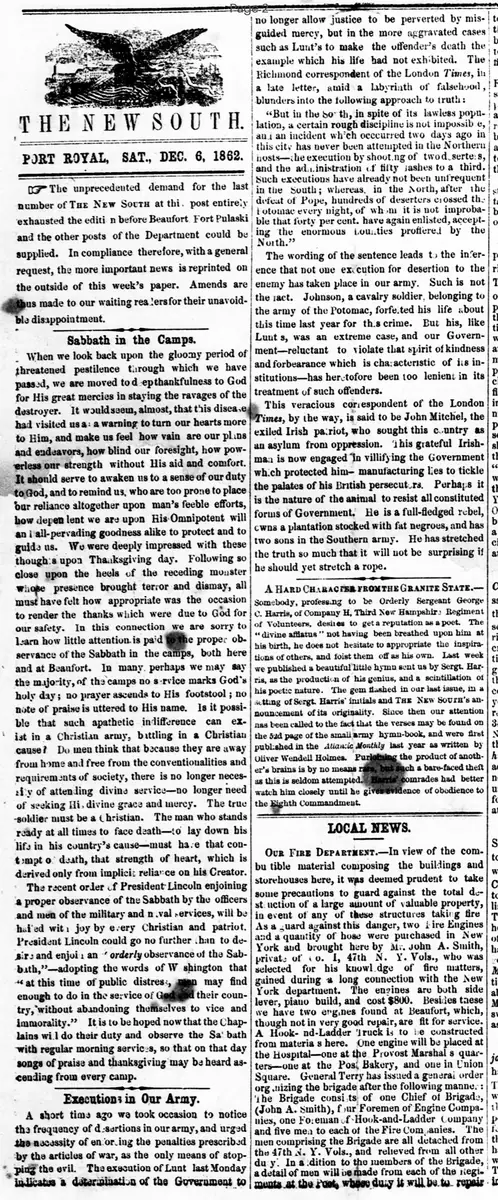
A short time ago we took occasion to notice the frequency of desertions in our army, and urged the necessity of enforcing the penalties prescribed by the articles of war, as the only means of stopping the evil. The execution of Lunt last Monday indicates a determination of the Government to no longer allow justice to be perverted by misguided mercy, but in the more aggravated cases such as Lunt's to make the offender's death the example which his life had not exhibited. The Richmond correspondent of the London Times, in a late letter, amid a labyrinth of falsehood, blunders into the following approach to truth: 'But in the South, in spite of its lawless population, a certain rough discipline is not impossible, and an incident which occurred two days ago in this city has never been attempted in the Northern posts—the execution by shooting of two deserters, and the administration of fifty lashes to a third. Such executions have already not been unfrequent in the South; whereas, in the North, after the defeat of Pope, hundreds of deserters crossed the Potomac every night, of whom it is not improbable that forty per cent. have again enlisted, accepting the enormous bounties proffered by the North.'
The wording of the sentence leads to the inference that not one execution for desertion to the enemy has taken place in our army. Such is not the fact. Johnson, a cavalry soldier, belonging to the army of the Potomac, forfeited his life about this time last year for this crime. But his, like Lunt's, was an extreme case, and our Government—reluctant to violate that spirit of kindness and forbearance which is characteristic of its institutions—has heretofore been too lenient in its treatment of such offenders.
This veracious correspondent of the London Times, by the way, is said to be John Mitchel, the exiled Irish patriot, who sought this country as an asylum from oppression. This grateful Irishman is now engaged in vilifying the Government which protected him—manufacturing lies to tickle the palates of his British persecutors. Perhaps it is the nature of the animal to resist all constituted forms of Government. He is a full-fledged rebel, owns a plantation stocked with fat negroes, and has two sons in the Southern army. He has stretched the truth so much that it will not be surprising if he should yet stretch a rope.
A short time ago we took occasion to notice the frequency of desertions in our army, and urged the necessity of enforcing the penalties prescribed by the articles of war, as the only means of stopping the evil. The execution of Lunt last Monday indicates a determination of the Government to no longer allow justice to be perverted by misguided mercy, but in the more aggravated cases such as Lunt's to make the offender's death the example which his life had not exhibited. The Richmond correspondent of the London Times, in a late letter, amid a labyrinth of falsehood, blunders into the following approach to truth: 'But in the South, in spite of its lawless population, a certain rough discipline is not impossible, and an incident which occurred two days ago in this city has never been attempted in the Northern posts—the execution by shooting of two deserters, and the administration of fifty lashes to a third. Such executions have already not been unfrequent in the South; whereas, in the North, after the defeat of Pope, hundreds of deserters crossed the Potomac every night, of whom it is not improbable that forty per cent. have again enlisted, accepting the enormous bounties proffered by the North.'
The wording of the sentence leads to the inference that not one execution for desertion to the enemy has taken place in our army. Such is not the fact. Johnson, a cavalry soldier, belonging to the army of the Potomac, forfeited his life about this time last year for this crime. But his, like Lunt's, was an extreme case, and our Government—reluctant to violate that spirit of kindness and forbearance which is characteristic of its institutions—has heretofore been too lenient in its treatment of such offenders.
This veracious correspondent of the London Times, by the way, is said to be John Mitchel, the exiled Irish patriot, who sought this country as an asylum from oppression. This grateful Irishman is now engaged in vilifying the Government which protected him—manufacturing lies to tickle the palates of his British persecutors. Perhaps it is the nature of the animal to resist all constituted forms of Government. He is a full-fledged rebel, owns a plantation stocked with fat negroes, and has two sons in the Southern army. He has stretched the truth so much that it will not be surprising if he should yet stretch a rope.
What sub-type of article is it?
Military Affairs
Crime Or Punishment
What keywords are associated?
Desertion
Executions
Union Army
Military Discipline
John Mitchel
London Times
What entities or persons were involved?
Lunt
Johnson
John Mitchel
London Times
Union Government
Southern Army
Editorial Details
Primary Topic
Executions For Desertion In The Union Army
Stance / Tone
Supportive Of Stricter Military Discipline And Critical Of Leniency And Foreign Correspondents
Key Figures
Lunt
Johnson
John Mitchel
London Times
Union Government
Southern Army
Key Arguments
Frequency Of Desertions Requires Enforcement Of War Penalties
Execution Of Lunt Shows Government's Determination Against Misguided Mercy
Richmond Correspondent's Claims About No Northern Executions Are False
Previous Execution Of Johnson For Desertion To Enemy
Government Has Been Too Lenient Historically
John Mitchel Vilifies The Protecting Government And Fabricates Lies