Thank you for visiting SNEWPapers!
Sign up free
The National Intelligencer And Washington Advertiser
Washington, District Of Columbia
What is this article about?
Proceedings of the U.S. House of Representatives on January 23, covering petitions for patents, mail route changes, revolutionary war pensions, impressed American seamen (1,538 named), foreign shipping duties, bills on capitol construction, Spanish treaty, navy appropriation, public buildings report, and a resolution on protecting commerce and seamen from British impressment and trade restrictions.
Clipping
OCR Quality
Full Text
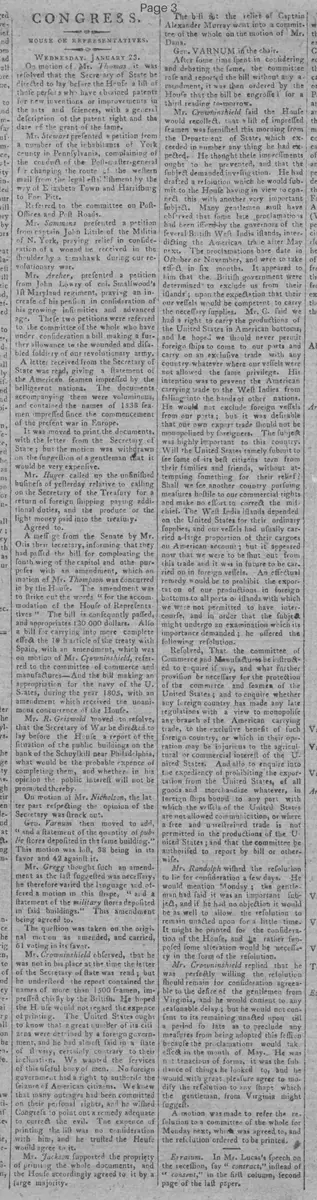
HOUSE OF REPRESENTATIVES.
WEDNESDAY, JANUARY 23.
On motion of Mr. Thomas, it was resolved that the Secretary of State be directed to lay before the House a list of those persons who have obtained patents for new inventions or improvements in the arts and sciences, with a general description of the patent right and the date of the grant of the same.
Mr. Stewart presented a petition from a number of the inhabitants of York county in Pennsylvania, complaining of the conduct of the Post-master-general for changing the route of the western mail from the legal establishment by the way of Elizabeth Town and Harrisburg to Fort Pitt. Referred to the committee on Post-Offices and Post Roads.
Mr. Sammons presented a petition from captain John Little of the Militia of N. York, praying relief in consideration of a wound he received in the shoulder by a tomahawk during our revolutionary war.
Mr. Archer, presented a petition from John Lowry of col. Smallwood's 1st Maryland regiment, praying an increase of his pension in consideration of his growing infirmities and advanced age. These two petitions were referred to the committee of the whole who have under consideration a bill making a further allowance to the wounded and disabled soldiery of our revolutionary army.
A letter received from the Secretary of State was read, giving a statement of the American seamen impressed by the belligerent nations. The documents accompanying them were voluminous, and contained the names of 1538 seamen impressed since the commencement of the present war in Europe.
It was moved to print the documents, with the letter from the Secretary of State; but the motion was withdrawn on the suggestion of a gentleman that it would be very expensive.
Mr. Huger called up the unfinished business of yesterday relative to calling on the Secretary of the Treasury for a return of foreign shipping paying additional duties, and the produce of the light money paid into the treasury. Agreed to.
A message from the Senate by Mr. Otis their secretary, informing that they had passed the bill for completing the south wing of the capitol and other purposes with an amendment, which on motion of Mr. Thompson was concurred in by the House. The amendment was to strike out the words "for the accommodation of the House of Representatives." The bill is consequently passed, and appropriates 130,000 dollars. Also a bill for carrying into more complete effect the 4th article of the treaty with Spain, with an amendment, which was on motion of Mr. Crowninshield, referred to the committee of commerce and manufactures--And the bill making an appropriation for the navy of the U. States, during the year 1805, with an amendment which received the unanimous concurrence of the House.
Mr. R. Griswold moved to resolve, that the Secretary of War be directed to lay before the House a report of the situation of the public buildings on the bank of the Schuylkill near Philadelphia, what would be the probable expense of completing them, and whether in his opinion the public interest will not be promoted thereby.
On motion of Mr. Nicholson, the latter part respecting the opinion of the Secretary was struck out.
Gen. Varnum then moved to add, "and a statement of the quantity of public stores deposited in the same building." This motion was lost, 38 being in its favor and 42 against it.
Mr. Gregg thought such an amendment as the last suggested was necessary, he therefore varied the language and offered a motion in this shape, "and a statement of the military stores deposited in said buildings." This amendment being agreed to.
The question was taken on the original motion as amended, and carried. 61 voting in its favor.
Mr. Crowninshield observed, that he was not in his place at the time the letter of the Secretary of state was read; but he understood the report contained the names of more than 1500 seamen, impressed chiefly by the British. He hoped the House would not regard the expense of printing. The United States ought to know that a great number of its citizens were detained by a foreign government, and he had almost said in a state of slavery, certainly contrary to their inclination. We wanted the services of this useful body of men. No foreign government had a right to authorize the seizure of American citizens. We knew that many outrages had been committed on their personal rights, and he wished Congress to point out a remedy adequate to correct the evil. The expense of printing the list was no consideration with him, and he trusted the House would agree to it.
Mr. Jackson supported the propriety of printing the whole documents, and the House accordingly agreed to it by a large majority.
The bill for the relief of Captain Alexander Murray went into a committee of the whole on the motion of Mr. Dana. Gen. VARNUM in the chair. After some time spent in considering and debating the same, the committee rose and reported the bill without any amendment, it was then ordered by the House that the bill be engrossed for a third reading to-morrow.
Mr. Crowninshield said the House would recollect, that a list of impressed seamen was furnished this morning from the Department of State, which exceeded in number any thing he had expected. He thought these impressments ought to be prevented, and that the subject demanded investigation. He had drafted a resolution which he would submit to the House having in view to connect this with another very important subject. Many gentlemen must have observed that some late proclamations had been issued by the governors of the several British West India islands, interdicting the American trade after May next. The proclamations bore date in October or November, and were to take effect in six months. It appeared to him that the British government were determined to exclude us from their islands; upon the expectation that their own vessels would be competent to carry the necessary supplies. Mr. C. said we had a right to carry the productions of the United States in American bottoms and he hoped we should never permit foreign ships to come to our ports and carry on an exclusive trade with any country whatever where our vessels were not allowed the same privilege. His intention was to prevent the American carrying trade to the West Indies from falling into the hands of other nations. He would not exclude foreign vessels from our ports; but it was desirable that our own export trade should not be monopolized by foreigners. The subject was highly important to this country. Will the United States tamely submit to see some of its best citizens torn from their families and friends, without attempting something for their relief? Shall we see another country pursuing measures hostile to our commercial rights and make no effort to correct the mischief. The West India islands depended on the United States for their ordinary supplies, and our vessels had usually carried a large proportion of their cargoes on American account; but it appeared now that we were to be shut out from this trade and it was in future to be carried on in foreign vessels. An effectual remedy would be to prohibit the exportation of our productions in foreign bottoms to all ports or islands with which we were not permitted to have intercourse. And in order that the subject might undergo an examination which its importance demanded; he offered the following resolution.
Resolved, That the committee of Commerce and Manufactures be instructed to enquire if any, and what farther provision be necessary for the protection of the commerce and seamen of the United States: and to enquire whether any foreign country has made any late regulations with a view to monopolize any branch of the American carrying trade, to the exclusive benefit of such foreign country, or which in their operation may be injurious to the agricultural or commercial interest of the United States. And also to enquire into the expediency of prohibiting the exportation from the United States, of all goods and merchandize whatever, in foreign ships bound to any port with which the vessels of the United States are not allowed communication, or where a free and unrestrained trade is not permitted in the productions of the United States; and that the committee be authorized to report by bill or otherwise.
Mr. Randolph wished the resolution to lie for consideration a few days. He would mention Monday: this gentleman had said it was an important subject, and if he had no objection it would be as well to allow the resolution to remain unacted upon for a little time. It might be printed for the consideration of the House, and he rather supposed some alteration would be necessary in the form of the resolution.
Mr. Crowninshield replied that he was perfectly willing the resolution should remain for consideration agreeable to the desire of the gentleman from Virginia, and he would consent to any reasonable delay: but he would not consent to its remaining unacted upon till a period so late as to preclude any measures from being adopted this session because the proclamations would take effect in the month of May. He was not tenacious of forms. it was the substance of things he looked to and he would with great pleasure agree to modify the resolution to any shape which the gentleman from Virginia might suggest.
A motion was made to refer the resolution to a committee of the whole for Monday next, which was agreed to, and the resolution ordered to be printed.
Erratum. In Mr. Lucas's speech on the secession, say "contract," instead of "consent," in the first column, second page of the last paper.
What sub-type of article is it?
What keywords are associated?
What entities or persons were involved?
Domestic News Details
Event Date
Wednesday, January 23.
Key Persons
Outcome
resolution for patent list passed; mail petition referred; two revolutionary war petitions referred; impressed seamen documents (1,538 names) to be printed; treasury return agreed; senate bills on capitol (130,000 dollars), spanish treaty, navy appropriation passed with amendments; public buildings report resolution passed (61-?); murray relief bill to third reading; commerce/seamen resolution referred to committee for monday and printed.
Event Details
The House considered motions for patent lists, petitions on mail routes and revolutionary war pensions, a report on 1,538 impressed American seamen, foreign shipping duties, Senate bills on capitol construction, Spanish treaty, and navy funding, a report on public buildings near Philadelphia, and a resolution instructing the commerce committee to investigate protections for U.S. commerce and seamen against British impressment and West India trade restrictions.