Thank you for visiting SNEWPapers!
Sign up free
Gazette Of The United States, & Philadelphia Daily Advertiser
Philadelphia, Philadelphia County, Pennsylvania
What is this article about?
Humorous letter from Christopher Cakeling detailing how his wife's efforts to save money on bread during wheat scarcity by using potato mixtures and home baking led to failed experiments, expensive kitchen modifications, family illnesses, and ridicule from neighbors, ironically increasing costs.
Merged-components note: The text in the second component continues the letter from the first without interruption; sequential reading order across pages indicates they form one coherent letter to the editor.
Clippings
1 of 2
OCR Quality
Full Text
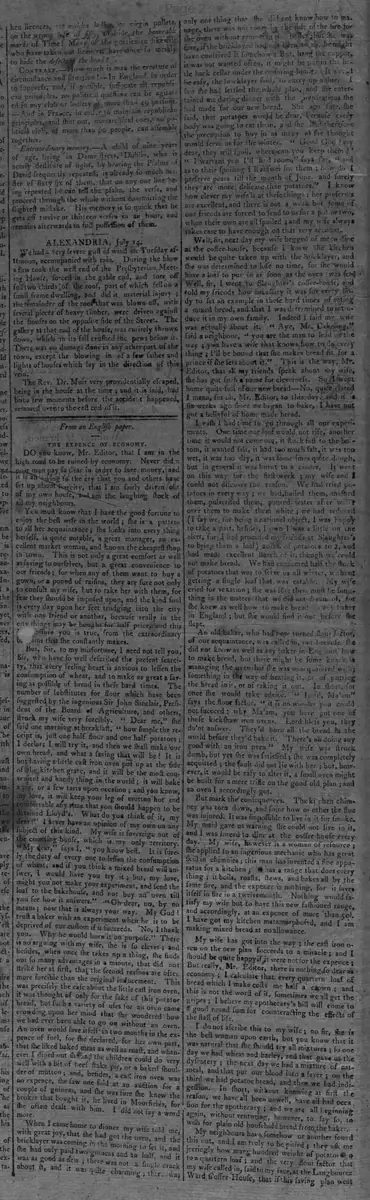
THE EXPENCE OF ECONOMY.
Do you know, Mr. Editor, that I am in the high road to be ruined by economy. Never did a poor man pay so dear in order to save money, and it is all owing to the cry that you and others have set up about scarcity, that I am fairly driven out of my own house, and am the laughing stock of all my neighbours.
You must know that I have the good fortune to enjoy the best wife in the world; she is a pattern to all her acquaintance; she looks into every thing herself, is quite notable, a great manager, an excellent market woman, and knows the cheapest shop in town. This is not only a great comfort as well as saving to ourselves, but a great convenience to our friends; for when any of them want to buy a gown, or a pound of raisins, they are sure not only to consult my wife, but to take her with them, for fear they should be imposed upon, and the kind soul is every day upon her feet trudging into the city with one friend or another, because really in the city things may be bought for half price, and this sure you is true, from the extraordinary bargains that she constantly makes.
But, Sir, to my misfortune, I need not tell you, Sir, who have so well described the present scarcity, that every feeling heart is anxious to lessen the consumption of wheat, and to make as great a saving as possible of bread in these hard times. The number of substitutes for flour which have been suggested by the ingenious Sir John Sinclair, President of the Board of Agriculture, and others, struck my wife very forcibly. "Dear me," she said one morning at breakfast, "how simple the receipt is, just one half flour and one half potatoes; I declare I will try it, and then we shall make our own bread, and what a saving that will be! It is but having a little cast iron oven put up at the side of the kitchen grate, and it will be the most convenient and handy thing in the world; it will bake a pie, or a few tarts upon occasion; and you know, my love, it will keep your leg of mutton hot and comfortable any time that you should happen to be detained at Lloyd's. What do you think of it, my dear?" I never have an opinion of my own on any subject of this kind. My wife is sovereign out of the counting-house, which is my only territory. "My dear," says I, "you know best. It is surely the duty of every one to lessen the consumption of wheat, and if you think a mixed bread will answer, I would have you try it; but, my love, might you not make your experiment, and send the loaf to the bakehouse, and not buy an oven till you see how it answers." "Oh dear, no, by no means; now that is always your way. My God! trust a baker with an experiment when he is to be deprived of our custom if it succeeds. No, I thank you. Why he would burn it on purpose." There is no arguing with my wife, she is so clever; and besides, when once she takes up a thing, she dins out so many advantages in a minute, that did not strike her at first, that the second reasons are often more forcible than the original inducement. This was precisely the case about the little cast iron oven, it was thought of only for the sake of this potato bread, but such a variety of uses for an oven came crowding upon her mind that she wondered how we had ever been able to go on without an oven. An oven would save itself in two months in the expense of fuel, for she declared, for her own part, that she liked baked meat as well as roast, and whenever I dined out she and the children could do very well with a beef steak pie, or a baked shoulder of mutton; and, besides, a cast iron oven was no expense, she saw one sold at an auction for a couple of guineas, and she was sure she knew the broker that bought it, he lived in Moorfields, for she often dealt with him. I did not say a word more.
When I came home to dinner my wife told me, with great joy, that she had got the oven, and the bricklayer was coming in the morning to set it, and she had only paid two guineas and a half, and it was as good as new; there was not a single crack about it, and it was quite charming; there was only one thing that she did not know how to manage, there was not room by the side of the fire for the oven without removing the boiler but she was sure, if the bricklayer had not been an ass, he might have contrived it somehow: But, hang the copper, it was not wanted often, it might be put in the little back cellar under the counting-house. It would be easy, the bricklayer said, to carry up a flue. I saw she had settled the whole plan, and she entertained me during dinner with the preparations she had made for our new bread. She was sure, she said, that potatoes would be dear, because every body was going to eat them, and she had therefore the precaution to buy in as many as she thought would serve us for the winter. "Good God! my dear, they will spoil, where can you keep them?" "I warrant you I'll find room," says she, "and as to their spoiling I will answer for them; how do I preserve pears till the month of June, and surely they are more delicate than potatoes." I know how clever my wife is at these things; her preserves are excellent, and there is not a week but some of our friends are forced to send to us for a pot or two, when their own are all spoiled; and my wife always takes care to have enough on that very account.
Well, sir, next day my wife begged of me to dine at the coffee-house, because I knew the kitchen would be quite taken up with the bricklayer, and she was determined to lose no time, for she would have a loaf to put in as soon as the oven was set. Well, sir, I went to Slaughter's coffee-house, and told my friends how necessary it was for every body to set an example in these hard times of eating a mixed bread, and that I was determined to introduce it in my own family. Indeed I said my wife was actually about it. "Aye, Mr. Cakeling," said a neighbour, "you are the man to lead us the way; you have a wife that knows how to do every thing; I'll be bound that she makes bread fit for a prince if she sets about it." This is the way, Mr. Editor, that all my friends speak about my wife, she has got such a name for cleverness. So I went home quite full of our new bread-No, quite elated I mean, for such, Mr. Editor, to this day, and it is six weeks ago since we began to bake, I have not got a bellyful of home made bread.
I wish I had time to go through all our experiments. One time our loaf would not rise, another time it would not come on, it stuck fast to the bottom, it wanted salt, it had too much salt, it was too wet, it was too dry, it was sometimes quite dough, but in general it was burnt to a cinder. It went on this way for the first week; my wife and I could not discover the reason. We had tried potatoes in every way; we had boiled them, mashed them, pulverized them, poured water after water over them to make them white; we had reduced (I say we, for being a national object, I was happy to take a part, besides, I own I was a little on the alert, for I had promised my friends at Slaughter's to bring them a loaf) 20 lbs. of potatoes to 2, and had made excellent starch of it, though we could not make bread. We had consumed half the stock of potatoes that was to serve us all winter, without getting a single loaf that was eatable. My wife cried for vexation; she was sure there must be something in the matter that we did not dream of, for she knew as well how to make bread as any baker in England; but she would find it out before she slept.
An old baker, who had now turned flour factor, of our acquaintance, was called in, not because she did not know as well as any baker in England how to make bread, but there might be some knack in managing the oven that she was unacquainted with; something in the way of heating it, or of putting the bread in it, or of raking it out. In short, for once she would take advice. "Lord, Ma'am," says the flour factor, "it is no wonder you could not succeed: why Ma'am, you have got one of those kickshaw iron ovens. Lord bless you, they don't answer. They'd burn all the bread in the world before they'd bake it. There's no doing any good with an iron oven." My wife was struck dumb, but yet she was satisfied; she was completely acquitted; the fault did not lie with her; but, however, it would be easy to alter it, a small oven might be built for a mere trifle on the good old plan; and an oven I accordingly got.
But mark the consequences. The kitchen chimney was tore down, and some how or other the flue was injured. It was impossible to live in it for smoke. My maid gave us warning she could not live in it, and I was forced to dine at the coffee-house every day. My wife, however is a woman of resource; she applied to an ingenious mechanic who has great skill in chimneys; this man has invented a fine apparatus for a kitchen; it has a range that does every thing; it boils, roasts, stews, and bakes all by the same fire, and the expense is nothing, for it saves itself in fire in a twelvemonth. Nothing would satisfy my wife but to have this new fashioned range, and accordingly, at an expense of more than £20, I have got my kitchen metamorphosed, and I am making mixed bread at no allowance.
My wife has got into the way; the cast iron oven on the new plan succeeds to a miracle; and I should be quite happy if it were not for the expense; But really, Mr. Editor, there is nothing so dear as economy; I calculate that, every quartern loaf of bread which I make costs me half a crown; and this is not the worst of it, sometimes we all get the gripes; I believe my apothecary's bill will come to a good round sum for counteracting the effects of the staff of life.
I do not ascribe this to my wife; no sir, she is the best woman upon earth, but you know that it was natural that she should try all mixtures; so one day we had wheat and barley, and that gave us the dysentery; the next day we had a mixture of oat-meal, and that put our blood into a fever; on the third we had potato bread, and then we had indigestion. In short, without knowing at first the reason, we have all been unwell, have all had occasion for the apothecary; and we are all beginning again, without venturing, however, to say so, to wish for plain old household bread from the baker.
My neighbours have somehow or another found this out, and I am truly to be pitied; they ask me jeeringly how many hundred weight of potatoes to a quartern loaf; and the very flour factor, that my wife called in, said to my face, at the Laugbourne Ward Coffee-House, that if his saving plan went on all the flour in the kingdom would be wasted, and 'tis true you the truth I begin to think so.
CHRISTOPHER CAKELING
Cranebourne Alley, Dec. 23.
What sub-type of article is it?
What themes does it cover?
What keywords are associated?
What entities or persons were involved?
Letter to Editor Details
Author
Christopher Cakeling
Recipient
Mr. Editor
Main Argument
attempts to economize on bread during wheat scarcity by using substitutes like potatoes and home baking have led to failed experiments, high expenses for kitchen alterations, family health issues, and social ridicule, proving economy can be costly.
Notable Details