Thank you for visiting SNEWPapers!
Sign up free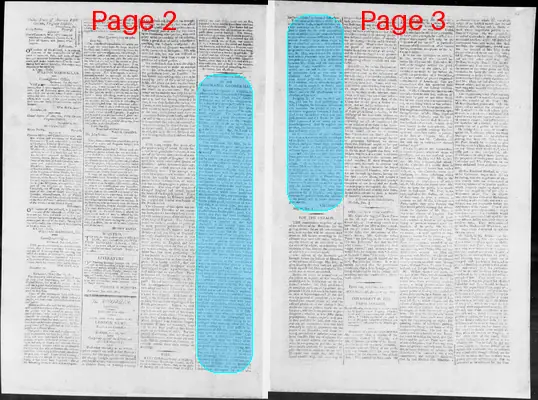
Letter to Editor
January 19, 1803
The Recorder
Richmond, Virginia
What is this article about?
Virginius addresses George Hay, criticizing his proposal to restrain press freedom as a personal response to attacks by Callender and Pace, rather than for public good, warning of dangers to liberty and precedents set.
Merged-components note: Continuation across pages of the same letter from Virginius responding to George Hay.
Clippings
1 of 2
OCR Quality
95%
Excellent
Full Text
FROM THE NORFOLK HERALD.
To
THE
HONORABLE GEORGE HAY.
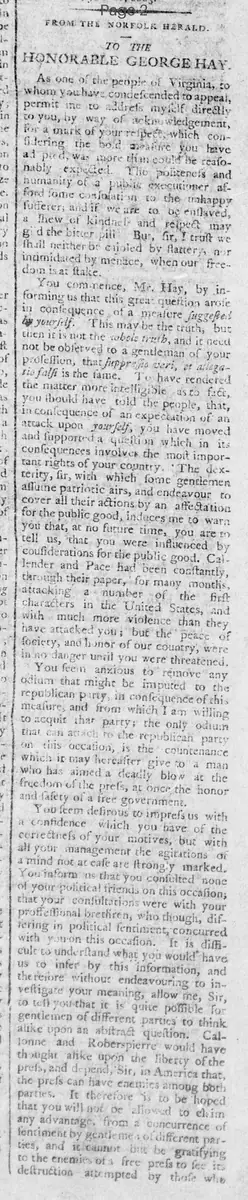
As one of the people of Virginia, to whom you have condescended to appeal, permit me to address myself directly to you, by way of acknowledgement, For a mark of your respect, which considering the bold measure you have adopted, was more than could be reasonably expected. The politeness and humanity of a public executioner afford some consolation to the unhappy sufferer; and if we are to be enslaved, a shew of kindness and respect may gild the bitter pill But, sir, I trust we shall neither be cajoled by flattery, nor intimidated by menace, when our freedom is at stake.
You commence, Mr. Hay, by informing us that this great question arose in consequence of a measure suggested by yourself. This may be the truth, but then it is not the whole truth, and it need not be observed to a gentleman of your profession, that suppressio veri, et allegatio falsi is the same. To have rendered the matter more intelligible as to fact, you should have told the people, that, in consequence of an expectation of an attack upon yourself, you have moved and supported a question which in its consequences involves the most important rights of your country. The dexterity, sir, with which some gentlemen assume patriotic airs, and endeavour to cover all their actions by an affectation for the public good, induces me to warn you that, at no future time, you are entitled to tell us, that you were influenced by considerations for the public good. Callender and Pace had been constantly, through their paper, for many months, attacking a number of the first characters in the United States, and with much more violence than they have attacked you; but the peace of society, and honor of our country, were in no danger until you were threatened.
You seem anxious to remove any odium that might be imputed to the republican party, in consequence of this measure, and from which I am willing to acquit that party; the only odium that can attach to the republican party on this occasion, is the countenance which it may hereafter give to a man who has aimed a deadly blow at the freedom of the press, at once the honor and safety of a free government.
You seem desirous to impress us with a confidence which you have of the correctness of your motives, but with all your management the agitations of a mind not at ease are strongly marked. You inform us that you consulted none of your political friends on this occasion; that your consultations were with your professional brethren, who though, differing in political sentiment, concurred with you on this occasion. It is difficult to understand what you would have us to infer by this information, and therefore without endeavouring to investigate your meaning, allow me, Sir, to tell you that it is quite possible for gentlemen of different parties to think alike upon an abstract question. Callender and Robespierre would have thought alike upon the liberty of the press, and depend, Sir, in America that, the press can have enemies among both parties. It therefore is, to be hoped that you will not be allowed to claim any advantage, from a concurrence of sentiment by gentlemen of different parties, and it cannot but be gratifying to the enemies of a free press to see its destruction attempted by those who had been reputed its warmest defenders.
Your ideas of the liberty of the press appear to be such, as most exclusive patriots entertain on that subject. You seem to think that the most unqualified abuse of public men and measures should be permitted without restraint, and that private scandal is what alone ought to be the object of restraint. It is evident, sir, that your passions have misled your judgment; you are too much of a lawyer, Mr. Hay, not to know the facility with which precedents may be worked into principles of law. The distinction between Mr. Hay, and the honorable George Hay, counsellor of state, would soon be lost in the operation of principles which, as you wish to establish. - And with submission to your better judgment, I think if a bold measure which menaces the public liberty is adopted, it should have the appearance of public good for its object, and not the gratification of individual resentment.
Judging, sir, of men by their actions, and not by their professions, it will, I imagine, be some time before you can convince the public of your attachment to genuine freedom. I shall be glad to see the defence which you propose to make, and if I should be hereafter convinced of my error, my acknowledgement shall be explicit and prompt, but (as you say) "this conviction will never come!"
In the conclusion of your address, you drop a few words which are designed to shelter your character from inconsistency, and you would fain persuade us that "under the state governments," a restraint upon the liberty of the press is no evil; this idea you have borrowed from governor McKean: your appeal to him puts us in the mind of a vulgar adage, "ask my brother, &c." Sir, governor McKean's ideas upon the liberty of the press, are upon record in the case of Oswald, the printer, when McKean was chief justice of Pennsylvania.
The writer of this, Mr. Hay, does not know you; so can have no malice against you; he knows nothing of your character, except what you have been pleased to lay of yourself; you appear anxious for political fame, the opinions of the public will in future determine your merits.
VIRGINIUS.
Norfolk, Jan. 5
To
THE
HONORABLE GEORGE HAY.
As one of the people of Virginia, to whom you have condescended to appeal, permit me to address myself directly to you, by way of acknowledgement, For a mark of your respect, which considering the bold measure you have adopted, was more than could be reasonably expected. The politeness and humanity of a public executioner afford some consolation to the unhappy sufferer; and if we are to be enslaved, a shew of kindness and respect may gild the bitter pill But, sir, I trust we shall neither be cajoled by flattery, nor intimidated by menace, when our freedom is at stake.
You commence, Mr. Hay, by informing us that this great question arose in consequence of a measure suggested by yourself. This may be the truth, but then it is not the whole truth, and it need not be observed to a gentleman of your profession, that suppressio veri, et allegatio falsi is the same. To have rendered the matter more intelligible as to fact, you should have told the people, that, in consequence of an expectation of an attack upon yourself, you have moved and supported a question which in its consequences involves the most important rights of your country. The dexterity, sir, with which some gentlemen assume patriotic airs, and endeavour to cover all their actions by an affectation for the public good, induces me to warn you that, at no future time, you are entitled to tell us, that you were influenced by considerations for the public good. Callender and Pace had been constantly, through their paper, for many months, attacking a number of the first characters in the United States, and with much more violence than they have attacked you; but the peace of society, and honor of our country, were in no danger until you were threatened.
You seem anxious to remove any odium that might be imputed to the republican party, in consequence of this measure, and from which I am willing to acquit that party; the only odium that can attach to the republican party on this occasion, is the countenance which it may hereafter give to a man who has aimed a deadly blow at the freedom of the press, at once the honor and safety of a free government.
You seem desirous to impress us with a confidence which you have of the correctness of your motives, but with all your management the agitations of a mind not at ease are strongly marked. You inform us that you consulted none of your political friends on this occasion; that your consultations were with your professional brethren, who though, differing in political sentiment, concurred with you on this occasion. It is difficult to understand what you would have us to infer by this information, and therefore without endeavouring to investigate your meaning, allow me, Sir, to tell you that it is quite possible for gentlemen of different parties to think alike upon an abstract question. Callender and Robespierre would have thought alike upon the liberty of the press, and depend, Sir, in America that, the press can have enemies among both parties. It therefore is, to be hoped that you will not be allowed to claim any advantage, from a concurrence of sentiment by gentlemen of different parties, and it cannot but be gratifying to the enemies of a free press to see its destruction attempted by those who had been reputed its warmest defenders.
Your ideas of the liberty of the press appear to be such, as most exclusive patriots entertain on that subject. You seem to think that the most unqualified abuse of public men and measures should be permitted without restraint, and that private scandal is what alone ought to be the object of restraint. It is evident, sir, that your passions have misled your judgment; you are too much of a lawyer, Mr. Hay, not to know the facility with which precedents may be worked into principles of law. The distinction between Mr. Hay, and the honorable George Hay, counsellor of state, would soon be lost in the operation of principles which, as you wish to establish. - And with submission to your better judgment, I think if a bold measure which menaces the public liberty is adopted, it should have the appearance of public good for its object, and not the gratification of individual resentment.
Judging, sir, of men by their actions, and not by their professions, it will, I imagine, be some time before you can convince the public of your attachment to genuine freedom. I shall be glad to see the defence which you propose to make, and if I should be hereafter convinced of my error, my acknowledgement shall be explicit and prompt, but (as you say) "this conviction will never come!"
In the conclusion of your address, you drop a few words which are designed to shelter your character from inconsistency, and you would fain persuade us that "under the state governments," a restraint upon the liberty of the press is no evil; this idea you have borrowed from governor McKean: your appeal to him puts us in the mind of a vulgar adage, "ask my brother, &c." Sir, governor McKean's ideas upon the liberty of the press, are upon record in the case of Oswald, the printer, when McKean was chief justice of Pennsylvania.
The writer of this, Mr. Hay, does not know you; so can have no malice against you; he knows nothing of your character, except what you have been pleased to lay of yourself; you appear anxious for political fame, the opinions of the public will in future determine your merits.
VIRGINIUS.
Norfolk, Jan. 5
What sub-type of article is it?
Persuasive
Political
Provocative
What themes does it cover?
Press Freedom
Politics
What keywords are associated?
Press Freedom
George Hay
Callender
Republican Party
Norfolk
Liberty Of The Press
Political Motives
What entities or persons were involved?
Virginius.
The Honorable George Hay.
Letter to Editor Details
Author
Virginius.
Recipient
The Honorable George Hay.
Main Argument
george hay's proposal to restrain the press stems from personal resentment against callender and pace's attacks, not public good, and sets dangerous precedents threatening freedom of the press and public liberty.
Notable Details
References Suppressio Veri Et Allegatio Falsi
Consultations With Professional Brethren Differing In Politics
Compares Hay's Views To Those Of Callender And Robespierre
Alludes To Governor Mckean's Stance In Oswald Case