Thank you for visiting SNEWPapers!
Sign up free
Editorial
April 23, 1881
The Rock Island Argus
Rock Island, Rock Island County County, Illinois
What is this article about?
The editorial critiques the protective tariff system, arguing it harms protected industries by limiting markets, raising costs, and leading to overproduction and combinations, ultimately robbing consumers without benefiting manufacturers long-term. Uses paper industry as example.
Clipping
OCR Quality
98%
Excellent
Full Text
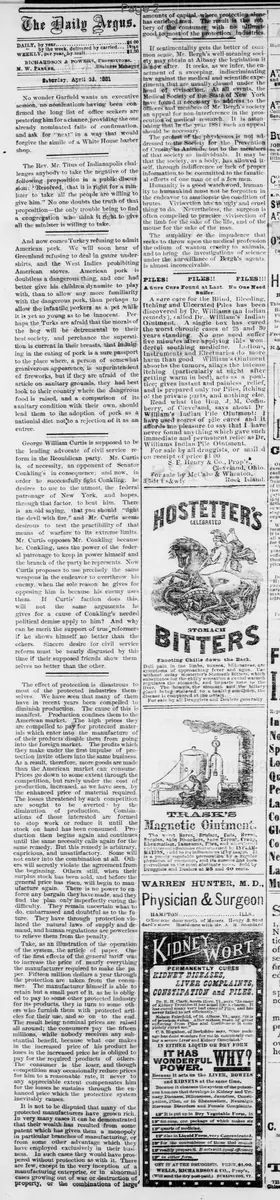
The effect of protection is disastrous to most of the protected industries themselves. We have seen that many of them have in recent years been compelled to diminish production. The cause of this is manifest. Production confines them to the American market. The high prices they are compelled to pay for protected materials which enter into the manufacture of their products disable them from going into the foreign market. The profits which they make under the first impulse of protection invite others into the same business. As a result, therefore, more goods are made than the American market can consume. Prices go down to some extent through the competition, but rarely under the cost of production, increased, as we have seen, by the enhanced price of material required. The losses threatened by such competition are sought to be averted by the diminution of production. Combinations of those interested are formed to stop work or reduce it until the stock on hand has been consumed. Production then begins again and continues until the same necessity calls again for the same remedy. But this remedy is arbitrary, capricious, and unsatisfactory.
Some will not enter into the combination at all. Others will secretly violate the agreement from the beginning. Others still, when their surplus stock has been sold, and before the general price has risen, will begin to manufacture again. There is no power to enforce any bargain they have made, and they find the plan only imperfectly curing the difficulty. They remain uncertain what to do, embarrassed and doubtful as to the future. They have through protection violated the natural laws of supply and demand, and human regulations are powerless to relieve them from the penalty.
Take, as an illustration of the operation of the system, the article of paper. One of the first effects of the general tariff was to increase the price of nearly everything the manufacturer required to make the paper. Fifteen million dollars a year through the protection are taken from the consumer. The manufacturer himself is able to retain but a small part of it, as he is obliged to pay to some other protected industry for its products, they in turn to some others who furnish them with protected articles for their use, and so on to the end. The result being nominal prices are raised all around; the consumers pay the fifteen millions, while nobody receives any substantial benefit, because what one makes in the increased price of his product he loses in the increased price he is obliged to pay for the required products of others. The consumer is the loser, and though competition may occasionally reduce prices for him to a reasonable rate, it never to any appreciable extent compensates him for the losses he sustains through the enhanced price which the protective system inevitably causes.
It is not to be disputed that many of the protected manufacturers have grown rich. In very many cases it can be demonstrated that their wealth has resulted from some patent which has given them a monopoly in particular branches of manufacturing, or from some other advantage which they have employed exclusively in their business. In such cases they would have prospered without protection as with it. There are few, except in the very inception of a manufacturing enterprise, or in abnormal cases growing out of war or destruction of property, or the combinations of large amounts of capital, where protection alone has enriched men. The result is the robbery of the consumer with no ultimate good to most of the protection industries.
Some will not enter into the combination at all. Others will secretly violate the agreement from the beginning. Others still, when their surplus stock has been sold, and before the general price has risen, will begin to manufacture again. There is no power to enforce any bargain they have made, and they find the plan only imperfectly curing the difficulty. They remain uncertain what to do, embarrassed and doubtful as to the future. They have through protection violated the natural laws of supply and demand, and human regulations are powerless to relieve them from the penalty.
Take, as an illustration of the operation of the system, the article of paper. One of the first effects of the general tariff was to increase the price of nearly everything the manufacturer required to make the paper. Fifteen million dollars a year through the protection are taken from the consumer. The manufacturer himself is able to retain but a small part of it, as he is obliged to pay to some other protected industry for its products, they in turn to some others who furnish them with protected articles for their use, and so on to the end. The result being nominal prices are raised all around; the consumers pay the fifteen millions, while nobody receives any substantial benefit, because what one makes in the increased price of his product he loses in the increased price he is obliged to pay for the required products of others. The consumer is the loser, and though competition may occasionally reduce prices for him to a reasonable rate, it never to any appreciable extent compensates him for the losses he sustains through the enhanced price which the protective system inevitably causes.
It is not to be disputed that many of the protected manufacturers have grown rich. In very many cases it can be demonstrated that their wealth has resulted from some patent which has given them a monopoly in particular branches of manufacturing, or from some other advantage which they have employed exclusively in their business. In such cases they would have prospered without protection as with it. There are few, except in the very inception of a manufacturing enterprise, or in abnormal cases growing out of war or destruction of property, or the combinations of large amounts of capital, where protection alone has enriched men. The result is the robbery of the consumer with no ultimate good to most of the protection industries.
What sub-type of article is it?
Economic Policy
Trade Or Commerce
What keywords are associated?
Protectionism
Tariffs
Overproduction
Consumer Losses
Industry Combinations
Supply And Demand
Paper Manufacturing
What entities or persons were involved?
Protected Industries
Consumers
Manufacturers
Paper Industry
Editorial Details
Primary Topic
Disastrous Effects Of Protective Tariffs On Industries And Consumers
Stance / Tone
Strongly Anti Protectionist
Key Figures
Protected Industries
Consumers
Manufacturers
Paper Industry
Key Arguments
Protection Limits Industries To American Market, Preventing Foreign Competition
High Prices For Protected Materials Increase Production Costs
Initial Profits Attract Competitors, Leading To Overproduction
Overproduction Causes Price Drops And Production Reductions Via Combinations
Combinations Are Unstable And Ineffective Due To Violations
Protection Violates Natural Laws Of Supply And Demand
Tariffs Raise Prices Across Supply Chain, Benefiting No One Substantially
Consumers Lose $15 Million Annually On Paper Alone
Manufacturer Wealth Often From Patents Or Other Advantages, Not Protection
Protection Results In Consumer Robbery Without Ultimate Good To Industries