Thank you for visiting SNEWPapers!
Sign up free
Literary
October 12, 1905
Iron County Register
Ironton, Iron County, Missouri
What is this article about?
A column of literary personals featuring anecdotes about Giosue Carducci's birthday and career, a failed play by Henry Arthur Jones produced by Charles Frohman, an American donor of Mommsen's library to Bonn University, Leo Tolstoy's humorous take on Henrik Ibsen, and Horatio F. Brown's repeated manuscript losses to fire.
Clipping
OCR Quality
98%
Excellent
Full Text
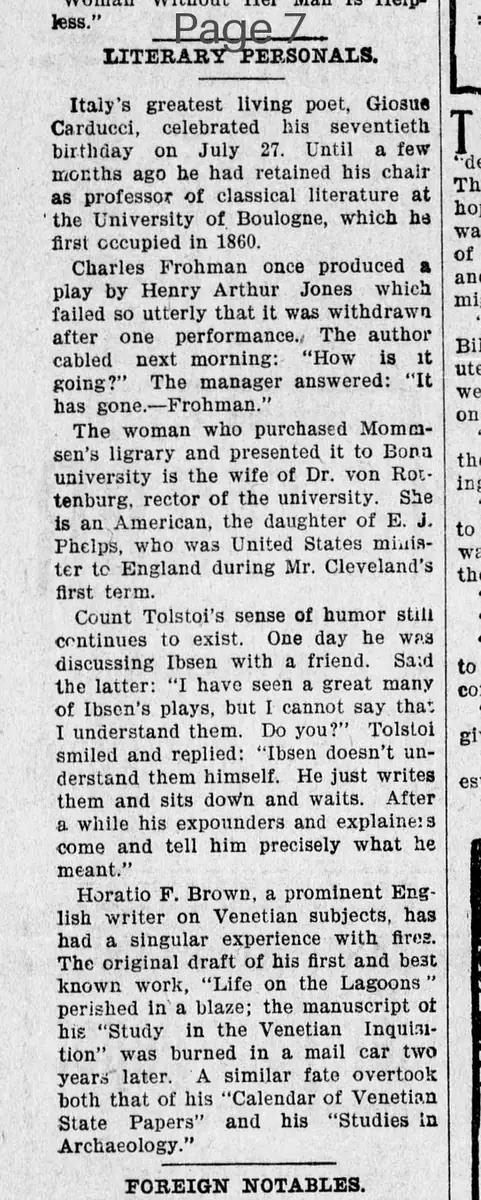
LITERARY PERSONALS.
Italy's greatest living poet, Giosue Carducci, celebrated his seventieth birthday on July 27. Until a few months ago he had retained his chair as professor of classical literature at the University of Bologna, which he first occupied in 1860.
Charles Frohman once produced a play by Henry Arthur Jones which failed so utterly that it was withdrawn after one performance. The author cabled next morning: "How is it going?" The manager answered: "It has gone.-Frohman."
The woman who purchased Mommsen's library and presented it to Bonn university is the wife of Dr. von Rottenburg, rector of the university. She is an American, the daughter of E. J. Phelps, who was United States minister to England during Mr. Cleveland's first term.
Count Tolstoi's sense of humor still continues to exist. One day he was discussing Ibsen with a friend. Said the latter: "I have seen a great many of Ibsen's plays, but I cannot say that I understand them. Do you?" Tolstoi smiled and replied: "Ibsen doesn't understand them himself. He just writes them and sits down and waits. After a while his expounders and explainers come and tell him precisely what he meant."
Horatio F. Brown, a prominent English writer on Venetian subjects, has had a singular experience with fires. The original draft of his first and best known work, "Life on the Lagoons" perished in a blaze; the manuscript of his "Study in the Venetian Inquisition" was burned in a mail car two years later. A similar fate overtook both that of his "Calendar of Venetian State Papers" and his "Studies in Archaeology."
Italy's greatest living poet, Giosue Carducci, celebrated his seventieth birthday on July 27. Until a few months ago he had retained his chair as professor of classical literature at the University of Bologna, which he first occupied in 1860.
Charles Frohman once produced a play by Henry Arthur Jones which failed so utterly that it was withdrawn after one performance. The author cabled next morning: "How is it going?" The manager answered: "It has gone.-Frohman."
The woman who purchased Mommsen's library and presented it to Bonn university is the wife of Dr. von Rottenburg, rector of the university. She is an American, the daughter of E. J. Phelps, who was United States minister to England during Mr. Cleveland's first term.
Count Tolstoi's sense of humor still continues to exist. One day he was discussing Ibsen with a friend. Said the latter: "I have seen a great many of Ibsen's plays, but I cannot say that I understand them. Do you?" Tolstoi smiled and replied: "Ibsen doesn't understand them himself. He just writes them and sits down and waits. After a while his expounders and explainers come and tell him precisely what he meant."
Horatio F. Brown, a prominent English writer on Venetian subjects, has had a singular experience with fires. The original draft of his first and best known work, "Life on the Lagoons" perished in a blaze; the manuscript of his "Study in the Venetian Inquisition" was burned in a mail car two years later. A similar fate overtook both that of his "Calendar of Venetian State Papers" and his "Studies in Archaeology."
What sub-type of article is it?
Essay
What keywords are associated?
Giosue Carducci
Henry Arthur Jones
Mommsen Library
Leo Tolstoi
Henrik Ibsen
Horatio F Brown
Venetian Subjects
Literary Details
Title
Literary Personals
Form / Style
Collection Of Short Prose Anecdotes
Key Lines
"How Is It Going?" The Manager Answered: "It Has Gone. Frohman."
"Ibsen Doesn't Understand Them Himself. He Just Writes Them And Sits Down And Waits. After A While His Expounders And Explainers Come And Tell Him Precisely What He Meant."