Thank you for visiting SNEWPapers!
Sign up free
Palladium Of Virginia And The Pacific Monitor
Lewisburg, Greenbrier County, West Virginia
What is this article about?
Dr. John C. Warren provides a detailed medical account of the 18-year-old Siamese conjoined twins recently arrived in Boston, describing their physical connection via cartilage and ligament, synchronized behaviors, intelligence, and physiological harmony.
Merged-components note: Account of the Siamese boys is a single continued narrative article.
Clipping
OCR Quality
Full Text
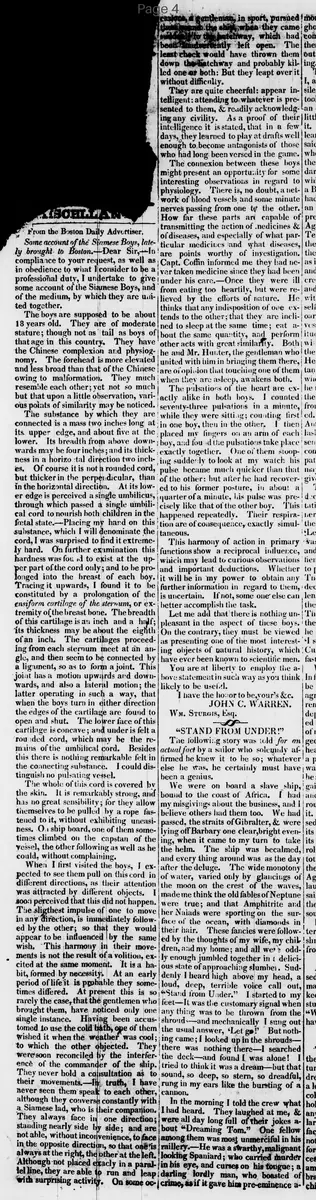
Some account of the Siamese Boys, lately brought to Boston.—Dear Sir,—In compliance to your request, as well as in obedience to what I consider to be a professional duty, I undertake to give some account of the Siamese Boys, and of the medium, by which they are united together.
The boys are supposed to be about 18 years old. They are of moderate stature; though not as tall as boys of that age in this country. They have the Chinese complexion and physiognomy. The forehead is more elevated and less broad than that of the Chinese owing to malformation. They much resemble each other; yet not so much but that upon a little observation, various points of dissimilarity may be noticed.
The substance by which they are connected is a mass two inches long at its upper edge, and about five at the lower. Its breadth from above downwards may be four inches; and its thickness in a horizontal direction two inches. Of course it is not a rounded cord, but thicker in the perpendicular, than in the horizontal direction. At its lower edge is perceived a single umbilicus, through which passed a single umbilical cord to nourish both children in the foetal state.—Placing my hand on this substance, which I will denominate the cord, I was surprised to find it extremely hard. On further examination this hardness was found to exist at the upper part of the cord only; and to be prolonged into the breast of each boy. Tracing it upwards, I found it to be constituted by a prolongation of the ensiform cartilage of the sternum, or extremity of the breast bone. The breadth of this cartilage is an inch and a half: its thickness may be about the eighth of an inch. The cartilages proceeding from each sternum meet at an angle, and then seem to be connected by a ligament, so as to form a joint. This joint has a motion upwards and downwards, and also a lateral motion; the latter operating in such a way, that when the boys turn in either direction the edges of the cartilage are found to open and shut. The lower face of this cartilage is concave; and under is felt a rounded cord, which may be the remains of the umbilical cord. Besides this there is nothing remarkable felt in the connecting substance. I could distinguish no pulsating vessel.
The whole of this cord is covered by the skin. It is remarkably strong, and has no great sensibility; for they allow themselves to be pulled by a rope fastened to it, without exhibiting uneasiness. On ship board, one of them sometimes climbed on the capstan of the vessel, the other following as well as he could, without complaining.
When I first visited the boys, I expected to see them pull on this cord in different directions, as their attention was attracted by different objects. I soon perceived that this did not happen. The slightest impulse of one to move in any direction, is immediately followed by the other; so that they would appear to be influenced by the same wish. This harmony in their movements is not the result of a volition, excited at the same moment. It is a habit, formed by necessity. At an early period of life it is probable they sometimes differed. At present this is so rarely the case, that the gentlemen who brought them, have noticed only one single instance. Having been accustomed to use the cold bath, one of them wished it when the weather was cool; to which the other objected. They were soon reconciled by the interference of the commander of the ship.
They never hold a consultation as to their movements.—In truth, I have never seen them speak to each other, although they converse constantly with a Siamese lad, who is their companion. They always face in one direction; standing nearly side by side; and are not able, without inconvenience, to face in the opposite direction, so that one is always at the right, the other at the left. Although not placed exactly in a parallel line, they are able to run and leap with surprising activity. On some occasions
various gentlemen in sport, pursued the ship when they came by the sport way, which had been accidentally left open. The least check would have thrown them down the hatchway and probably killed one or both: But they leapt over it without difficulty.
They are quite cheerful: appear intelligent: attending to whatever is presented to them, & readily acknowledging any civility. As a proof of their intelligence it is stated, that in a few days, they learned to play at drafts well enough to, become antagonists of those who had long been versed in the game.
The connexion between these boys might present an opportunity for some interesting observations in regard to physiology. There is, no doubt, a network of blood vessels and some minute nerves passing from one to the other. How far these parts are capable of transmitting the action of medicines & of diseases, and especially of what particular medicines and what diseases, are points worthy of investigation.
Capt. Coffin informed me they had never taken medicine since they had been under his care.—Once they were ill from eating too heartily, but were relieved by the efforts of nature. He thinks that any indisposition of one extends to the other; that they are inclined to sleep at the same time; eat about the same quantity, and perform other acts with great similarity. Both he and Mr. Hunter, the gentleman who united with him in bringing them there, are of opinion that touching one of them when they are asleep, awakens both.
The pulsations of the heart are exactly alike in both boys. I counted seventy-three pulsations in a minute, while they were sitting; counting first in one boy, then in the other. I then placed my fingers on an arm of each boy, and found the pulsations take place exactly together. One of them stooping suddenly to look at my watch his pulse became much quicker than that of the other: but after he had recovered to his former posture, in about a quarter of a minute, his pulse was precisely like that of the other boy. This happened repeatedly. Their respiration are of consequence, exactly simultaneous.
This harmony of action in primary functions show a reciprocal influence, which may lead to curious observations and important deductions. Whether it will be in my power to obtain any further information in regard to them, is uncertain. If not, some one else can better accomplish the task.
Let me add that there is nothing unpleasant in the aspect of these boys. On the contrary, they must be viewed as presenting one of the most interesting objects of natural history, which have ever been known to scientific men.
You are at liberty to employ the above statement in such way as you think likely to be useful.
I have the honor to be, yours &c.
JOHN C. WARREN.
Wm. Sturgis, Esq.
What sub-type of article is it?
What themes does it cover?
What keywords are associated?
What entities or persons were involved?
Where did it happen?
Story Details
Key Persons
Location
Boston
Event Date
Lately Brought To Boston
Story Details
Dr. Warren examines the conjoined Siamese boys, describing their physical union via sternal cartilage and ligament, their synchronized movements and functions, intelligence, and potential for physiological study.