Thank you for visiting SNEWPapers!
Sign up free
Story
September 22, 1952
Trainman News
Indianapolis, Marion County, Indiana
What is this article about?
Ewan Clague reports American industry's peak productivity in 1950-1951 due to capital investments and high production volumes. About 60% of industries increased since 1939, with critiques on tax write-offs and war surplus acquisitions benefiting industry at public expense.
Clipping
OCR Quality
88%
Good
Full Text
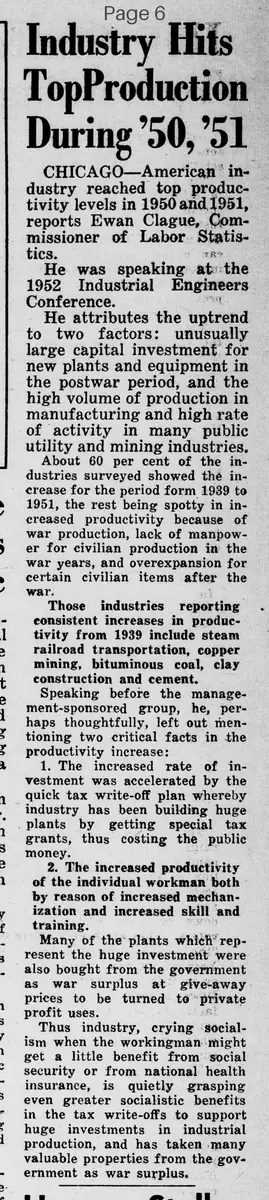
Industry Hits Top Production During '50, 51
CHICAGO--American industry reached top productivity levels in 1950 and 1951, reports Ewan Clague, Commissioner of Labor Statistics.
He was speaking at the 1952 Industrial Engineers Conference.
He attributes the uptrend to two factors: unusually large capital investment for new plants and equipment in the postwar period, and the high volume of production in manufacturing and high rate of activity in many public utility and mining industries.
About 60 per cent of the industries surveyed showed the increase for the period from 1939 to 1951, the rest being spotty in increased productivity because of war production, lack of manpower for civilian production in the war years, and overexpansion for certain civilian items after the war.
Those industries reporting consistent increases in productivity from 1939 include steam railroad transportation, copper mining, bituminous coal, clay construction and cement.
Speaking before the management-sponsored group, he, perhaps thoughtfully, left out mentioning two critical facts in the productivity increase:
1. The increased rate of investment was accelerated by the quick tax write-off plan whereby industry has been building huge plants by getting special tax grants, thus costing the public money.
2. The increased productivity of the individual workman both by reason of increased mechanization and increased skill and training.
Many of the plants which represent the huge investment were also bought from the government as war surplus at give-away prices to be turned to private profit uses.
Thus industry, crying socialism when the workingman might get a little benefit from social security or from national health insurance, is quietly grasping even greater socialistic benefits in the tax write-offs to support huge investments in industrial production, and has taken many valuable properties from the government as war surplus.
CHICAGO--American industry reached top productivity levels in 1950 and 1951, reports Ewan Clague, Commissioner of Labor Statistics.
He was speaking at the 1952 Industrial Engineers Conference.
He attributes the uptrend to two factors: unusually large capital investment for new plants and equipment in the postwar period, and the high volume of production in manufacturing and high rate of activity in many public utility and mining industries.
About 60 per cent of the industries surveyed showed the increase for the period from 1939 to 1951, the rest being spotty in increased productivity because of war production, lack of manpower for civilian production in the war years, and overexpansion for certain civilian items after the war.
Those industries reporting consistent increases in productivity from 1939 include steam railroad transportation, copper mining, bituminous coal, clay construction and cement.
Speaking before the management-sponsored group, he, perhaps thoughtfully, left out mentioning two critical facts in the productivity increase:
1. The increased rate of investment was accelerated by the quick tax write-off plan whereby industry has been building huge plants by getting special tax grants, thus costing the public money.
2. The increased productivity of the individual workman both by reason of increased mechanization and increased skill and training.
Many of the plants which represent the huge investment were also bought from the government as war surplus at give-away prices to be turned to private profit uses.
Thus industry, crying socialism when the workingman might get a little benefit from social security or from national health insurance, is quietly grasping even greater socialistic benefits in the tax write-offs to support huge investments in industrial production, and has taken many valuable properties from the government as war surplus.
What sub-type of article is it?
Historical Event
What themes does it cover?
Triumph
Deception
What keywords are associated?
Industrial Productivity
Postwar Investment
Tax Write Offs
War Surplus
Economic Critique
What entities or persons were involved?
Ewan Clague
Where did it happen?
Chicago
Story Details
Key Persons
Ewan Clague
Location
Chicago
Event Date
1950 1951
Story Details
Ewan Clague attributes postwar industrial productivity surge to capital investments and high output, with 60% industries increasing since 1939; critiques omitted factors like tax write-offs and war surplus deals enabling private profits at public cost.