Thank you for visiting SNEWPapers!
Sign up free
Editorial
January 27, 1928
Union Labor Bulletin
Little Rock, Pulaski County, Arkansas
What is this article about?
Secretary of Labor James J. Davis criticizes low-wage employers as parasites in his report to Congress, defending high wages and organized labor's position. He argues that low wages harm home markets and national prosperity, urging employers to pay decent wages or exit business.
Clipping
OCR Quality
98%
Excellent
Full Text
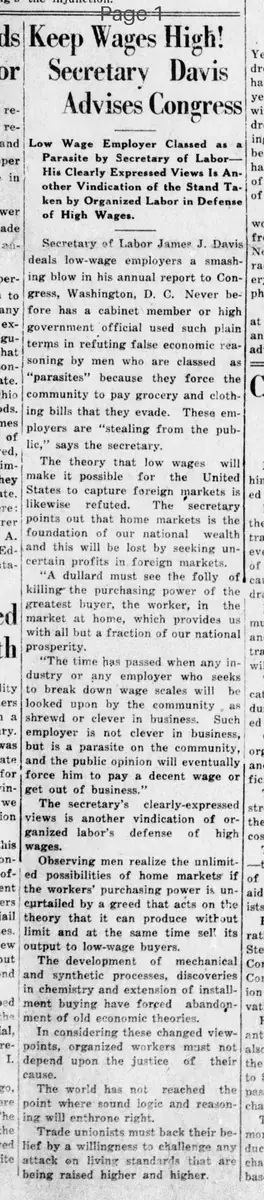
Keep Wages High!
Secretary Davis
Advises Congress
Low Wage Employer Classed as a Parasite by Secretary of Labor--His Clearly Expressed Views Is Another Vindication of the Stand Taken by Organized Labor in Defense of High Wages.
Secretary of Labor James J. Davis deals low-wage employers a smashing blow in his annual report to Congress, Washington, D. C. Never before has a cabinet member or high government official used such plain terms in refuting false economic reasoning by men who are classed as "parasites" because they force the community to pay grocery and clothing bills that they evade. These employers are "stealing from the public," says the secretary.
The theory that low wages will make it possible for the United States to capture foreign markets is likewise refuted. The secretary points out that home markets is the foundation of our national wealth and this will be lost by seeking uncertain profits in foreign markets.
"A dullard must see the folly of killing the purchasing power of the greatest buyer, the worker, in the market at home, which provides us with all but a fraction of our national prosperity.
"The time has passed when any industry or any employer who seeks to break down wage scales will be looked upon by the community as shrewd or clever in business. Such employer is not clever in business, but is a parasite on the community, and the public opinion will eventually force him to pay a decent wage or get out of business.
The secretary's clearly-expressed views is another vindication of organized labor's defense of high wages.
Observing men realize the unlimited possibilities of home markets if the workers' purchasing power is uncurtailed by a greed that acts on the theory that it can produce without limit and at the same time sell its output to low-wage buyers.
The development of mechanical and synthetic processes, discoveries in chemistry and extension of installment buying have forced abandonment of old economic theories.
In considering these changed viewpoints, organized workers must not depend upon the justice of their cause.
The world has not reached the point where sound logic and reasoning will enthrone right.
Trade unionists must back their belief by a willingness to challenge any attack on living standards that are being raised higher and higher.
Secretary Davis
Advises Congress
Low Wage Employer Classed as a Parasite by Secretary of Labor--His Clearly Expressed Views Is Another Vindication of the Stand Taken by Organized Labor in Defense of High Wages.
Secretary of Labor James J. Davis deals low-wage employers a smashing blow in his annual report to Congress, Washington, D. C. Never before has a cabinet member or high government official used such plain terms in refuting false economic reasoning by men who are classed as "parasites" because they force the community to pay grocery and clothing bills that they evade. These employers are "stealing from the public," says the secretary.
The theory that low wages will make it possible for the United States to capture foreign markets is likewise refuted. The secretary points out that home markets is the foundation of our national wealth and this will be lost by seeking uncertain profits in foreign markets.
"A dullard must see the folly of killing the purchasing power of the greatest buyer, the worker, in the market at home, which provides us with all but a fraction of our national prosperity.
"The time has passed when any industry or any employer who seeks to break down wage scales will be looked upon by the community as shrewd or clever in business. Such employer is not clever in business, but is a parasite on the community, and the public opinion will eventually force him to pay a decent wage or get out of business.
The secretary's clearly-expressed views is another vindication of organized labor's defense of high wages.
Observing men realize the unlimited possibilities of home markets if the workers' purchasing power is uncurtailed by a greed that acts on the theory that it can produce without limit and at the same time sell its output to low-wage buyers.
The development of mechanical and synthetic processes, discoveries in chemistry and extension of installment buying have forced abandonment of old economic theories.
In considering these changed viewpoints, organized workers must not depend upon the justice of their cause.
The world has not reached the point where sound logic and reasoning will enthrone right.
Trade unionists must back their belief by a willingness to challenge any attack on living standards that are being raised higher and higher.
What sub-type of article is it?
Labor
Economic Policy
What keywords are associated?
High Wages
Low Wage Employers
Parasites
Organized Labor
Home Markets
Purchasing Power
Economic Theories
What entities or persons were involved?
James J. Davis
Congress
Organized Labor
Low Wage Employers
Editorial Details
Primary Topic
Defense Of High Wages Against Low Wage Employers
Stance / Tone
Strongly Pro High Wages And Supportive Of Organized Labor
Key Figures
James J. Davis
Congress
Organized Labor
Low Wage Employers
Key Arguments
Low Wage Employers Are Parasites Stealing From The Public By Evading Community Costs
Low Wages Undermine Home Markets, The Foundation Of National Wealth
Seeking Foreign Markets At Expense Of Domestic Purchasing Power Is Folly
Public Opinion Will Force Employers To Pay Decent Wages Or Exit Business
Organized Labor Must Actively Challenge Attacks On Living Standards