Thank you for visiting SNEWPapers!
Sign up free
Literary
April 20, 1816
Richmond Enquirer
Richmond, Richmond County, Virginia
What is this article about?
Review of 'The Paris Spectator,' an imitation of the English Spectator, featuring a witty translated fable by M. Arnaud titled 'The Snail,' which portrays the egotist as a solitary, selfish creature akin to a snail.
Clipping
OCR Quality
75%
Good
Full Text
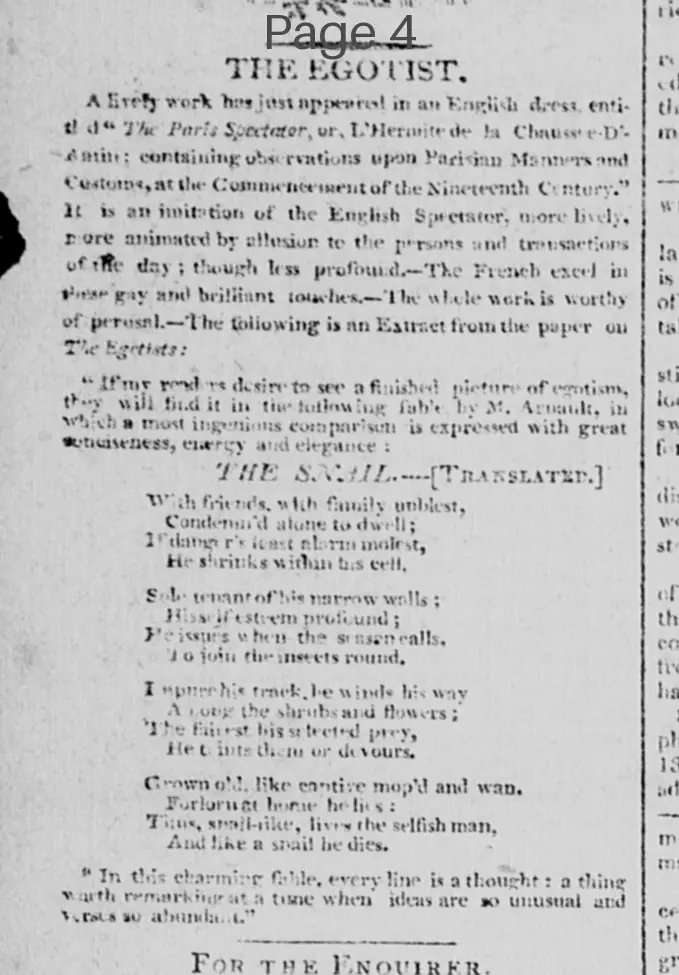
THE EGOTIST.
A lively work has just appeared in an English dress entitled "The Paris Spectator, or, L'Heritage de La Chaussée d'Antin: containing observations upon Parisian Manners and Customs, at the Commencement of the Nineteenth Century."
It is an imitation of the English Spectator, more gay, more animated by allusion to the persons and transactions of the day: though less profound. The French excel in those gay and brilliant touches. The whole work is worthy of perusal. The following is an extract from the paper on The Egotists:
"If you read to desire to see a finished picture of egotism, they will find it in the following fable by M. Arnaud, in which a most ingenious comparison is expressed with great wittiness, elegancy and elegance:
THE SNAIL.-[TRANSLATED.]
With friends, with family unblest,
Condemned alone to dwell;
Indignant at the least molest,
He shrinks within his cell.
Self-tenant of his narrow walls;
His life seems profound;
But he stirs when the season calls
To join the insects round.
I pursue his track, he winds his way
Along the shrubs and flowers;
The first he bisects, prey,
He eats or devours.
Grown old, the egotist moped and wan.
Forlorn he breathes his last:
Thus, snail-like, live the selfish man,
And like a snail he dies."
In this charming fable, every line is a thought: a thing worth remarking at a time when ideas are so unusual and wits so abundant.
A lively work has just appeared in an English dress entitled "The Paris Spectator, or, L'Heritage de La Chaussée d'Antin: containing observations upon Parisian Manners and Customs, at the Commencement of the Nineteenth Century."
It is an imitation of the English Spectator, more gay, more animated by allusion to the persons and transactions of the day: though less profound. The French excel in those gay and brilliant touches. The whole work is worthy of perusal. The following is an extract from the paper on The Egotists:
"If you read to desire to see a finished picture of egotism, they will find it in the following fable by M. Arnaud, in which a most ingenious comparison is expressed with great wittiness, elegancy and elegance:
THE SNAIL.-[TRANSLATED.]
With friends, with family unblest,
Condemned alone to dwell;
Indignant at the least molest,
He shrinks within his cell.
Self-tenant of his narrow walls;
His life seems profound;
But he stirs when the season calls
To join the insects round.
I pursue his track, he winds his way
Along the shrubs and flowers;
The first he bisects, prey,
He eats or devours.
Grown old, the egotist moped and wan.
Forlorn he breathes his last:
Thus, snail-like, live the selfish man,
And like a snail he dies."
In this charming fable, every line is a thought: a thing worth remarking at a time when ideas are so unusual and wits so abundant.
What sub-type of article is it?
Fable
Poem
Satire
What themes does it cover?
Moral Virtue
Social Manners
What keywords are associated?
Egotism
Snail Fable
Selfishness
Moral Instruction
Selfish Man
What entities or persons were involved?
By M. Arnaud
Literary Details
Title
The Snail. [Translated.]
Author
By M. Arnaud
Subject
On Egotism
Form / Style
Translated Moral Fable In Verse
Key Lines
With Friends, With Family Unblest,
Condemned Alone To Dwell;
Indignant At The Least Molest,
He Shrinks Within His Cell.
Self Tenant Of His Narrow Walls;
His Life Seems Profound;
But He Stirs When The Season Calls
To Join The Insects Round.
I Pursue His Track, He Winds His Way
Along The Shrubs And Flowers;
The First He Bisects, Prey,
He Eats Or Devours.
Grown Old, The Egotist Moped And Wan,
Forlorn He Breathes His Last:
Thus, Snail Like, Live The Selfish Man,
And Like A Snail He Dies.