Thank you for visiting SNEWPapers!
Sign up free
Editorial
July 11, 1828
Winchester Virginia Republican
Winchester, Virginia
What is this article about?
Editorial in the Republican defends Henry Clay against a fabricated letter in Duff Green's Telegraph accusing him of dropping anti-Jackson pamphlets and slandering Jackson on Morgan's death during his June 24, 1828, stop in Woodstock, Va.; denounces Jackson party for defamation and supports Clay's honorable character.
Clipping
OCR Quality
98%
Excellent
Full Text
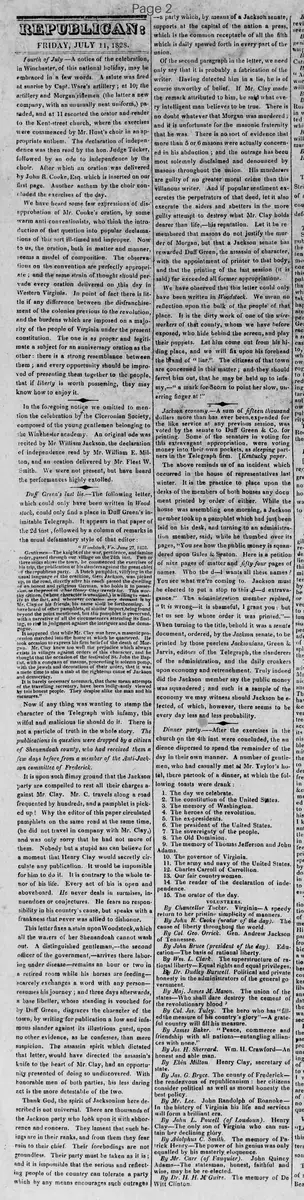
Duff Green's last lie.—The following letter, which could only have been written in Woodstock, could only find a place in Duff Green's inimitable Telegraph. It appears in that paper of the 2d inst., followed by a column of remarks in the usual defamatory style of that editor:
"Woodstock, Va. June 27, 1828.
Gentlemen—The knight of the war, pestilence, and famine order, passed through our village on the 24th inst. Two or three miles above the town, he commenced the exercises of his trip, the publication of his slanders against the great chieftain of the republican party. A Dutch pamphlet, vilifying in the usual language of the coalition, Get Jackson, was picked up in the road, directly after his coach passed the dwelling of an honest and religious German who holds possession, as the proof of that Henry Clay travels for. This worthy citizen, (whose character is unsullied,) is willing to qualify to the fact, and whenever occasion may demand it by Mr. Clay or his friends, his name shall be forthcoming. I have heard of other pamphlets, of similar import, being found beyond the point mentioned, but this pamphlet is preserved, with a narrative of all the circumstances attending its finding, to rise in judgment against the intriguer and the demagogue.
It happened that while Mr. Clay was here, a masonic procession marched into the house at which he quartered. He took occasion to express his firm belief of the death of Morgan. Mr. Clay knew too well the prejudice which always exists in villages against orders of this character, and he thought that the occasion of the festival of St. John the Baptist, with a company of masons, proceeding in solemn pomp, with the jewels and decorations of their order, that it was a meet time to aim a stab at the righteous cause of Jackson and democracy.
It is barely necessary to remark, that these mean attempts of the travelling secretary, have been indignantly viewed by this honest people. They despise alike the man and his measures."
Now if any thing was wanting to stamp the character of the Telegraph with infamy, this wilful and malicious lie should do it. There is not a particle of truth in the whole story. The publications in question were dropped by a citizen of Shenandoah county, who had received them a few days before from a member of the Anti-Jackson committee of Frederick.
It is upon such flimsy ground that the Jackson party are compelled to rest all their charges against Mr. Clay. Mr. C. travels along a road frequented by hundreds, and a pamphlet is picked up! Why the editor of this paper circulated pamphlets on the same road at the same time, (he did not travel in company with Mr. Clay,) and was only sorry that he had not more of them. Nobody but a stupid ass can believe for a moment that Henry Clay would secretly circulate any publication. It would be impossible for him to do it. It is contrary to the whole tenor of his life. Every act of his is open and aboveboard. He never deals in surmises, innuendoes or conjectures. He fears no responsibility in his country's cause, but speaks with a frankness that never was allied to dishonor.
This letter fixes a stain upon Woodstock, which all the waters of her Shenandoah cannot wash out. A distinguished gentleman,—the second officer of the government,—arrives there laboring under disease—remains an hour or two in a retired room while his horses are feeding—scarcely exchanges a word with any person—resumes his journey; and three days afterwards a base libeller, whose standing is vouched for by Duff Green, disgraces the character of the town, by writing for publication a low and infamous slander against its illustrious guest, upon no other evidence, as he confesses, than mere suspicion. The assassin spirit which dictated that letter, would have directed the assassin's knife to the heart of Mr. Clay, had an opportunity presented of doing so undiscovered. With honorable men of both parties, his less daring act is the more detestable of the two.
Thank God, the spirit of Jacksonism here described is not universal. There are thousands of the Jackson party who look upon it with abhorrence and concern. They lament that such beings are in their ranks, and from them they fear ruin to their chief. Their forebodings are not groundless. Their party must be taken as it is; and it is impossible that the serious and reflecting people of the country can tolerate a party which by any means encourages such outrages—a party which, by means of a Jackson senate, supports at the capital of the nation a press, which is the common receptacle of all the filth which is daily spewed forth in every part of the union.
Of the second paragraph in the letter, we need only say that it is probably a fabrication of the writer. Having detected him in a lie, he is of course unworthy of belief. If Mr. Clay made the remark attributed to him, he said what every intelligent man believes to be true. There is no doubt whatever that Morgan was murdered; and it is unfortunate for the masonic fraternity that he was. There is no sort of evidence that more than 5 or 6 masons were actually concerned in his abduction; and the outrage has been most solemnly disclaimed and denounced by masons throughout the union. His murderers are guilty of no greater moral crime than this villanous writer. And if popular sentiment execrates the perpetrators of that deed, let it also execrate the aiders and abetters in the more guilty attempt to destroy what Mr. Clay holds dearer than life,—his reputation. Let it be remembered that masons do not justify the murder of Morgan, but that a Jackson senate has rewarded Duff Green, the assassin of character, with the appointment of printer to that body and that the printing of the last session (it is said) far exceeded all former appropriations.
We have observed that this letter could only have been written in Woodstock. We mean no reflection upon the bulk of the people of that place. It is the dirty work of one of the wire-workers of that county, whom we have before exposed, who hide behind the screen, and play their puppets. Let him come out from his hiding place, and we will fix upon his forehead the brand of "liar." The citizens of that town are concerned in this matter; and they should ferret him out, that he may be held up to infamy,—"a mark for Scorn to point her slow, unerring finger at!"
"Woodstock, Va. June 27, 1828.
Gentlemen—The knight of the war, pestilence, and famine order, passed through our village on the 24th inst. Two or three miles above the town, he commenced the exercises of his trip, the publication of his slanders against the great chieftain of the republican party. A Dutch pamphlet, vilifying in the usual language of the coalition, Get Jackson, was picked up in the road, directly after his coach passed the dwelling of an honest and religious German who holds possession, as the proof of that Henry Clay travels for. This worthy citizen, (whose character is unsullied,) is willing to qualify to the fact, and whenever occasion may demand it by Mr. Clay or his friends, his name shall be forthcoming. I have heard of other pamphlets, of similar import, being found beyond the point mentioned, but this pamphlet is preserved, with a narrative of all the circumstances attending its finding, to rise in judgment against the intriguer and the demagogue.
It happened that while Mr. Clay was here, a masonic procession marched into the house at which he quartered. He took occasion to express his firm belief of the death of Morgan. Mr. Clay knew too well the prejudice which always exists in villages against orders of this character, and he thought that the occasion of the festival of St. John the Baptist, with a company of masons, proceeding in solemn pomp, with the jewels and decorations of their order, that it was a meet time to aim a stab at the righteous cause of Jackson and democracy.
It is barely necessary to remark, that these mean attempts of the travelling secretary, have been indignantly viewed by this honest people. They despise alike the man and his measures."
Now if any thing was wanting to stamp the character of the Telegraph with infamy, this wilful and malicious lie should do it. There is not a particle of truth in the whole story. The publications in question were dropped by a citizen of Shenandoah county, who had received them a few days before from a member of the Anti-Jackson committee of Frederick.
It is upon such flimsy ground that the Jackson party are compelled to rest all their charges against Mr. Clay. Mr. C. travels along a road frequented by hundreds, and a pamphlet is picked up! Why the editor of this paper circulated pamphlets on the same road at the same time, (he did not travel in company with Mr. Clay,) and was only sorry that he had not more of them. Nobody but a stupid ass can believe for a moment that Henry Clay would secretly circulate any publication. It would be impossible for him to do it. It is contrary to the whole tenor of his life. Every act of his is open and aboveboard. He never deals in surmises, innuendoes or conjectures. He fears no responsibility in his country's cause, but speaks with a frankness that never was allied to dishonor.
This letter fixes a stain upon Woodstock, which all the waters of her Shenandoah cannot wash out. A distinguished gentleman,—the second officer of the government,—arrives there laboring under disease—remains an hour or two in a retired room while his horses are feeding—scarcely exchanges a word with any person—resumes his journey; and three days afterwards a base libeller, whose standing is vouched for by Duff Green, disgraces the character of the town, by writing for publication a low and infamous slander against its illustrious guest, upon no other evidence, as he confesses, than mere suspicion. The assassin spirit which dictated that letter, would have directed the assassin's knife to the heart of Mr. Clay, had an opportunity presented of doing so undiscovered. With honorable men of both parties, his less daring act is the more detestable of the two.
Thank God, the spirit of Jacksonism here described is not universal. There are thousands of the Jackson party who look upon it with abhorrence and concern. They lament that such beings are in their ranks, and from them they fear ruin to their chief. Their forebodings are not groundless. Their party must be taken as it is; and it is impossible that the serious and reflecting people of the country can tolerate a party which by any means encourages such outrages—a party which, by means of a Jackson senate, supports at the capital of the nation a press, which is the common receptacle of all the filth which is daily spewed forth in every part of the union.
Of the second paragraph in the letter, we need only say that it is probably a fabrication of the writer. Having detected him in a lie, he is of course unworthy of belief. If Mr. Clay made the remark attributed to him, he said what every intelligent man believes to be true. There is no doubt whatever that Morgan was murdered; and it is unfortunate for the masonic fraternity that he was. There is no sort of evidence that more than 5 or 6 masons were actually concerned in his abduction; and the outrage has been most solemnly disclaimed and denounced by masons throughout the union. His murderers are guilty of no greater moral crime than this villanous writer. And if popular sentiment execrates the perpetrators of that deed, let it also execrate the aiders and abetters in the more guilty attempt to destroy what Mr. Clay holds dearer than life,—his reputation. Let it be remembered that masons do not justify the murder of Morgan, but that a Jackson senate has rewarded Duff Green, the assassin of character, with the appointment of printer to that body and that the printing of the last session (it is said) far exceeded all former appropriations.
We have observed that this letter could only have been written in Woodstock. We mean no reflection upon the bulk of the people of that place. It is the dirty work of one of the wire-workers of that county, whom we have before exposed, who hide behind the screen, and play their puppets. Let him come out from his hiding place, and we will fix upon his forehead the brand of "liar." The citizens of that town are concerned in this matter; and they should ferret him out, that he may be held up to infamy,—"a mark for Scorn to point her slow, unerring finger at!"
What sub-type of article is it?
Partisan Politics
Press Freedom
Moral Or Religious
What keywords are associated?
Henry Clay Defense
Duff Green Lie
Jackson Party Slander
Morgan Murder
Masonry
1828 Election
Woodstock Va
What entities or persons were involved?
Henry Clay
Duff Green
Andrew Jackson
William Morgan
Masonic Fraternity
Jackson Party
Telegraph Newspaper
Editorial Details
Primary Topic
Defense Of Henry Clay Against False Accusations Of Slander And Pamphlet Distribution
Stance / Tone
Strongly Pro Clay, Anti Jackson Party And Anti Duff Green
Key Figures
Henry Clay
Duff Green
Andrew Jackson
William Morgan
Masonic Fraternity
Jackson Party
Telegraph Newspaper
Key Arguments
The Letter Accusing Clay Of Dropping Anti Jackson Pamphlets Is A Complete Fabrication; Pamphlets Were Distributed By Others.
Clay's Character Is Honorable And Open, Incapable Of Secret Slander.
The Accusation Dishonors Woodstock, Va.
Jackson Party Relies On Such Lies And Supports Defamatory Press Like Green's Telegraph.
Clay's Alleged Remark On Morgan's Death Is Truthful; Morgan Was Murdered, But Only A Few Masons Involved, And The Fraternity Disclaims It.
Jackson Senate Rewards Character Assassins Like Green With Printing Contracts.