Thank you for visiting SNEWPapers!
Sign up free
Literary
November 24, 1804
The Enquirer
Richmond, Henrico County, Virginia
What is this article about?
An essay outlining the natural progression of settlement and improvement in agricultural nations, from hunting and shepherding stages to farming and urbanization, influenced by geography, commerce, and security. Focuses on U.S. colonial patterns along coasts and rivers.
Clipping
OCR Quality
98%
Excellent
Full Text
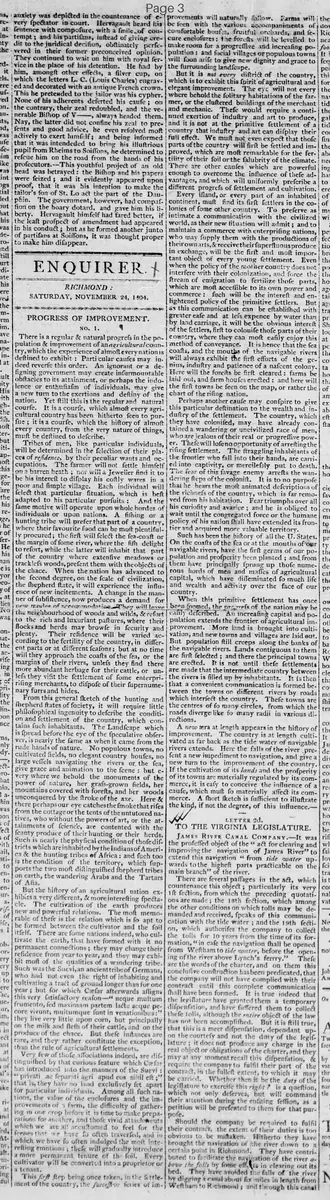
ENQUIRER.
RICHMOND:
SATURDAY, NOVEMBER 24, 1804.
PROGRESS OF IMPROVEMENT.
No. 1.
There is a regular & natural progress in the population & improvement of an agricultural country, which the experience of almost every nation is destined to exhibit: Particular causes may indeed reverse this order. An ignorant or a designing government may create insurmountable obstacles to its attainment, or perhaps the indolence or enthusiasm of individuals, may give a new turn to the exertions and destiny of the nation. Yet still this is the regular and natural course. It is a course, which almost every agricultural country has been hitherto seen to pursue; it is a course, which the history of almost every country, from the very nature of things, must be destined to describe.
Tribes of men, like particular individuals, will be determined in the election of their places of residence, by their peculiar wants and occupations. The farmer will not settle himself on a barren heath; nor will a Jeweller find it to be his interest to display his costly wares in a poor and simple village. Each individual will elect that particular situation, which is best adapted to his particular pursuits: And the same motive will operate upon whole hordes of individuals or upon nations. A fishing or a hunting tribe will prefer that part of a country, where their favourite food can be most plentifully procured: the first will select the sea-coast or the margin of some river, where the fish delight to resort, while the latter will inhabit that part of the country where extensive meadows or trackless woods, present them with the objects of the chase. When the nation has advanced to the second degree, on the scale of civilization, the shepherd state, it will experience the influence of new incitements. A change in the manner of subsistence, now produces a demand for new modes of accommodations They will leave the neighbourhood of woods and wilds, & resort to the rich and luxuriant pastures, where their flocks and herds may browse in security and plenty. Their residence will be varied according to the fertility of the country, in different parts or at different seasons; but at no time will they approach the coasts of the sea, or the margins of their rivers, unless they find there more abundant herbage for their cattle, or unless they visit the settlement of some enterprising merchants, to dispose of their supernumerary furrs and hides.
From this general sketch of the hunting and shepherd states of society. it will require little philosophical ingenuity to describe the condition and settlement of the country, which contains such inhabitants. The Landscape which is spread before the eye of the speculative observer, is nearly the same as when it came from the rude hands of nature. No populous towns, no cultivated fields, no elegant country houses, no large vessels navigating the rivers or the sea, give grace and animation to the scene: but everywhere we behold the monuments of the power of nature, her grass-grown fields, her mountains covered with forests, and her woods unconquered by the stroke of the axe. Here & there perhaps our eye catches the smoke that rises from the cottage or the tents of the untutored natives, who without the powers of art, or the attainments of science, are contented with the scanty produce of their hunting or their herds Such is nearly the physical condition of those districts which are inhabited by the Indians of America & the hunting tribes of Africa: and such too is the condition of the territory, which supports the two most distinguished shepherd tribes on earth, the wandering Arabs and the Tartars of Asia.
But the history of an agricultural nation exhibits a very different, & more interesting spectacle. The cultivation of the earth produces new and powerful relations. The most memorable of these is the relation which is so apt to be formed between the cultivator and the soil itself. There are some nations indeed, who cultivate the earth, that have formed with it no permanent connections; they may change their residence from year to year, and they may exhibit most of the qualities of a wandering tribe. Such was the Suevi, an ancient tribe of Germans, who had not even the right of inhabiting and cultivating a tract of ground longer than for one year; but for which Caesar afterwards assigns this very satisfactory reason-"neque multum frumento, sed maximam partem lacte atque pecore vivunt, multumque sunt in venationibus:" they live very little upon corn, but principally on the milk and flesh of their cattle, and on the produce of the chase. But these instances are rare, and they rather constitute the exception, than the rule of agricultural settlements.
Very few of those associations indeed, are distinguished by that curious feature which Caesar has introduced into the manners of the Suevi: "privati ac separati agri apud eos nihil est;" that is, they have no land exclusively set apart for particular individuals. Among all such nations, the value of the enclosures and the improvements of a farm, the difficulty of gathering in one crop before it is time to make preparations for another, and those vivid attachments which we are all accustomed to feel for the scenes that we have so often traversed, and in which we have so often indulged the most interesting emotions; these will gradually introduce a more permanent tenure of the soil. Every cultivator will be converted into a proprietor or a tenant.
This first step being once taken, in the settlement of the country, the successive series of improvements will naturally follow. Farms will be seen with the various accompaniments of comfortable houses. fruitful orchards, and secure enclosures: the forests will be levelled to make room for a progressive and increasing population: and social villages or populous towns will soon arise to give new dignity and grace to the surrounding landscape.
But it is not every district of the country, which is to exhibit this spirit of agricultural and elegant improvement. The eye will not everywhere behold the solitary habitations of the farmer, or the clustered buildings of the merchant and mechanic. These would require a continued exertion of industry and art to produce and it is not at the primitive settlement of a country that industry and art can display their full effect. We must not even expect that those parts of the country will first be settled and improved, which are most remarkable for the fertility of their soil or the salubrity of the climate. There are other causes which are powerful enough to overcome the influence of these advantages, and which will uniformly prescribe a different progress of settlement and cultivation.
Every island, or every part of an inhabited continent, must find its first settlers in the colonies of some other country. To preserve as intimate a communication with the civilized world, as their new situation will admit: and to maintain a commerce with enterprising nations, who may supply them with the productions of their own arts, & receive their superfluous produce in exchange, will be the first and most important object of every young settlement. Even when the policy of the mother country does not interfere with their colonization, and force the stream of emigration to fertilize those parts, which are most accessible to its own power and commerce: such will be the interest and enlightened policy of the primitive settlers. But as this communication can be established with greater ease and at less expense by water than by land carriage, it will be the obvious interest of the settlers, first to colonise those parts of their country, where they can most easily enjoy this method of conveyance. It is hence that the sea coasts, and the mouths of the navigable rivers will always exhibit the first efforts of the genius, industry and patience of a nascent colony. Here will the forests be first cleared: farms be laid out, and farm houses erected: and here will the first towns be seen on the map, or rather the chart of the rising nation.
Perhaps another cause may conspire to give this particular destination to the wealth and industry of the settlement. The country, which they have colonised, may have already contained a wandering or uncivilized race of men, who are jealous of their real or progressive power. These will lose no opportunity of arresting the rising settlement. The straggling inhabitants of the frontier who fall into their hands, are carried into captivity, or mercilessly put to death. The fear of this savage enemy arrests the wandering steps of the colonist. It is to no purpose that he hears the most animated descriptions of the richness of the country, which is far removed from his habitation. Fear triumphs over all his curiosity and avarice; and he is obliged to wait until the congregated force or the humane policy of his nation shall have extended its frontier and acquired more valuable territory.
Such has been the history of all the U. States. On the coasts of the sea or at the mouths of our navigable rivers, have the first germs of our population and prosperity been planted; and from them have principally sprung up those numerous hordes of men and masses of agricultural capital, which have disseminated so much life and wealth and activity over the face of our country.
When this primitive settlement has once been formed. the progress of the nation may be easily described. An increasing capital and population extends the frontier of agricultural improvement. More land is brought into cultivation, and new towns and villages are laid out. But population still creeps along the banks of the navigable rivers. Lands contiguous to them are first selected; and there the principal towns are erected. It is not until these settlements are made that the intermediate country between the rivers is filled up by inhabitants. It is then that a convenient communication is formed between the towns on different rivers by roads which intersect the country. These towns are the centres of so many circles, from which the roads diverge like so many radii in various directions.
A new era at length appears in the history of improvement. The country is at length cultivated as far back as the tide water of navigable rivers extends. Here the falls of the river present a new impediment to navigation, and give a new turn to the improvement of the country. If the cultivation of its lands and the prosperity of its towns are materially regulated by its commerce, it is easy to conceive the influence of a cause, which must so materially affect its commerce. A short sketch is sufficient to illustrate the kind, if not the degree, of this influence.
RICHMOND:
SATURDAY, NOVEMBER 24, 1804.
PROGRESS OF IMPROVEMENT.
No. 1.
There is a regular & natural progress in the population & improvement of an agricultural country, which the experience of almost every nation is destined to exhibit: Particular causes may indeed reverse this order. An ignorant or a designing government may create insurmountable obstacles to its attainment, or perhaps the indolence or enthusiasm of individuals, may give a new turn to the exertions and destiny of the nation. Yet still this is the regular and natural course. It is a course, which almost every agricultural country has been hitherto seen to pursue; it is a course, which the history of almost every country, from the very nature of things, must be destined to describe.
Tribes of men, like particular individuals, will be determined in the election of their places of residence, by their peculiar wants and occupations. The farmer will not settle himself on a barren heath; nor will a Jeweller find it to be his interest to display his costly wares in a poor and simple village. Each individual will elect that particular situation, which is best adapted to his particular pursuits: And the same motive will operate upon whole hordes of individuals or upon nations. A fishing or a hunting tribe will prefer that part of a country, where their favourite food can be most plentifully procured: the first will select the sea-coast or the margin of some river, where the fish delight to resort, while the latter will inhabit that part of the country where extensive meadows or trackless woods, present them with the objects of the chase. When the nation has advanced to the second degree, on the scale of civilization, the shepherd state, it will experience the influence of new incitements. A change in the manner of subsistence, now produces a demand for new modes of accommodations They will leave the neighbourhood of woods and wilds, & resort to the rich and luxuriant pastures, where their flocks and herds may browse in security and plenty. Their residence will be varied according to the fertility of the country, in different parts or at different seasons; but at no time will they approach the coasts of the sea, or the margins of their rivers, unless they find there more abundant herbage for their cattle, or unless they visit the settlement of some enterprising merchants, to dispose of their supernumerary furrs and hides.
From this general sketch of the hunting and shepherd states of society. it will require little philosophical ingenuity to describe the condition and settlement of the country, which contains such inhabitants. The Landscape which is spread before the eye of the speculative observer, is nearly the same as when it came from the rude hands of nature. No populous towns, no cultivated fields, no elegant country houses, no large vessels navigating the rivers or the sea, give grace and animation to the scene: but everywhere we behold the monuments of the power of nature, her grass-grown fields, her mountains covered with forests, and her woods unconquered by the stroke of the axe. Here & there perhaps our eye catches the smoke that rises from the cottage or the tents of the untutored natives, who without the powers of art, or the attainments of science, are contented with the scanty produce of their hunting or their herds Such is nearly the physical condition of those districts which are inhabited by the Indians of America & the hunting tribes of Africa: and such too is the condition of the territory, which supports the two most distinguished shepherd tribes on earth, the wandering Arabs and the Tartars of Asia.
But the history of an agricultural nation exhibits a very different, & more interesting spectacle. The cultivation of the earth produces new and powerful relations. The most memorable of these is the relation which is so apt to be formed between the cultivator and the soil itself. There are some nations indeed, who cultivate the earth, that have formed with it no permanent connections; they may change their residence from year to year, and they may exhibit most of the qualities of a wandering tribe. Such was the Suevi, an ancient tribe of Germans, who had not even the right of inhabiting and cultivating a tract of ground longer than for one year; but for which Caesar afterwards assigns this very satisfactory reason-"neque multum frumento, sed maximam partem lacte atque pecore vivunt, multumque sunt in venationibus:" they live very little upon corn, but principally on the milk and flesh of their cattle, and on the produce of the chase. But these instances are rare, and they rather constitute the exception, than the rule of agricultural settlements.
Very few of those associations indeed, are distinguished by that curious feature which Caesar has introduced into the manners of the Suevi: "privati ac separati agri apud eos nihil est;" that is, they have no land exclusively set apart for particular individuals. Among all such nations, the value of the enclosures and the improvements of a farm, the difficulty of gathering in one crop before it is time to make preparations for another, and those vivid attachments which we are all accustomed to feel for the scenes that we have so often traversed, and in which we have so often indulged the most interesting emotions; these will gradually introduce a more permanent tenure of the soil. Every cultivator will be converted into a proprietor or a tenant.
This first step being once taken, in the settlement of the country, the successive series of improvements will naturally follow. Farms will be seen with the various accompaniments of comfortable houses. fruitful orchards, and secure enclosures: the forests will be levelled to make room for a progressive and increasing population: and social villages or populous towns will soon arise to give new dignity and grace to the surrounding landscape.
But it is not every district of the country, which is to exhibit this spirit of agricultural and elegant improvement. The eye will not everywhere behold the solitary habitations of the farmer, or the clustered buildings of the merchant and mechanic. These would require a continued exertion of industry and art to produce and it is not at the primitive settlement of a country that industry and art can display their full effect. We must not even expect that those parts of the country will first be settled and improved, which are most remarkable for the fertility of their soil or the salubrity of the climate. There are other causes which are powerful enough to overcome the influence of these advantages, and which will uniformly prescribe a different progress of settlement and cultivation.
Every island, or every part of an inhabited continent, must find its first settlers in the colonies of some other country. To preserve as intimate a communication with the civilized world, as their new situation will admit: and to maintain a commerce with enterprising nations, who may supply them with the productions of their own arts, & receive their superfluous produce in exchange, will be the first and most important object of every young settlement. Even when the policy of the mother country does not interfere with their colonization, and force the stream of emigration to fertilize those parts, which are most accessible to its own power and commerce: such will be the interest and enlightened policy of the primitive settlers. But as this communication can be established with greater ease and at less expense by water than by land carriage, it will be the obvious interest of the settlers, first to colonise those parts of their country, where they can most easily enjoy this method of conveyance. It is hence that the sea coasts, and the mouths of the navigable rivers will always exhibit the first efforts of the genius, industry and patience of a nascent colony. Here will the forests be first cleared: farms be laid out, and farm houses erected: and here will the first towns be seen on the map, or rather the chart of the rising nation.
Perhaps another cause may conspire to give this particular destination to the wealth and industry of the settlement. The country, which they have colonised, may have already contained a wandering or uncivilized race of men, who are jealous of their real or progressive power. These will lose no opportunity of arresting the rising settlement. The straggling inhabitants of the frontier who fall into their hands, are carried into captivity, or mercilessly put to death. The fear of this savage enemy arrests the wandering steps of the colonist. It is to no purpose that he hears the most animated descriptions of the richness of the country, which is far removed from his habitation. Fear triumphs over all his curiosity and avarice; and he is obliged to wait until the congregated force or the humane policy of his nation shall have extended its frontier and acquired more valuable territory.
Such has been the history of all the U. States. On the coasts of the sea or at the mouths of our navigable rivers, have the first germs of our population and prosperity been planted; and from them have principally sprung up those numerous hordes of men and masses of agricultural capital, which have disseminated so much life and wealth and activity over the face of our country.
When this primitive settlement has once been formed. the progress of the nation may be easily described. An increasing capital and population extends the frontier of agricultural improvement. More land is brought into cultivation, and new towns and villages are laid out. But population still creeps along the banks of the navigable rivers. Lands contiguous to them are first selected; and there the principal towns are erected. It is not until these settlements are made that the intermediate country between the rivers is filled up by inhabitants. It is then that a convenient communication is formed between the towns on different rivers by roads which intersect the country. These towns are the centres of so many circles, from which the roads diverge like so many radii in various directions.
A new era at length appears in the history of improvement. The country is at length cultivated as far back as the tide water of navigable rivers extends. Here the falls of the river present a new impediment to navigation, and give a new turn to the improvement of the country. If the cultivation of its lands and the prosperity of its towns are materially regulated by its commerce, it is easy to conceive the influence of a cause, which must so materially affect its commerce. A short sketch is sufficient to illustrate the kind, if not the degree, of this influence.
What sub-type of article is it?
Essay
What themes does it cover?
Agriculture Rural
Commerce Trade
Political
What keywords are associated?
Agricultural Progress
Settlement Patterns
Colonization
Rivers Commerce
Population Growth
Civilization Stages
U.S. History
Literary Details
Title
Progress Of Improvement. No. 1.
Key Lines
There Is A Regular & Natural Progress In The Population & Improvement Of An Agricultural Country, Which The Experience Of Almost Every Nation Is Destined To Exhibit:
It Is Hence That The Sea Coasts, And The Mouths Of The Navigable Rivers Will Always Exhibit The First Efforts Of The Genius, Industry And Patience Of A Nascent Colony.
Such Has Been The History Of All The U. States. On The Coasts Of The Sea Or At The Mouths Of Our Navigable Rivers, Have The First Germs Of Our Population And Prosperity Been Planted;