Thank you for visiting SNEWPapers!
Sign up free
Literary
October 17, 1865
Daily State Sentinel
Indianapolis, Marion County, Indiana
What is this article about?
In this short story, a group tests the emotional insensibility of Count de St. Floy, who claims his heart was surgically removed. Through flirtation, gambling, and a mock duel, they fail to rouse him until the Baroness de St. Agne convinces him she holds his heart, leading to his death from overwhelming emotion. She later dies, questioning true madness.
Clipping
OCR Quality
98%
Excellent
Full Text
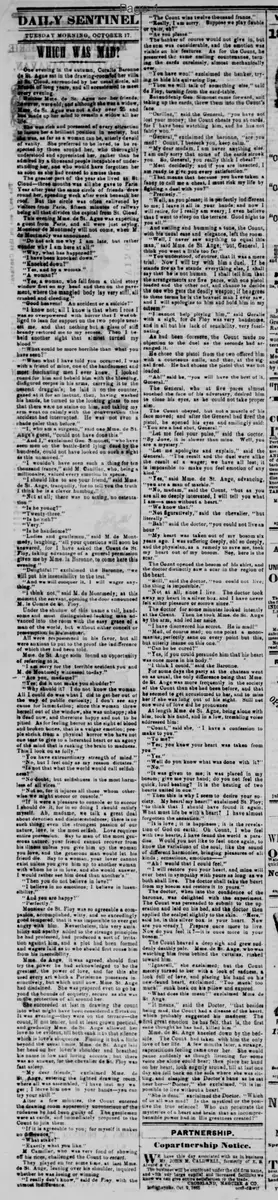
DAILY SENTINEL
TUESDAY MORNING, OCTOBER 17.
WHICH WAS MAD?
One evening in the autumn, Coralie Baronne de St. Agne sat in the drawing-room of her villa at St. Cloud, surrounded by her usual circle, all of long years, and all accustomed to meet every evening. Neither Mme. de St. Agne nor her friends were old: and although she was a widow, Mme. de St. Agne was not a day over 25 and had made up her mind to remain a widow all her life. She was rich and possessed every attraction to insure her a brilliant position in society, but she was, as far as a woman can be, utterly devoid of vanity. She preferred to be loved, to be respected by those around her, who thoroughly understood and appreciated her, rather than be admired by a thousand people incapable of understanding her, and who would have forgotten her as soon as she had ceased to amuse them.
The greater part of the year she lived at St. Cloud—three months was all she gave to Paris. Year after year the same circle of friends drew round her, spending week after week beneath her roof. But the circle was often enlivened by visitors from Paris, fifteen minutes of railway being all that divides the capital from St. Cloud.
This evening Mme. de St. Agne was expecting a guest from Paris, and all were just saying, "Monsieur de Montmedy will not come," when M. de Montmedy was announced.
"Do not ask me why I am late, but rather wonder why I am here at all."
"Why? What has happened?"
"I have been knocked down."
"Knocked down?"
"Yes, and by a woman, who fell from a third story window first on my head and then on the pavement, where the mangled body lay very still, all crushed and bleeding."
"Good heavens! An accident or a suicide?"
"I know not: all I know is that when I rose I was so overpowered with horror that I was obliged to lean for support on the two people nearest me, and that nothing but a glass of stiff brandy restored me to my senses. Then I beheld another sight that almost turned my blood."
"What could be more horrible than what you have seen?"
"When what I have told you occurred, I was with a friend of mine, one of the handsomest and most fascinating men I ever knew. I looked round for him and beheld him with the bleeding, disfigured corpse in his arms, carrying it to the nearest druggist's; he laid it on the counter, gazed at it for an instant, then, having washed his hands, he turned to the looking glass to see that there were no stains on him, and taking my arm went on calmly with the conversation this accident had interrupted. He was not even a shade paler than before."
"I, who am a surgeon," said one Mme. de St. Ange's guest, "could not have done this."
"And I," exclaimed Gen. Simonet, "who have seen men on the battle-field lying dead by the hundreds, could not have looked on such a sight unmoved."
"I wouldn't have seen such a thing for ten thousand francs," said M. Camillac, who, being a millionaire, valued every emotion in specie.
"I should like to see your friend," said Mme. de St. Ange, tranquilly, "for to tell you the truth I think he is a clever humbug."
"Not at all; there was no acting, no ostentation."
"Is he young?"
"Twenty-three."
"Is he rich?"
"Very."
"Is he handsome?"
"Ladies and gentlemen," said M. de Montmedy, laughing, "all your questions will soon be answered, for I have asked the Count de St. Floy, taking advantage of a general permission given me by Mme. la Baronne, to come here this evening."
"Delightful!" exclaimed the Baronne, "we will put his insensibility to the test. And we will conquer it. I will wager anything."
"I think not," said M. de Montmedy; at this moment the servant, opening the door announced M. le Comte de St. Floy.
Under the shadow of this name a tall, handsome and most distinguished-looking man advanced into the room with the easy grace of a man of the world, but without either conceit or presumption in his manner. All were prepossessed in his favor, but all were anxious to put to the proof the indifference of which they had been told.
Mme. de St. Ange soon found an opportunity of referring to it.
"I am sorry for the terrible accident you and M. de Montmedy witnessed to-day."
"Are you, madame?"
"Yes; did it not make you shudder?"
"Why should it? I do not know the woman. All I could do was what I did to get her out of the way of public curiosity; I don't see any cause for lamentation; since this woman threw herself out of the window, she was unhappy; she is dead now, and therefore happy and not to be pitied. As for feeling horror at the sight of blood and broken bones, that is a vulgar emotion; people shrink from a physical horror who have not one tear to give to a lacerated heart or an agony of the mind that is racking the brain to madness. This I look on as folly."
"You have extraordinary strength of mind."
"No, but I feel only as my reason dictates. Is not that what the world would call selfishness?"
"No doubt; but selfishness is the most harmless of all vices."
"Not so, for it injures all those whom otherwise we might succor or console."
"If it were a pleasure to console or to succor I should do it, for in so doing I should satisfy myself. Ah, madame, we talk a great deal about devotion and disinterestedness; there is no such thing; even the strongest passion of our nature, love, is the most selfish. Love requires entire possession. Say to man of the most generous nature, your friend cannot recover from his illness unless you give him up the woman you love, and the generous man would let his friend die. Say to a woman, your lover cannot exist unless you give him up to another woman with whom he is in love, and she would answer, I would rather see him dead than another's."
"Then you do not believe in love?"
"I believe in insensibility."
"And you are happy?"
"Perfectly."
Monsieur de St. Floy was so agreeable a companion, accomplished, witty, and so exceedingly good tempered, that it was impossible to ever get angry with him. Nevertheless, this very amiability and apathy added to the strange principles he had professed, had produced a sort of irritation against him, and a plot had been formed and wagers laid as to who should first rouse him from his insensibility.
Mme. de Ange, it was agreed, should first try the power he had acknowledged to be the greatest, the power of love, and for this she used every art which a Parisienne possesses instinctively, but which until now, Mme St. Ange had disdained. She was prepared even to go beyond the bounds of coquetry, secure as she was in the protection of all around her.
She succeeded at last in drawing the count into what might have been considered a flirtation. It was evening—they were on the terrace—the count, if not tender, had at least grown poetical, and gradually Mme de St Auge allowed her love to be evident, till both sank into that silence which is love's eloquence. Finding it but a little beyond the usual limits, Mme. de St. Ange laid her head on her lover's shoulder and breathed his name in low and loving accents; but there was no answer, for the chevalier de St. Floy was fast asleep.
"My dear friends," exclaimed Mme. de St. Ange, entering the lighted drawing room, where all was assembled, "I have lost my wager; I leave him now in your hands—you can try your skill."
After a few minutes, the Count entered the drawing room apparently unconscious of the rudeness he had been guilty of. The gentlemen were at cards, and immediately proposed to the Count to join them.
"If it is agreeable to you; for myself it makes no difference. What stake?"
"Exactly what you like."
M. Camillac, who was very fond of showing off his riches, challenged the Count to écarté. They played on for some time, at last Mme. de St. Auge, leaning over his shoulder, inquired whether he was losing or winning.
"I really don't know," said de Floy, with the utmost indifference.
"The Count wins twelve thousand francs."
"Really, I am sorry. Suppose we play double or quits, eh?"
The banker of course would not give in, but the sum was considerable, and the emotion was visible on his features. As for the Count, he preserved the same smiling countenance, turning the cards carelessly, almost mechanically over.
"You have won!" exclaimed the banker, trying to hide his quivering lips.
"Then we will talk of something else," said de Floy, turning from the card-table.
But suddenly Gen. Simonet came forward, and taking up the cards, threw them into the Count's face.
"Camillac," said the General, "you have not lost your money; the Count cheats you at cards, for I have been watching him, and he has not fairly won."
"General," exclaimed the baronne, "are you mad? Count, I beseech you, keep calm."
"My dear madam, I am never anything else. I am only sorry that some of the cards struck you. So, General, you really think I cheat?"
"Most decidedly; and if you are insulted, I am ready to give you every satisfaction."
"That means that because you have taken a fancy to call me a cheat, I must risk my life by fighting a duel with you?"
"Precisely."
"Well, as you please; it is perfectly indifferent to me; I leave it all in your hands; and now I will retire, for I really am weary; I even believe that I went to sleep on the terrace. Good night to you all."
And smiling and humming a tune, the Count with his usual ease and elegance, left the room.
"Well, I never saw anything to equal this man," said Mme. de St. Ange; "but, General, I think you went a little too far."
"You understood, of course, that it was a mere trial. Now I will try with him a duel. If he stands fire as he stands everything else, I shall say that he is not human. I shall tell him that the arrangements are five paces, with one pistol loaded and the other not, and chance to decide the one who gets the deadly weapon; if he agrees to these terms he is the bravest man I ever saw, and I will apologize to him and hold him in my esteem."
"I cannot help pitying him," said Coralie with a sigh, for de Floy was very handsome, and in all but his lack of sensibility, very fascinating.
As had been foreseen, the Count made no objection to the duel as the seconds had arranged it. He chose the pistol from the two offered him with a courteous smile, and then, at the signal fired. He had chosen the pistol that was not loaded.
"Ah!" said he, "you will have the best of it, General."
The General, who at five paces almost touched the face of his adversary, desired him to close his eyes, as he could not take proper aim.
The Count obeyed, but not a muscle of his face moved; and after the General had fired the pistol, he opened his eyes and smilingly said:
"You are a bad shot, General."
"Let me feel your pulse," said the doctor.
"By Jove, it is slower than mine. Well, you are a mystery."
"Let me apologize and explain," said the General. "The result and the duel were alike the result of a wager; we have all lost; it is impossible to make you feel emotion of any kind."
"Yes," said Mme. de St. Ange, advancing, "you are a man of marble."
"No, madam," said the Count, "but as you are all so deeply interested, I will tell you what I am—a man without a heart."
"We know that."
"Not figuratively," said the chevalier, "but literally."
"Bah!" said the doctor, "you could not live an hour."
"My heart was taken out of my bosom six years ago. I was suffering deeply, oh! so deeply, and the physician, as a remedy to save me, took my heart out of my bosom. See, here is the scar."
The Count opened the bosom of his shirt, and the doctor distinctly saw a scar in the region of the heart.
"Still," said the doctor, "you could not live; the thing is impossible."
"Not at all, since I live. The doctor took away my heart in a silver box, and I have never felt either pleasure or sorrow since."
The doctor for some minutes looked intently at the Count. Then he took Mme. de St. Ange by the arm, and led her aside.
"I have discovered his secret. He is mad!"
"Mad, of course mad; on one point a monomaniac; perfectly sane on every point but this, but utterly insane on this one."
"Can he be cured?"
"Yes, if you could persuade him that his heart was once more in his body."
"I think I could," said the Baronne.
For some days the party at the chateau went on as usual, the only difference being that Mme. de St. Ange was more frequently in the society of the Count than she had been before, and that he seemed to get accustomed to her, and to miss her if she was long out of his sight. Still not one word of love did he pronounce.
At length Mme. de St Agne, being alone with him, took his hand, and in a low, trembling voice addressed him:
"Count," said she, "I have a confession to make to you."
"To me?"
"Yes; you know your heart was taken from you."
"Yes."
"Well do you know what was done with it?"
"No."
"It was given to me; it was placed in my bosom; give me your hand; do you not feel the quick, loud beating? It is the beating of two hearts united in one."
"Then this is why I seem to desire your society. My heart! my heart!" exclaimed St. Floy; "to think that I should have found it again. What must life be with a heart? I have almost forgotten the sensation. It is love; it is happiness; it is the revelation of God on earth: Oh Count. I who feel with two hearts, I have found the world a paradise. Would you not like to feel once again, to know the variations of the soul, like the sound of different harmonies, bringing pleasures of all kinds; sensations, emotions."
"Ah I would that I could feel."
"I will restore you your heart, and mine will ever beat in sympathy with yours as long as we both shall live. The doctor shall take the heart from my bosom and restore it to yours."
The doctor, when taken into the confidence of the baronne, was delighted with the experiment. The Count was persuaded to submit to the operation and laid on his bed, and the doctor then applied the scalpel slightly to the skin. "Here," said he, "in this silver box is your heart. Now are you ready? Prepare once more to live. Now do you feel it?—it is once more in your bosom."
The Count heaved a deep sigh and grew suddenly deathly pale. Mme. de St. Ange, who was watching him from behind the curtains, rushed toward him.
"Ignace!" she exclaimed; but the Count merely turned to her with a look of sadness, a look full of love, and placing his hand on his new-found heart, exclaimed: "Too much! too much!" sunk back on his pillow and expired.
"What does this mean?" exclaimed Mme de St. Ange.
"It means," said the Doctor, "that besides being mad, the Count had a disease of the heart, which probably suggested his madness. The first great emotion he has felt, that is, the first sane thought he has had, killed him."
Mme. de St. Ange kneeled down by the bedside. The Count had taken with him the only love of her life. A few months later, a strange, superstitious feeling came over her. She would pause suddenly as though listening for some voice she alone could hear; then place her hand on her heart, look eagerly around, till at last one day she fell back on the sofa where she was sitting, and clasping the Doctor's hand as he sat near her—"Doctor," she exclaimed, "it is impossible to live without a heart."
"She is dead!" exclaimed the Doctor. "Which of us all was mad? Is the mystical or the positive the true science? Who can penetrate the mysteries of a heart and brain that an incomprehensible power had in His greatness created?"
TUESDAY MORNING, OCTOBER 17.
WHICH WAS MAD?
One evening in the autumn, Coralie Baronne de St. Agne sat in the drawing-room of her villa at St. Cloud, surrounded by her usual circle, all of long years, and all accustomed to meet every evening. Neither Mme. de St. Agne nor her friends were old: and although she was a widow, Mme. de St. Agne was not a day over 25 and had made up her mind to remain a widow all her life. She was rich and possessed every attraction to insure her a brilliant position in society, but she was, as far as a woman can be, utterly devoid of vanity. She preferred to be loved, to be respected by those around her, who thoroughly understood and appreciated her, rather than be admired by a thousand people incapable of understanding her, and who would have forgotten her as soon as she had ceased to amuse them.
The greater part of the year she lived at St. Cloud—three months was all she gave to Paris. Year after year the same circle of friends drew round her, spending week after week beneath her roof. But the circle was often enlivened by visitors from Paris, fifteen minutes of railway being all that divides the capital from St. Cloud.
This evening Mme. de St. Agne was expecting a guest from Paris, and all were just saying, "Monsieur de Montmedy will not come," when M. de Montmedy was announced.
"Do not ask me why I am late, but rather wonder why I am here at all."
"Why? What has happened?"
"I have been knocked down."
"Knocked down?"
"Yes, and by a woman, who fell from a third story window first on my head and then on the pavement, where the mangled body lay very still, all crushed and bleeding."
"Good heavens! An accident or a suicide?"
"I know not: all I know is that when I rose I was so overpowered with horror that I was obliged to lean for support on the two people nearest me, and that nothing but a glass of stiff brandy restored me to my senses. Then I beheld another sight that almost turned my blood."
"What could be more horrible than what you have seen?"
"When what I have told you occurred, I was with a friend of mine, one of the handsomest and most fascinating men I ever knew. I looked round for him and beheld him with the bleeding, disfigured corpse in his arms, carrying it to the nearest druggist's; he laid it on the counter, gazed at it for an instant, then, having washed his hands, he turned to the looking glass to see that there were no stains on him, and taking my arm went on calmly with the conversation this accident had interrupted. He was not even a shade paler than before."
"I, who am a surgeon," said one Mme. de St. Ange's guest, "could not have done this."
"And I," exclaimed Gen. Simonet, "who have seen men on the battle-field lying dead by the hundreds, could not have looked on such a sight unmoved."
"I wouldn't have seen such a thing for ten thousand francs," said M. Camillac, who, being a millionaire, valued every emotion in specie.
"I should like to see your friend," said Mme. de St. Ange, tranquilly, "for to tell you the truth I think he is a clever humbug."
"Not at all; there was no acting, no ostentation."
"Is he young?"
"Twenty-three."
"Is he rich?"
"Very."
"Is he handsome?"
"Ladies and gentlemen," said M. de Montmedy, laughing, "all your questions will soon be answered, for I have asked the Count de St. Floy, taking advantage of a general permission given me by Mme. la Baronne, to come here this evening."
"Delightful!" exclaimed the Baronne, "we will put his insensibility to the test. And we will conquer it. I will wager anything."
"I think not," said M. de Montmedy; at this moment the servant, opening the door announced M. le Comte de St. Floy.
Under the shadow of this name a tall, handsome and most distinguished-looking man advanced into the room with the easy grace of a man of the world, but without either conceit or presumption in his manner. All were prepossessed in his favor, but all were anxious to put to the proof the indifference of which they had been told.
Mme. de St. Ange soon found an opportunity of referring to it.
"I am sorry for the terrible accident you and M. de Montmedy witnessed to-day."
"Are you, madame?"
"Yes; did it not make you shudder?"
"Why should it? I do not know the woman. All I could do was what I did to get her out of the way of public curiosity; I don't see any cause for lamentation; since this woman threw herself out of the window, she was unhappy; she is dead now, and therefore happy and not to be pitied. As for feeling horror at the sight of blood and broken bones, that is a vulgar emotion; people shrink from a physical horror who have not one tear to give to a lacerated heart or an agony of the mind that is racking the brain to madness. This I look on as folly."
"You have extraordinary strength of mind."
"No, but I feel only as my reason dictates. Is not that what the world would call selfishness?"
"No doubt; but selfishness is the most harmless of all vices."
"Not so, for it injures all those whom otherwise we might succor or console."
"If it were a pleasure to console or to succor I should do it, for in so doing I should satisfy myself. Ah, madame, we talk a great deal about devotion and disinterestedness; there is no such thing; even the strongest passion of our nature, love, is the most selfish. Love requires entire possession. Say to man of the most generous nature, your friend cannot recover from his illness unless you give him up the woman you love, and the generous man would let his friend die. Say to a woman, your lover cannot exist unless you give him up to another woman with whom he is in love, and she would answer, I would rather see him dead than another's."
"Then you do not believe in love?"
"I believe in insensibility."
"And you are happy?"
"Perfectly."
Monsieur de St. Floy was so agreeable a companion, accomplished, witty, and so exceedingly good tempered, that it was impossible to ever get angry with him. Nevertheless, this very amiability and apathy added to the strange principles he had professed, had produced a sort of irritation against him, and a plot had been formed and wagers laid as to who should first rouse him from his insensibility.
Mme. de Ange, it was agreed, should first try the power he had acknowledged to be the greatest, the power of love, and for this she used every art which a Parisienne possesses instinctively, but which until now, Mme St. Ange had disdained. She was prepared even to go beyond the bounds of coquetry, secure as she was in the protection of all around her.
She succeeded at last in drawing the count into what might have been considered a flirtation. It was evening—they were on the terrace—the count, if not tender, had at least grown poetical, and gradually Mme de St Auge allowed her love to be evident, till both sank into that silence which is love's eloquence. Finding it but a little beyond the usual limits, Mme. de St. Ange laid her head on her lover's shoulder and breathed his name in low and loving accents; but there was no answer, for the chevalier de St. Floy was fast asleep.
"My dear friends," exclaimed Mme. de St. Ange, entering the lighted drawing room, where all was assembled, "I have lost my wager; I leave him now in your hands—you can try your skill."
After a few minutes, the Count entered the drawing room apparently unconscious of the rudeness he had been guilty of. The gentlemen were at cards, and immediately proposed to the Count to join them.
"If it is agreeable to you; for myself it makes no difference. What stake?"
"Exactly what you like."
M. Camillac, who was very fond of showing off his riches, challenged the Count to écarté. They played on for some time, at last Mme. de St. Auge, leaning over his shoulder, inquired whether he was losing or winning.
"I really don't know," said de Floy, with the utmost indifference.
"The Count wins twelve thousand francs."
"Really, I am sorry. Suppose we play double or quits, eh?"
The banker of course would not give in, but the sum was considerable, and the emotion was visible on his features. As for the Count, he preserved the same smiling countenance, turning the cards carelessly, almost mechanically over.
"You have won!" exclaimed the banker, trying to hide his quivering lips.
"Then we will talk of something else," said de Floy, turning from the card-table.
But suddenly Gen. Simonet came forward, and taking up the cards, threw them into the Count's face.
"Camillac," said the General, "you have not lost your money; the Count cheats you at cards, for I have been watching him, and he has not fairly won."
"General," exclaimed the baronne, "are you mad? Count, I beseech you, keep calm."
"My dear madam, I am never anything else. I am only sorry that some of the cards struck you. So, General, you really think I cheat?"
"Most decidedly; and if you are insulted, I am ready to give you every satisfaction."
"That means that because you have taken a fancy to call me a cheat, I must risk my life by fighting a duel with you?"
"Precisely."
"Well, as you please; it is perfectly indifferent to me; I leave it all in your hands; and now I will retire, for I really am weary; I even believe that I went to sleep on the terrace. Good night to you all."
And smiling and humming a tune, the Count with his usual ease and elegance, left the room.
"Well, I never saw anything to equal this man," said Mme. de St. Ange; "but, General, I think you went a little too far."
"You understood, of course, that it was a mere trial. Now I will try with him a duel. If he stands fire as he stands everything else, I shall say that he is not human. I shall tell him that the arrangements are five paces, with one pistol loaded and the other not, and chance to decide the one who gets the deadly weapon; if he agrees to these terms he is the bravest man I ever saw, and I will apologize to him and hold him in my esteem."
"I cannot help pitying him," said Coralie with a sigh, for de Floy was very handsome, and in all but his lack of sensibility, very fascinating.
As had been foreseen, the Count made no objection to the duel as the seconds had arranged it. He chose the pistol from the two offered him with a courteous smile, and then, at the signal fired. He had chosen the pistol that was not loaded.
"Ah!" said he, "you will have the best of it, General."
The General, who at five paces almost touched the face of his adversary, desired him to close his eyes, as he could not take proper aim.
The Count obeyed, but not a muscle of his face moved; and after the General had fired the pistol, he opened his eyes and smilingly said:
"You are a bad shot, General."
"Let me feel your pulse," said the doctor.
"By Jove, it is slower than mine. Well, you are a mystery."
"Let me apologize and explain," said the General. "The result and the duel were alike the result of a wager; we have all lost; it is impossible to make you feel emotion of any kind."
"Yes," said Mme. de St. Ange, advancing, "you are a man of marble."
"No, madam," said the Count, "but as you are all so deeply interested, I will tell you what I am—a man without a heart."
"We know that."
"Not figuratively," said the chevalier, "but literally."
"Bah!" said the doctor, "you could not live an hour."
"My heart was taken out of my bosom six years ago. I was suffering deeply, oh! so deeply, and the physician, as a remedy to save me, took my heart out of my bosom. See, here is the scar."
The Count opened the bosom of his shirt, and the doctor distinctly saw a scar in the region of the heart.
"Still," said the doctor, "you could not live; the thing is impossible."
"Not at all, since I live. The doctor took away my heart in a silver box, and I have never felt either pleasure or sorrow since."
The doctor for some minutes looked intently at the Count. Then he took Mme. de St. Ange by the arm, and led her aside.
"I have discovered his secret. He is mad!"
"Mad, of course mad; on one point a monomaniac; perfectly sane on every point but this, but utterly insane on this one."
"Can he be cured?"
"Yes, if you could persuade him that his heart was once more in his body."
"I think I could," said the Baronne.
For some days the party at the chateau went on as usual, the only difference being that Mme. de St. Ange was more frequently in the society of the Count than she had been before, and that he seemed to get accustomed to her, and to miss her if she was long out of his sight. Still not one word of love did he pronounce.
At length Mme. de St Agne, being alone with him, took his hand, and in a low, trembling voice addressed him:
"Count," said she, "I have a confession to make to you."
"To me?"
"Yes; you know your heart was taken from you."
"Yes."
"Well do you know what was done with it?"
"No."
"It was given to me; it was placed in my bosom; give me your hand; do you not feel the quick, loud beating? It is the beating of two hearts united in one."
"Then this is why I seem to desire your society. My heart! my heart!" exclaimed St. Floy; "to think that I should have found it again. What must life be with a heart? I have almost forgotten the sensation. It is love; it is happiness; it is the revelation of God on earth: Oh Count. I who feel with two hearts, I have found the world a paradise. Would you not like to feel once again, to know the variations of the soul, like the sound of different harmonies, bringing pleasures of all kinds; sensations, emotions."
"Ah I would that I could feel."
"I will restore you your heart, and mine will ever beat in sympathy with yours as long as we both shall live. The doctor shall take the heart from my bosom and restore it to yours."
The doctor, when taken into the confidence of the baronne, was delighted with the experiment. The Count was persuaded to submit to the operation and laid on his bed, and the doctor then applied the scalpel slightly to the skin. "Here," said he, "in this silver box is your heart. Now are you ready? Prepare once more to live. Now do you feel it?—it is once more in your bosom."
The Count heaved a deep sigh and grew suddenly deathly pale. Mme. de St. Ange, who was watching him from behind the curtains, rushed toward him.
"Ignace!" she exclaimed; but the Count merely turned to her with a look of sadness, a look full of love, and placing his hand on his new-found heart, exclaimed: "Too much! too much!" sunk back on his pillow and expired.
"What does this mean?" exclaimed Mme de St. Ange.
"It means," said the Doctor, "that besides being mad, the Count had a disease of the heart, which probably suggested his madness. The first great emotion he has felt, that is, the first sane thought he has had, killed him."
Mme. de St. Ange kneeled down by the bedside. The Count had taken with him the only love of her life. A few months later, a strange, superstitious feeling came over her. She would pause suddenly as though listening for some voice she alone could hear; then place her hand on her heart, look eagerly around, till at last one day she fell back on the sofa where she was sitting, and clasping the Doctor's hand as he sat near her—"Doctor," she exclaimed, "it is impossible to live without a heart."
"She is dead!" exclaimed the Doctor. "Which of us all was mad? Is the mystical or the positive the true science? Who can penetrate the mysteries of a heart and brain that an incomprehensible power had in His greatness created?"
What sub-type of article is it?
Prose Fiction
Dialogue
What themes does it cover?
Love Romance
Death Mortality
Moral Virtue
What keywords are associated?
Madness
Insensibility
Love
Heart
Duel
Suicide
Emotion
Physician
Scar
Literary Details
Title
Which Was Mad?
Key Lines
"My Heart Was Taken Out Of My Bosom Six Years Ago. I Was Suffering Deeply, Oh! So Deeply, And The Physician, As A Remedy To Save Me, Took My Heart Out Of My Bosom. See, Here Is The Scar."
"It Was Given To Me; It Was Placed In My Bosom; Give Me Your Hand; Do You Not Feel The Quick, Loud Beating? It Is The Beating Of Two Hearts United In One."
"Too Much! Too Much!" Sunk Back On His Pillow And Expired.
"Doctor," She Exclaimed, "It Is Impossible To Live Without A Heart."
"Which Of Us All Was Mad? Is The Mystical Or The Positive The True Science? Who Can Penetrate The Mysteries Of A Heart And Brain That An Incomprehensible Power Had In His Greatness Created?"