Thank you for visiting SNEWPapers!
Sign up free
Editorial
September 9, 1843
The Port Gibson Correspondent
Port Gibson, Claiborne County, Mississippi
What is this article about?
Editorial listing democratic principles attributed to Thomas Jefferson, covering popular sovereignty, church-state separation, limited federal power, individual rights, and accountable government.
Clipping
OCR Quality
95%
Excellent
Full Text
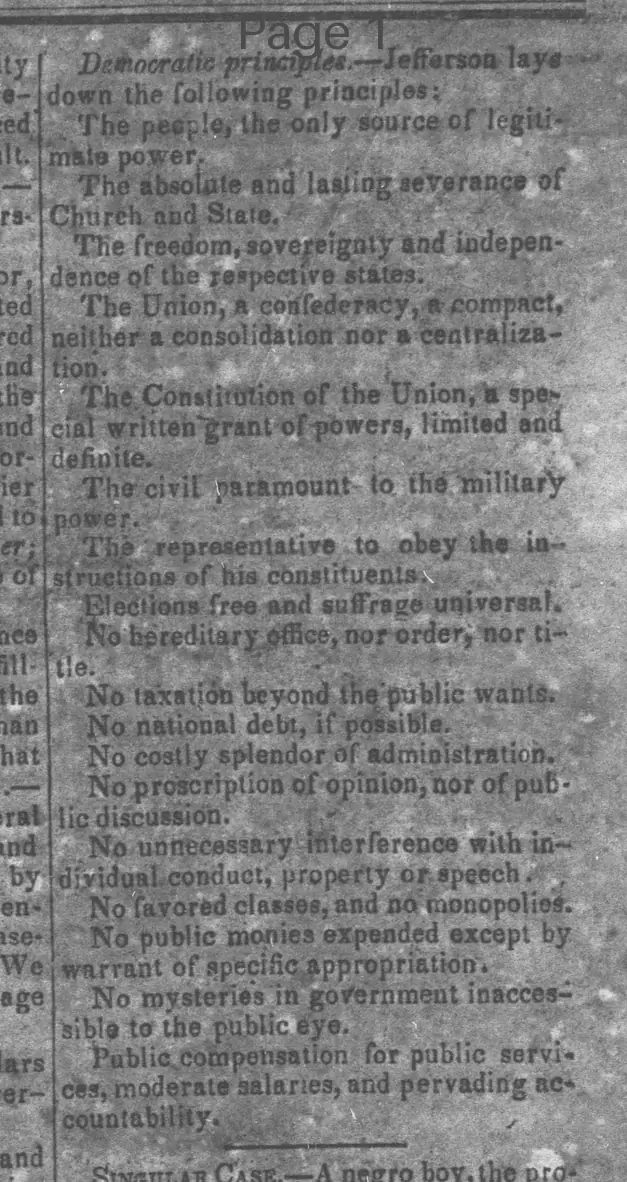
Democratic principles.—Jefferson laid down the following principles:
The people, the only source of legitimate power,
The absolute and lasting severance of Church and State.
The freedom, sovereignty and independence of the respective states.
The Union, a confederacy, & compact, neither a consolidation nor a centralization.
The Constitution of the Union, a special written grant of powers, limited and definite.
The civil paramount to the military power.
The representative to obey the instructions of his constituents
Elections free and suffrage universal.
No hereditary office, nor order, nor title.
No taxation beyond the public wants.
No national debt, if possible.
No costly splendor of administration.
No proscription of opinion, nor of public discussion.
No unnecessary interference with individual conduct, property or speech.
No favored classes, and no monopolies.
No public monies expended except by warrant of specific appropriation.
No mysteries in government inaccessible to the public eye.
Public compensation for public services, moderate salaries, and pervading accountability.
The people, the only source of legitimate power,
The absolute and lasting severance of Church and State.
The freedom, sovereignty and independence of the respective states.
The Union, a confederacy, & compact, neither a consolidation nor a centralization.
The Constitution of the Union, a special written grant of powers, limited and definite.
The civil paramount to the military power.
The representative to obey the instructions of his constituents
Elections free and suffrage universal.
No hereditary office, nor order, nor title.
No taxation beyond the public wants.
No national debt, if possible.
No costly splendor of administration.
No proscription of opinion, nor of public discussion.
No unnecessary interference with individual conduct, property or speech.
No favored classes, and no monopolies.
No public monies expended except by warrant of specific appropriation.
No mysteries in government inaccessible to the public eye.
Public compensation for public services, moderate salaries, and pervading accountability.
What sub-type of article is it?
Constitutional
What keywords are associated?
Jefferson Principles
Democratic Ideals
Church State Separation
Limited Government
Popular Sovereignty
Universal Suffrage
State Sovereignty
What entities or persons were involved?
Jefferson
Editorial Details
Primary Topic
Jefferson's Democratic Principles
Stance / Tone
Affirmative Endorsement
Key Figures
Jefferson
Key Arguments
People As Only Source Of Legitimate Power
Absolute Severance Of Church And State
State Sovereignty And Independence
Union As Confederacy And Compact
Constitution As Limited Grant Of Powers
Civil Power Paramount To Military
Representatives Obey Constituents
Free Elections And Universal Suffrage
No Hereditary Offices Or Titles
Taxation Only For Public Needs
Avoid National Debt
Modest Administration
No Suppression Of Opinion Or Discussion
No Interference With Individual Rights
No Favored Classes Or Monopolies
Public Funds By Specific Appropriation
Transparent Government
Moderate Salaries And Accountability