Thank you for visiting SNEWPapers!
Sign up free
The Cecil Whig
Elkton, Cecil County, Maryland
What is this article about?
A major fire broke out on July 25 in Baltimore's Joseph Thomas & Son planing mills on Clay Street, spreading to four blocks and destroying 113 buildings with $500,000 in losses; fire department contained it by afternoon with citizen aid.
Clipping
OCR Quality
Full Text
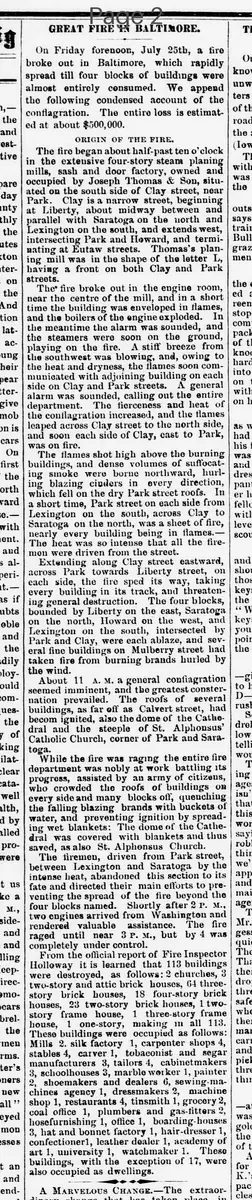
On Friday forenoon, July 25th, a fire broke out in Baltimore, which rapidly spread till four blocks of buildings were almost entirely consumed. We append the following condensed account of the conflagration. The entire loss is estimated at about $500,000.
ORIGIN OF THE FIRE.
The fire began about half-past ten o'clock in the extensive four-story steam planing mills, sash and door factory, owned and occupied by Joseph Thomas & Son, situated on the south side of Clay street, near Park. Clay is a narrow street, beginning at Liberty, about midway between and parallel with Saratoga on the north and Lexington on the south, and extends west, intersecting Park and Howard, and terminating at Eutaw streets. Thomas's planing mill was in the shape of the letter L, having a front on both Clay and Park streets. The fire broke out in the engine room, near the centre of the mill, and in a short time the building was enveloped in flames, and the boilers of the engine exploded. In the meantime the alarm was sounded, and the steamers were soon on the ground, playing on the fire. A stiff breeze from the southwest was blowing, and, owing to the heat and dryness, the flames soon communicated with adjoining building on each side on Clay and Park streets. A general alarm was sounded, calling out the entire department. The fierceness and heat of the conflagration increased, and the flames leaped across Clay street to the north side, and soon each side of Clay, cast to Park, was on fire. The flames shot high above the burning buildings, and dense volumes of suffocating smoke were borne northward, hurling blazing cinders in every direction, which fell on the dry Park street roofs. In a short time, Park street on each side from Lexington on the south, across Clay to Saratoga on the north, was a sheet of fire, nearly every building being in flames.— The heat was so intense that all the fire men were driven from the street. Extending along Clay street eastward, across Park towards Liberty street, on each side, the fire sped its way, taking every building in its track, and threatening general destruction. The four blocks, bounded by Liberty on the east, Saratoga on the north, Howard on the west, and Lexington on the south, intersected by Park and Clay, were each ablaze, and several fine buildings on Mulberry street had taken fire from burning brands hurled by the wind. About 11 A. M. a general conflagration seemed imminent, and the greatest consternation prevailed. The roofs of several buildings, as far off as Calvert street, had become ignited, also the dome of the Cathedral and the steeple of St. Alphonsus Catholic Church, corner of Park and Saratoga. While the fire was raging the entire fire department was nobly at work battling its progress, assisted by an army of citizens, who crowded the roofs of buildings on every side and many blocks off, quenching the falling blazing brands with buckets of water, and preventing ignition by spreading wet blankets: The dome of the Cathedral was covered with blankets and thus saved, as also St. Alphonsus Church. The firemen, driven from Park street, between Lexington and Saratoga by the intense heat, abandoned this section to its fate and directed their main efforts to preventing the spread of the fire beyond the four blocks named. Shortly after 2 P. M., two engines arrived from Washington and rendered valuable assistance. The fire raged until near 3 P. M., but by 4 was completely under control. From the official report of Fire Inspector Holloway it is learned that 113 buildings were destroyed, as follows: 2 churches, 3 two-story and attic brick houses, 64 three-story brick houses, 18 four-story brick houses, 23 two-story brick houses, 1 two-story frame house, 1 three-story frame house, 1 one-story, making in all 113. These buildings were occupied as follows: Mills 2, silk factory 1, carpenter shops 4, stables 4, carver 1, tobacconist and segar manufacturers 3, tailors 4, cabinetmakers 3, schoolhouses 3, marble worker 1, painter 2, shoemakers and dealers 6, sewing-machines agency 1, dressmakers 2, machine shop 1, restaurants 4, tinsmith 1, grocery 2, coal office 1, plumbers and gas-fitters 2, hose-furnishing 1, office 1, boarding-houses 3, hat and bonnet factory 1, hair-dresser 1, confectioner 1, leather dealer 1, academy of art 1, university 1, watchmaker 1. These buildings, with the exception of 17, were also occupied as dwellings.
What sub-type of article is it?
What keywords are associated?
What entities or persons were involved?
Where did it happen?
Domestic News Details
Primary Location
Baltimore
Event Date
Friday Forenoon, July 25th
Key Persons
Outcome
113 buildings destroyed, including 2 churches and various businesses and dwellings; total loss estimated at $500,000; no human casualties mentioned
Event Details
Fire originated in the engine room of Joseph Thomas & Son's four-story steam planing mills on Clay street near Park, spreading rapidly due to southwest breeze and dry conditions, consuming four blocks bounded by Liberty, Saratoga, Howard, and Lexington streets; fire department and citizens battled the blaze, with assistance from Washington engines; controlled by 4 P.M.