Thank you for visiting SNEWPapers!
Sign up free
Editorial
June 1, 1962
Newport Navalog
Newport, Newport County, Rhode Island
What is this article about?
Editorial praises the self-respect of American POWs, especially Maj. Theodore Harris who refused repatriation until a false bacteriological warfare accusation was removed, linking it to Theodore Parker's words and the Armed Forces Code of Conduct. Highlights loyalty in Korean Conflict.
Clipping
OCR Quality
98%
Excellent
Full Text
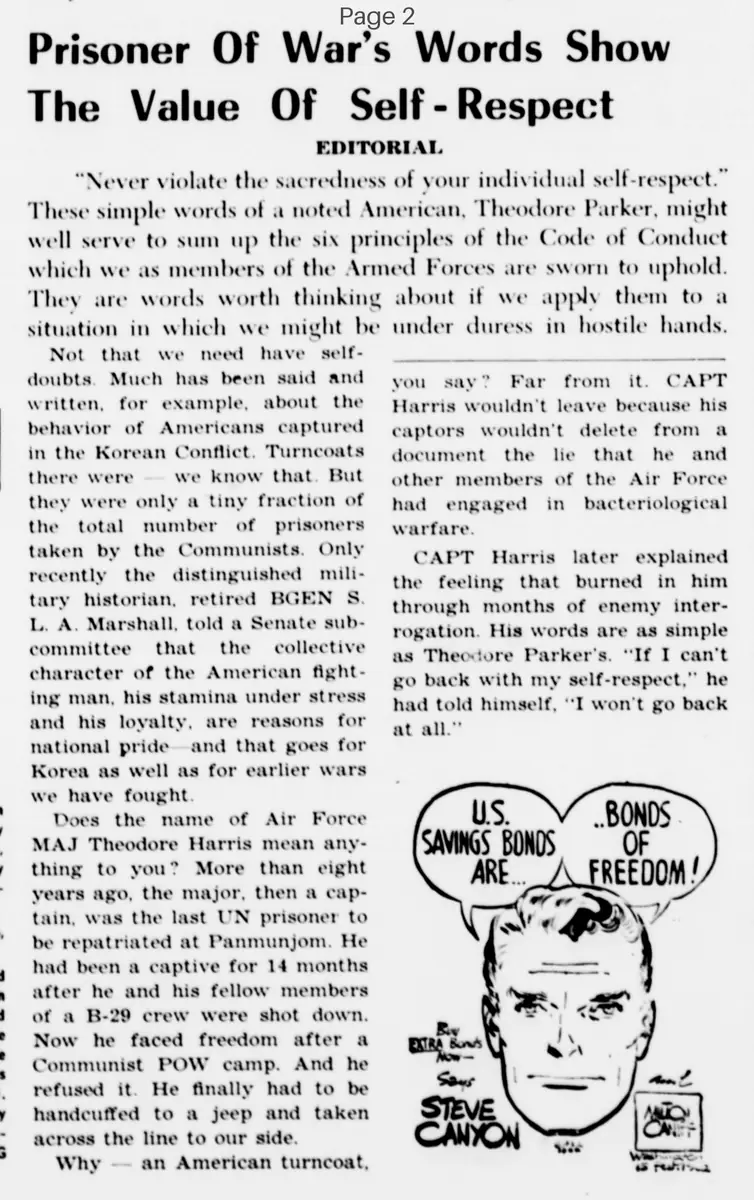
Prisoner Of War's Words Show The Value Of Self - Respect
EDITORIAL
"Never violate the sacredness of your individual self-respect. These simple words of a noted American, Theodore Parker, might well serve to sum up the six principles of the Code of Conduct which we as members of the Armed Forces are sworn to uphold. They are words worth thinking about if we apply them to a situation in which we might be under duress in hostile hands.
Not that we need have self-doubts. Much has been said and written, for example, about the behavior of Americans captured in the Korean Conflict. Turncoats there were- we know that. But they were only a tiny fraction of the total number of prisoners taken by the Communists. Only recently the distinguished mili- tary historian, retired BGEN S. L. A. Marshall. told a Senate sub- committee that the collective character of the American fight- ing man. his stamina under stress and his loyalty. are reasons for national pride and that goes for Korea as well as for earlier wars we have fought.
Does the name of Air Force MAJ Theodore Harris mean any- thing to you? More than eight years ago, the major, then a cap- tain, was the last UN prisoner to be repatriated at Panmunjom. He had been a captive for 14 months after he and his fellow members of a B-29 crew were shot down. Now he faced freedom after a Communist POW camp. And he refused it. He finally had to be handcuffed to a jeep and taken across the line to our side. Why - an American turncoat, you say? Far from it. CAPT Harris wouldn't leave because his captors wouldn't delete from a document the lie that he and other members of the Air Force had engaged in bacteriological warfare. CAPT Harris later explained the feeling that burned in him through months of enemy inter- rogation. His words are as simple as Theodore Parker's. "If I can't go back with my self-respect," he had told himself, "I won't go back at all."
EDITORIAL
"Never violate the sacredness of your individual self-respect. These simple words of a noted American, Theodore Parker, might well serve to sum up the six principles of the Code of Conduct which we as members of the Armed Forces are sworn to uphold. They are words worth thinking about if we apply them to a situation in which we might be under duress in hostile hands.
Not that we need have self-doubts. Much has been said and written, for example, about the behavior of Americans captured in the Korean Conflict. Turncoats there were- we know that. But they were only a tiny fraction of the total number of prisoners taken by the Communists. Only recently the distinguished mili- tary historian, retired BGEN S. L. A. Marshall. told a Senate sub- committee that the collective character of the American fight- ing man. his stamina under stress and his loyalty. are reasons for national pride and that goes for Korea as well as for earlier wars we have fought.
Does the name of Air Force MAJ Theodore Harris mean any- thing to you? More than eight years ago, the major, then a cap- tain, was the last UN prisoner to be repatriated at Panmunjom. He had been a captive for 14 months after he and his fellow members of a B-29 crew were shot down. Now he faced freedom after a Communist POW camp. And he refused it. He finally had to be handcuffed to a jeep and taken across the line to our side. Why - an American turncoat, you say? Far from it. CAPT Harris wouldn't leave because his captors wouldn't delete from a document the lie that he and other members of the Air Force had engaged in bacteriological warfare. CAPT Harris later explained the feeling that burned in him through months of enemy inter- rogation. His words are as simple as Theodore Parker's. "If I can't go back with my self-respect," he had told himself, "I won't go back at all."
What sub-type of article is it?
Military Affairs
Moral Or Religious
War Or Peace
What keywords are associated?
Self Respect
Pow
Korean Conflict
Code Of Conduct
Theodore Harris
Bacteriological Warfare
What entities or persons were involved?
Theodore Parker
Theodore Harris
S. L. A. Marshall
Armed Forces
Communists
Editorial Details
Primary Topic
Value Of Self Respect For American Pows In Korean Conflict
Stance / Tone
Proud And Supportive Of American Military Loyalty
Key Figures
Theodore Parker
Theodore Harris
S. L. A. Marshall
Armed Forces
Communists
Key Arguments
Self Respect Sums Up The Code Of Conduct Principles
Few American Turncoats In Korean Conflict
American Fighting Men's Loyalty Is A National Pride
Theodore Harris Refused Repatriation To Preserve Self Respect Against False Accusations