Thank you for visiting SNEWPapers!
Sign up free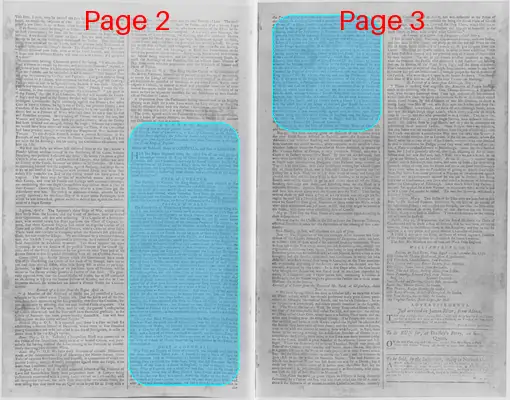
The Virginia Gazette
Richmond, Williamsburg, Richmond County, Virginia
What is this article about?
Following the death of Frederick, Prince of Wales and eldest son of King George II, this article provides an authentic historical account of how the titles Prince of Wales, Duke of Cornwall, and Earl of Chester pass to the eldest sons of English kings, detailing origins from medieval statutes and precedents.
Merged-components note: Continuation of the foreign news article from London about the titles of the Prince of Wales, Duke of Cornwall, and Earl of Chester across pages 2 and 3; the second part was incorrectly labeled as literary but fits as foreign news given the dateline and historical explanation of British royal titles.
Clippings
1 of 2
OCR Quality
Full Text
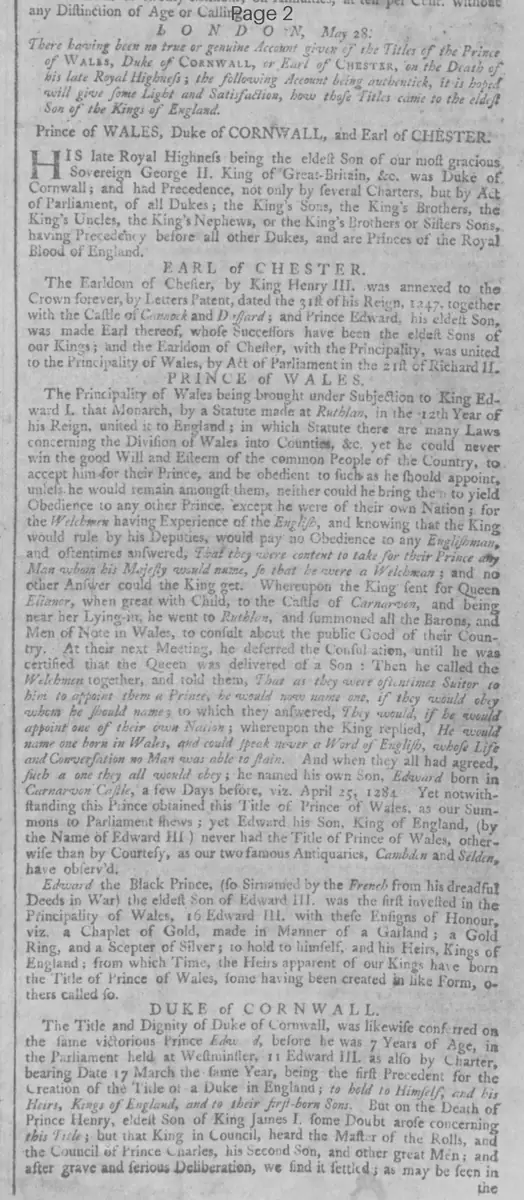
There having been no true or genuine Account given of the Titles of the Prince of Wales, Duke of Cornwall, or Earl of Chester, on the Death of his late Royal Highness; the following Account being authentick, it is hoped will give some Light and Satisfaction, how those Titles came to the eldest Son of the Kings of England.
Prince of WALES, Duke of CORNWALL, and Earl of CHESTER.
His late Royal Highness being the eldest Son of our most gracious Sovereign George II. King of Great-Britain, &c. was Duke of Cornwall; and had Precedence, not only by several Charters, but by Act of Parliament, of all Dukes; the King's Sons, the King's Brothers, the King's Uncles, the King's Nephews, or the King's Brothers or Sisters Sons, having Precedency before all other Dukes, and are Princes of the Royal Blood of England.
EARL Of CHESTER.
The Earldom of Chester, by King Henry III. was annexed to the Crown forever, by Letters Patent, dated the 31st of his Reign, 1247, together with the Castle of Cannock and Duffield; and Prince Edward, his eldest Son, was made Earl thereof, whose Successors have been the eldest Sons of our Kings; and the Earldom of Chester, with the Principality, was united to the Principality of Wales, by Act of Parliament in the 21st of Richard II.
PRINCE Of WALES.
The Principality of Wales being brought under Subjection to King Edward I. that Monarch, by a Statute made at Ruthlan, in the 12th Year of his Reign, united it to England; in which Statute there are many Laws concerning the Division of Wales into Counties, &c. yet he could never win the good Will and Esteem of the common People of the Country, to accept him for their Prince, and be obedient to such as he should appoint, unless he would remain amongst them, neither could he bring them to yield Obedience to any other Prince, except he were of their own Nation; for the Welchmen having Experience of the English, and knowing that the King would rule by his Deputies, would pay no Obedience to any Englishman, and oftentimes answered, That they were content to take for their Prince any Man whom his Majesty would name, so that he were a Welchman; and no other Answer could the King get. Whereupon the King sent for Queen Eleanor, when great with Child, to the Castle of Carnarvon, and being near her Lying-in, he went to Ruthlan, and summoned all the Barons, and Men of Note in Wales, to consult about the public Good of their Country. At their next Meeting, he deferred the Consultation, until he was certified that the Queen was delivered of a Son: Then he called the Welchmen together, and told them, That as they were oftentimes Suitor to him to appoint them a Prince, he would now name one, if they would obey whom he should name; to which they answered, They would, if he would appoint one of their own Nation; whereupon the King replied, He would name one born in Wales, and could speak never a Word of English, whose Life and Conversation no Man was able to stain. And when they all had agreed, such a one they all would obey; he named his own Son, Edward born in Carnarvon Castle, a few Days before, viz. April 25, 1284 Yet notwithstanding this Prince obtained this Title of Prince of Wales, as our Summons to Parliament Shews; yet Edward his Son, King of England, (by the Name of Edward III.) never had the Title of Prince of Wales, otherwise than by Courtesy, as our two famous Antiquaries, Camden and Selden, have observed.
Edward the Black Prince, (so Sirnamed by the French from his dreadful Deeds in War) the eldest Son of Edward III. was the first invested in the Principality of Wales, 16 Edward III. with these Ensigns of Honour, viz. a Chaplet of Gold, made in Manner of a Garland; a Gold Ring, and a Scepter of Silver; to hold to himself, and his Heirs, Kings of England; from which Time, the Heirs apparent of our Kings have borne the Title of Prince of Wales, some having been created in like Form, others called so.
DUKE Of CORNWALL.
The Title and Dignity of Duke of Cornwall, was likewise conferred on the same victorious Prince Edward, before he was 7 Years of Age, in the Parliament held at Westminster, 11 Edward III. as also by Charter, bearing Date 17 March the same Year, being the first Precedent for the Creation of the Title of a Duke in England; to hold to Himself, and his Heirs, Kings of England, and to their first-born Sons. But on the Death of Prince Henry, eldest Son of King James I. some Doubt arose concerning this Title; but that King in Council, heard the Master of the Rolls, and the Council of Prince Charles, his Second Son, and other great Men; and after grave and serious Deliberation, we find it settled; as may be seen in
the Proceedings and Precedents on Baronies by Writ, and other Honours. where the Case of the Duchy of Cornwall is mentioned at large; The chief Doubt arose out of a literal Construction of the Words, Filius primogenitus, contained in that singular Form of Limitation of the said Duchy made by Patent, enacted by Parliament 11 Edward III. whereby the King did give the said Duchy and large Possessions, &c. to have and to hold, &c. to the said Duke, and to the first begotten Son of him, and his Heirs, Kings of England and Dukes of the said Place, that hereditarily succeed in the Kingdom of England; so as they may in no wise be separated from the said Duchy, nor be given, or any Way granted by us, or our Heirs, to any other, or others, than Dukes of the said Place; yet it appeareth in the case of Richard, (after Richard II. eldest Son of the same Prince Edward, who died in the Life of King Edward III. his Father; by Means whereof, he became lineal Heir Male to the King; yet because he was not the eldest Son of a King, but of a King's Son, he was not Duke of Cornwall by Right of that Grant and Limitation, but was made Duke by King Edward III by Letters Patents, and not by Parliament. Henry VII. in the 10th of his Reign, with the Consent of the Prelates, Dukes, Earls, and Barons, in Parliament, did make and create his Son Henry Prince of Wales and Earl of Chester; but did not create him Duke of Cornwall; which he would have done, if he had not been Duke of Cornwall before by Birth, without Creation: Yet the King styled him his dearest Second begotten Son, Henry Duke of Cornwall, &c. for his elder Brother died S. P. Vita Patris, and by Statute made 9 Henry V. it is expressed, that the eldest Sons of the Kings of England, that should be next Heirs to the Crown of England, should be Dukes of Cornwall; so that in James the First's Time, it was unanimously agreed and declared, that Prince Charles, being next Heir to the Realm of England, and the King's eldest Son (after his Brother's Death) was in Right, and by Virtue of the Statute of 11 Edward III. Duke of Cornwall. By these Acts, &c. the Title of Prince of Wales, Duke of Cornwall, and Earl of Chester, came to his late royal Highness Frederick Lewis, &c.
What sub-type of article is it?
What keywords are associated?
What entities or persons were involved?
Where did it happen?
Foreign News Details
Primary Location
London
Event Date
May 28
Key Persons
Outcome
the titles prince of wales, duke of cornwall, and earl of chester pass to the eldest son of the king of england by historical statutes and precedents.
Event Details
Authentic historical account explaining the origins and legal precedence of the titles Prince of Wales, Duke of Cornwall, and Earl of Chester, annexed to the Crown and held by the eldest sons of English kings, following the death of Frederick, eldest son of George II.