Thank you for visiting SNEWPapers!
Sign up free
Editorial
May 14, 1812
Alexandria Daily Gazette, Commercial & Political
Alexandria, Virginia
What is this article about?
An editorial from Alexandria critiques the Jefferson-Madison administration's financial policies, contrasting them with Albert Gallatin's 1796 book that praised early U.S. revenue systems under Washington and Hamilton, highlighting increased smuggling, high duties, military waste, and public debt dangers.
Merged-components note: Continuation of the editorial on Gallatin's finance book across pages.
Clippings
1 of 2
OCR Quality
95%
Excellent
Full Text
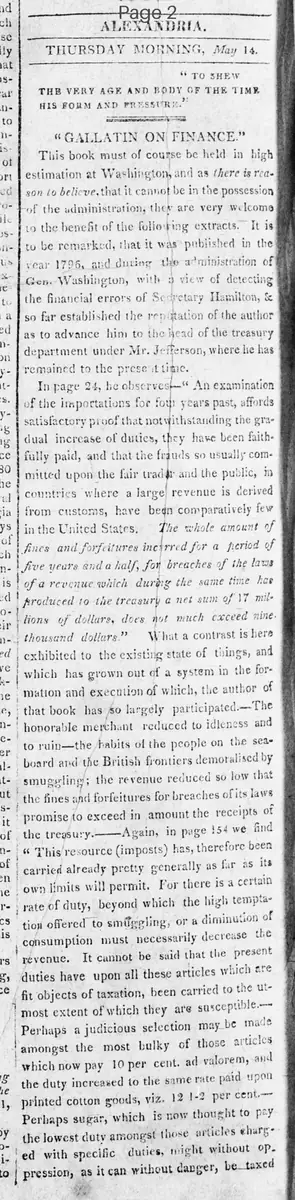
ALEXANDRIA.
THURSDAY MORNING, May 14.
TO SHEW
THE VERY AGE AND BODY OF THE TIME
HIS FORM AND PRESSURE.
"GALLATIN ON FINANCE."
This book must of course be held in high
estimation at Washington, and as there is reason
to believe, that it cannot be in the possession
of the administration, they are very welcome
to the benefit of the following extracts. It is
to be remarked, that it was published in the
year 1796, and during the administration of
Gen. Washington, with a view of detecting
the financial errors of Secretary Hamilton, & so
far established the reputation of the author
as to advance him to the head of the treasury
department under Mr. Jefferson, where he has
remained to the present time.
In page 24, he observes -" An examination
of the importations for four years past, affords
satisfactory proof that notwithstanding the gradual
increase of duties, they have been faithfully
paid, and that the frauds so usually committed
upon the fair trader and the public, in
countries where a large revenue is derived
from customs, have been comparatively few
in the United States. The whole amount of
fines and forfeitures incurred for a period of
five years and a half, for breaches of the laws
of a revenue which during the same time has
produced to the treasury a net sum of 17 millions
of dollars, does not much exceed nine.
thousand dollars." What a contrast is here
exhibited to the existing state of things, and
which has grown out of a system in the formation
and execution of which, the author of
that book has so largely participated.--The
honorable merchant reduced to idleness and
to ruin--the habits of the people on the sea-
board and the British frontiers demoralised by
smuggling; the revenue reduced so low that
the fines and forfeitures for breaches of its laws
promise to exceed in amount the receipts of
the treasury.--Again, in page 154 we find
" This resource (imposts) has, therefore been
carried already pretty generally as far as its
own limits will permit. For there is a certain
rate of duty, beyond which the high temptation
offered to smuggling, or a diminution of
consumption must necessarily decrease the
revenue. It cannot be said that the present
duties have upon all these articles which are
fit objects of taxation, been carried to the utmost
extent of which they are susceptible.--
Perhaps a judicious selection may be made
amongst the most bulky of those articles
which now pay 10 per cent. ad valorem, and
the duty increased to the same rate paid upon
printed cotton goods, viz. 12 1-2 per cent.--
Perhaps sugar, which is now thought to pay
the lowest duty amongst those articles charged
with specific duties, might without op.
pression, as it can without danger, be taxed
half a cent higher. We here have the ultimatum to which it was believed the duties could be extended without endangering the revenue by smuggling—Yet now when smuggling has become a trade perfectly understood, and the duties are already 5 per cent. beyond the 12 1-2 per cent. to which it was then thought prudent to limit them, it is proposed in the desperation of poverty, at one stroke to double them. Such is democratic consistency!
In relation to the waste of money in the military and naval establishments—'It is highly probable that the protection of the frontiers might have been effected with a less number of men, and the men in service supported with less expence, what might have been saved on this head cannot be calculated.'—Page 58.
It has however been calculated I think by the honorable Mr. Sheffy, that the expence of the military establishment under Mr. Madison has been twice as great per man as it was under Mr. Adams.—'T he naval armament which on its present plan seems to be rather an object of parade than of real utility, has already cost $470,000.'—Page 59.
What cost the Gun-Boats? what's their utility? They are not even an object of parade.
Upon the subject of borrowing money the financier gives much sage counsel, which is particularly recommended to the notice of the administration at this time.
'It requires no argument to prove it, it is a self evident truth, that in a political point of view at least, every nation is enfeebled by a public debt'...Page 134.
'Two circumstances must concur in rendering borrowing useful, a low rate of interest, and a proper application of the capital borrowed.' Page 130.
* To support a war, to defray any kind of public expence, by taxes, is to do it by the resources of economy, by retrenching the consumption of individuals, the consumption of the nation. To defray it by loans, is the mode of the spendthrift; it is irretrievably to destroy the principal, rather than to diminish our immediate consumption and enjoyments.' Page 125.
a The assistance to be received from the Bank may however be abused, both by government and by individuals; and it has certainly been abused by government. Instead of raising sufficient revenue or abstaining from expences, they have, as has already been observed, recurred too freely to loans and anticipations; have in some instances paid too dear for them,' &c. &c. &c.—Page 110.
THURSDAY MORNING, May 14.
TO SHEW
THE VERY AGE AND BODY OF THE TIME
HIS FORM AND PRESSURE.
"GALLATIN ON FINANCE."
This book must of course be held in high
estimation at Washington, and as there is reason
to believe, that it cannot be in the possession
of the administration, they are very welcome
to the benefit of the following extracts. It is
to be remarked, that it was published in the
year 1796, and during the administration of
Gen. Washington, with a view of detecting
the financial errors of Secretary Hamilton, & so
far established the reputation of the author
as to advance him to the head of the treasury
department under Mr. Jefferson, where he has
remained to the present time.
In page 24, he observes -" An examination
of the importations for four years past, affords
satisfactory proof that notwithstanding the gradual
increase of duties, they have been faithfully
paid, and that the frauds so usually committed
upon the fair trader and the public, in
countries where a large revenue is derived
from customs, have been comparatively few
in the United States. The whole amount of
fines and forfeitures incurred for a period of
five years and a half, for breaches of the laws
of a revenue which during the same time has
produced to the treasury a net sum of 17 millions
of dollars, does not much exceed nine.
thousand dollars." What a contrast is here
exhibited to the existing state of things, and
which has grown out of a system in the formation
and execution of which, the author of
that book has so largely participated.--The
honorable merchant reduced to idleness and
to ruin--the habits of the people on the sea-
board and the British frontiers demoralised by
smuggling; the revenue reduced so low that
the fines and forfeitures for breaches of its laws
promise to exceed in amount the receipts of
the treasury.--Again, in page 154 we find
" This resource (imposts) has, therefore been
carried already pretty generally as far as its
own limits will permit. For there is a certain
rate of duty, beyond which the high temptation
offered to smuggling, or a diminution of
consumption must necessarily decrease the
revenue. It cannot be said that the present
duties have upon all these articles which are
fit objects of taxation, been carried to the utmost
extent of which they are susceptible.--
Perhaps a judicious selection may be made
amongst the most bulky of those articles
which now pay 10 per cent. ad valorem, and
the duty increased to the same rate paid upon
printed cotton goods, viz. 12 1-2 per cent.--
Perhaps sugar, which is now thought to pay
the lowest duty amongst those articles charged
with specific duties, might without op.
pression, as it can without danger, be taxed
half a cent higher. We here have the ultimatum to which it was believed the duties could be extended without endangering the revenue by smuggling—Yet now when smuggling has become a trade perfectly understood, and the duties are already 5 per cent. beyond the 12 1-2 per cent. to which it was then thought prudent to limit them, it is proposed in the desperation of poverty, at one stroke to double them. Such is democratic consistency!
In relation to the waste of money in the military and naval establishments—'It is highly probable that the protection of the frontiers might have been effected with a less number of men, and the men in service supported with less expence, what might have been saved on this head cannot be calculated.'—Page 58.
It has however been calculated I think by the honorable Mr. Sheffy, that the expence of the military establishment under Mr. Madison has been twice as great per man as it was under Mr. Adams.—'T he naval armament which on its present plan seems to be rather an object of parade than of real utility, has already cost $470,000.'—Page 59.
What cost the Gun-Boats? what's their utility? They are not even an object of parade.
Upon the subject of borrowing money the financier gives much sage counsel, which is particularly recommended to the notice of the administration at this time.
'It requires no argument to prove it, it is a self evident truth, that in a political point of view at least, every nation is enfeebled by a public debt'...Page 134.
'Two circumstances must concur in rendering borrowing useful, a low rate of interest, and a proper application of the capital borrowed.' Page 130.
* To support a war, to defray any kind of public expence, by taxes, is to do it by the resources of economy, by retrenching the consumption of individuals, the consumption of the nation. To defray it by loans, is the mode of the spendthrift; it is irretrievably to destroy the principal, rather than to diminish our immediate consumption and enjoyments.' Page 125.
a The assistance to be received from the Bank may however be abused, both by government and by individuals; and it has certainly been abused by government. Instead of raising sufficient revenue or abstaining from expences, they have, as has already been observed, recurred too freely to loans and anticipations; have in some instances paid too dear for them,' &c. &c. &c.—Page 110.
What sub-type of article is it?
Economic Policy
Taxation
Partisan Politics
What keywords are associated?
Gallatin Finance
Customs Duties
Smuggling
Public Debt
Military Expense
Naval Armament
Borrowing Money
Revenue Frauds
What entities or persons were involved?
Albert Gallatin
Alexander Hamilton
George Washington
Thomas Jefferson
James Madison
John Adams
Mr. Sheffy
Administration
Editorial Details
Primary Topic
Critique Of Administration's Financial Policies Using Gallatin's 1796 Book
Stance / Tone
Critical And Sarcastic Of Democratic Administration
Key Figures
Albert Gallatin
Alexander Hamilton
George Washington
Thomas Jefferson
James Madison
John Adams
Mr. Sheffy
Administration
Key Arguments
Early U.S. Customs Duties Were Faithfully Paid With Few Frauds Under Washington.
Current Smuggling Has Demoralized Merchants And Reduced Revenue.
Duties Should Not Exceed 12.5% To Avoid Smuggling, Yet Now Proposed To Double.
Military Expenses Under Madison Twice As High Per Man As Under Adams.
Gunboats Costly And Useless.
Public Debt Enfeebles Nations.
Borrowing Should Be At Low Interest And Properly Applied.
Funding By Taxes Is Economical; By Loans Is Spendthrift.
Government Has Abused Bank Assistance By Excessive Loans.