Thank you for visiting SNEWPapers!
Sign up free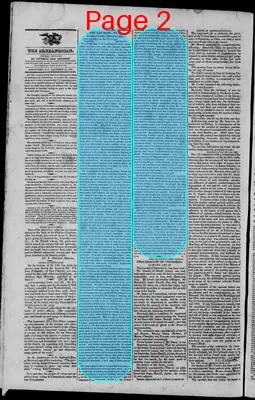
Literary
December 28, 1820
The Alexandrian: A Commercial, Agricultural And Literary Journal
Alexandria, District Of Columbia
What is this article about?
An introspective essay titled 'Irresolution' in 'The Lay Monk' series, exploring the vice of irresolution through psychological, social, and personal lenses, from inherent weakness and deliberate doubt to youthful inexperience, culminating in the author's retreat to solitary reflection.
Clipping
OCR Quality
98%
Excellent
Full Text
FOR THE ALEXANDRIAN,
THE LAY MONK...NO. I.
INTRODUCTORY...IRRESOLUTION.
I was a stricken deer that left the herd
Long since...
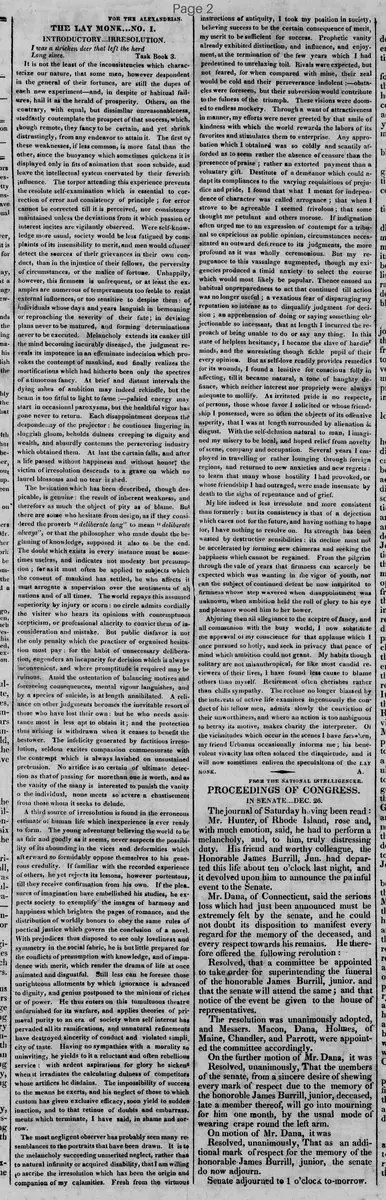
It is not the least of the inconsistencies which characterize our nature, that some men, however despondent in the general of their fortunes, are still the dupes of each new experiment-and, in despite of habitual failures, hail it as the herald of prosperity. Others, on the contrary, with equal, but dissimilar unreasonableness, steadfastly contemplate the prospect of that success, which, though remote, they fancy to be certain, and yet shrink distrustingly, from any endeavor to attain it. The first of these weaknesses, if less common, is more fatal than the other, since the buoyancy which sometimes quickens it is displayed only in fits of animation that soon subside, and leave the intellectual system enervated by their feverish influence. The torpor attending this experience prevents the resolute self-examination which is essential to correction of error and consistency of principle; for error cannot be corrected till it is perceived, nor consistency maintained unless the deviations from it which passion or interest incites are vigilantly observed. Were self-knowledge more usual, society would be less fatigued by complaints of its insensibility to merit, and men would oftener detect the sources of their grievances in their own conduct, than in the injustice of their fellows, the perversity of circumstances, or the malice of fortune. Unhappily, however, this firmness is unfrequent, or at least the examples are numerous of temperaments too feeble to resist external influences, or too sensitive to despise them: of individuals whose days and years languish in bemoaning or reproaching the severity of their fate; in devising plans never to be matured, and forming determinations never to be executed. Melancholy extends its canker till the mind becoming incurably diseased, the judgment reveals its impotence in an effeminate indecision which provokes the contempt of mankind, and finally realizes the mortifications which had hitherto been only the spectres of a timorous fancy. At brief and distant intervals the dying ashes of ambition may indeed rekindle, but the beam is too fitful to light to fame: palsied energy may start in occasional paroxysms, but the healthful vigor has gone never to return. Each disappointment deepens the despondency of the projector: he continues lingering in sluggish gloom, beholds dulness creeping to dignity and wealth, and absurdly contemns the persevering industry which obtained them. At last the Curtain falls, and after a life passed without happiness and without honor; the victim of irresolution descends to a grave on which no laurel blossoms and no tear is shed.
The hesitation which has been described, though despicable, is genuine: the result of inherent weakness, and therefore as much the object of pity as of blame. But there are some who hesitate from design, as if they considered the proverb "deliberate long" to mean "deliberate always", or that the philosopher who made doubt the beginning of knowledge, supposed it also to be the end. The doubt which exists in every instance must be sometimes useless, and indicates not modesty but presumption; for as it must often be applied to subjects which the consent of mankind has settled, he who affects it must arrogate a supervision over the sentiments of all nations and of all times. The world repays this assumed superiority by injury or scorn: no circle admits cordially the visiter who hears its opinions with contemptuous scepticism, or professional alacrity to convict them of inconsideration and mistake. But public disfavor is not the only penalty which the practiser of organised hesitation must pay: for the habit of unnecessary deliberation, engenders an incapacity for decision which is always inconvenient, and where promptitude is required may be ruinous. Amid the ostentation of balancing motives and foreseeing consequences, mental vigour languishes, and by a species of suicide, is at length annihilated. A reliance on other judgments becomes the inevitable resort of those who have lost their own: but he who needs assistance most is less apt to obtain it; and the protection thus arising is withdrawn when it ceases to benefit the bestower. The infelicity generated by factitious irresolution, seldom excites compassion commensurate with the contempt which is always lavished on unsustained pretension. No artifice is so certain of ultimate detection as that of passing for more than one is worth, and as the vanity of the many is interested to punish the vanity of the individual, none meets so severe a chastisement from those whom it seeks to delude.
A third source of irresolution is found in the erroneous estimate of human life which inexperience is ever ready to form. The young adventurer believing the world to be as fair and goodly as it seems, never suspects the possibility of its abounding in the vices and deformities which afterward so formidably oppose themselves to his generous credulity. If familiar with the recorded experience of others, he yet rejects its lessons, however portentous, till they receive confirmation from his own. If the pleasures of imagination have embellished his studies, he expects society to exemplify the images of harmony and happiness which brighten the pages of romance, and the distribution of worldly honors to obey the same rules of poetical justice which govern the conclusion of a novel. With prejudices thus disposed to see only loveliness and symmetry in the social fabric, he is but little prepared for the conflicts of presumption with knowledge, and of impudence with merit, which render the drama of life at once animated and disgustful. Still less can he foresee those unrighteous allotments by which ignorance is advanced to dignity, and genius postponed to the minions of riches or of power. He thus enters on this tumultuous theatre unfurnished for its warfare, and applies theories of primitive purity to an era of society when self interest has pervaded all its ramifications, and unnatural refinements have destroyed sincerity of conduct and violated simplicity of taste. Having no sympathies with a morality so uninviting, he yields to it a reluctant and often rebellious service: with ardent aspirations for glory he sickens when it irradiates the calculating dulness of competitors whose artifices he disdains. The impossibility of success to the means he exerts, and his neglect of those to which custom has given exclusive efficacy, soon yield to sudden inaction, and to that retinue of doubts and embarrassments which terminate, I have said, in shame and sorrow.
The most negligent observer has probably seen many resemblances to the portraits that have been drawn. It is to the melancholy succeeding unmerited neglect, rather than to natural infirmity or acquired disability, that I am willing to ascribe the irresolution which has been the origin and companion of my calamities. Fresh from the virtuous instructions of antiquity, I took my position in society, believing success to be the certain consequence of merit, my merit to be sufficient for success. Prophetic vanity already exhibited distinction, and influence, and enjoyment, at the termination of the few years which I had predestined to unrelaxing toil. Rivals were expected, but not feared, for when compared with mine, their zeal would be cold and their perseverance indolent: obstacles were foreseen, but their subversion would contribute to the fulness of the triumph. These visions were doomed to endless mockery. Through a want of attractiveness in manner, my efforts were never greeted by that smile of kindness with which the world rewards the labors of its favorites and stimulates them to enterprise. Any approbation which I obtained was so coldly and scantily afforded as to seem rather the absence of censure than the presence of praise; rather an extorted payment than a voluntary gift. Destitute of a demeanor which could adapt its compliances to the varying requisitions of prejudice and pride, I found that what I meant for independence of character was called arrogance; that when I strove to be agreeable I seemed frivolous; that some thought me petulant and others morose. If indignation often urged me to an expression of contempt for a tribunal so capricious as public opinion, circumstances necessitated an outward deference to its judgments, the more profound as it was wholly ceremonious. But my repugnance to this vassalage augmented, though my exigencies produced a timid anxiety to select the course which would most likely be popular. Thence ensued an habitual unpreparedness to act that continued till action was no longer useful; a vexatious fear of disparaging my reputation so intense as to disqualify judgment for decision; an apprehension of doing or saying something objectionable so incessant, that at length I incurred the reproach of being unable to do or say any thing. In this state of helpless hesitancy, I became the slave of hardier minds, and the unresisting though fickle pupil of their every opinion. But as self-love readily provides remedies for its wounds, I found a lenitive for conscious folly in affecting, till it became natural, a tone of haughty defiance, which neither interest nor propriety were always adequate to mollify. As irritated pride is no respecter of persons, those whose favor I solicited or whose friendship I possessed, were so often the objects of its offensive asperity, that I was at length surrounded by alienation & disgust. With the self-delusion natural to man, I imagined my misery to be local, and hoped relief from novelty of scene, company and occupation. Several years I employed in travelling or rather lounging through foreign regions, and returned to new anxieties and new regrets: to learn that many whose hostility I had provoked, or whose friendship I had outraged, were made insensate by death to the sighs of repentance and of grief.
My life indeed is less irresolute and more consistent than formerly: but its consistency is that of a dejection which cares not for the future, and having nothing to hope for, I have nothing to resolve on. Its strength has been wasted by destructive sensibilities: its decline must not be accelerated by forming new chimeras and seeking the happiness which cannot be regained. From the pilgrim through the vale of years that firmness can scarcely be expected which was wanting in the vigor of youth, nor can the subject of continued defeat be now inspirited to firmness whose step wavered when disappointment was unknown, when ambition held the roll of glory to his eye and pleasure wooed him to her bower.
Abjuring then all allegiance to the sceptre of fancy, and all communion with the busy world, I now substitute the approval of my conscience for that applause which I once pursued so hotly, and seek in privacy that peace of mind which ambition could not grant. My habits though solitary are not misanthropical, for like most candid reviewers of their lives, I have found less cause to blame others than myself. Retirement often cherishes rather than chills sympathy. The recluse no longer biassed by the interests of active life examines ingenuously the conduct of his fellow men, admits slowly the conviction of their unworthiness, and where an action is too ambiguous to betray its motive, makes charity the interpreter. Of the vicissitudes which occur in the scenes I have forsaken, my friend Urbanus occasionally informs me; his benevolent vivacity has often solaced the disquietude, and it will now sometimes enliven the speculations of the LAY MONK.
A.
THE LAY MONK...NO. I.
INTRODUCTORY...IRRESOLUTION.
I was a stricken deer that left the herd
Long since...
It is not the least of the inconsistencies which characterize our nature, that some men, however despondent in the general of their fortunes, are still the dupes of each new experiment-and, in despite of habitual failures, hail it as the herald of prosperity. Others, on the contrary, with equal, but dissimilar unreasonableness, steadfastly contemplate the prospect of that success, which, though remote, they fancy to be certain, and yet shrink distrustingly, from any endeavor to attain it. The first of these weaknesses, if less common, is more fatal than the other, since the buoyancy which sometimes quickens it is displayed only in fits of animation that soon subside, and leave the intellectual system enervated by their feverish influence. The torpor attending this experience prevents the resolute self-examination which is essential to correction of error and consistency of principle; for error cannot be corrected till it is perceived, nor consistency maintained unless the deviations from it which passion or interest incites are vigilantly observed. Were self-knowledge more usual, society would be less fatigued by complaints of its insensibility to merit, and men would oftener detect the sources of their grievances in their own conduct, than in the injustice of their fellows, the perversity of circumstances, or the malice of fortune. Unhappily, however, this firmness is unfrequent, or at least the examples are numerous of temperaments too feeble to resist external influences, or too sensitive to despise them: of individuals whose days and years languish in bemoaning or reproaching the severity of their fate; in devising plans never to be matured, and forming determinations never to be executed. Melancholy extends its canker till the mind becoming incurably diseased, the judgment reveals its impotence in an effeminate indecision which provokes the contempt of mankind, and finally realizes the mortifications which had hitherto been only the spectres of a timorous fancy. At brief and distant intervals the dying ashes of ambition may indeed rekindle, but the beam is too fitful to light to fame: palsied energy may start in occasional paroxysms, but the healthful vigor has gone never to return. Each disappointment deepens the despondency of the projector: he continues lingering in sluggish gloom, beholds dulness creeping to dignity and wealth, and absurdly contemns the persevering industry which obtained them. At last the Curtain falls, and after a life passed without happiness and without honor; the victim of irresolution descends to a grave on which no laurel blossoms and no tear is shed.
The hesitation which has been described, though despicable, is genuine: the result of inherent weakness, and therefore as much the object of pity as of blame. But there are some who hesitate from design, as if they considered the proverb "deliberate long" to mean "deliberate always", or that the philosopher who made doubt the beginning of knowledge, supposed it also to be the end. The doubt which exists in every instance must be sometimes useless, and indicates not modesty but presumption; for as it must often be applied to subjects which the consent of mankind has settled, he who affects it must arrogate a supervision over the sentiments of all nations and of all times. The world repays this assumed superiority by injury or scorn: no circle admits cordially the visiter who hears its opinions with contemptuous scepticism, or professional alacrity to convict them of inconsideration and mistake. But public disfavor is not the only penalty which the practiser of organised hesitation must pay: for the habit of unnecessary deliberation, engenders an incapacity for decision which is always inconvenient, and where promptitude is required may be ruinous. Amid the ostentation of balancing motives and foreseeing consequences, mental vigour languishes, and by a species of suicide, is at length annihilated. A reliance on other judgments becomes the inevitable resort of those who have lost their own: but he who needs assistance most is less apt to obtain it; and the protection thus arising is withdrawn when it ceases to benefit the bestower. The infelicity generated by factitious irresolution, seldom excites compassion commensurate with the contempt which is always lavished on unsustained pretension. No artifice is so certain of ultimate detection as that of passing for more than one is worth, and as the vanity of the many is interested to punish the vanity of the individual, none meets so severe a chastisement from those whom it seeks to delude.
A third source of irresolution is found in the erroneous estimate of human life which inexperience is ever ready to form. The young adventurer believing the world to be as fair and goodly as it seems, never suspects the possibility of its abounding in the vices and deformities which afterward so formidably oppose themselves to his generous credulity. If familiar with the recorded experience of others, he yet rejects its lessons, however portentous, till they receive confirmation from his own. If the pleasures of imagination have embellished his studies, he expects society to exemplify the images of harmony and happiness which brighten the pages of romance, and the distribution of worldly honors to obey the same rules of poetical justice which govern the conclusion of a novel. With prejudices thus disposed to see only loveliness and symmetry in the social fabric, he is but little prepared for the conflicts of presumption with knowledge, and of impudence with merit, which render the drama of life at once animated and disgustful. Still less can he foresee those unrighteous allotments by which ignorance is advanced to dignity, and genius postponed to the minions of riches or of power. He thus enters on this tumultuous theatre unfurnished for its warfare, and applies theories of primitive purity to an era of society when self interest has pervaded all its ramifications, and unnatural refinements have destroyed sincerity of conduct and violated simplicity of taste. Having no sympathies with a morality so uninviting, he yields to it a reluctant and often rebellious service: with ardent aspirations for glory he sickens when it irradiates the calculating dulness of competitors whose artifices he disdains. The impossibility of success to the means he exerts, and his neglect of those to which custom has given exclusive efficacy, soon yield to sudden inaction, and to that retinue of doubts and embarrassments which terminate, I have said, in shame and sorrow.
The most negligent observer has probably seen many resemblances to the portraits that have been drawn. It is to the melancholy succeeding unmerited neglect, rather than to natural infirmity or acquired disability, that I am willing to ascribe the irresolution which has been the origin and companion of my calamities. Fresh from the virtuous instructions of antiquity, I took my position in society, believing success to be the certain consequence of merit, my merit to be sufficient for success. Prophetic vanity already exhibited distinction, and influence, and enjoyment, at the termination of the few years which I had predestined to unrelaxing toil. Rivals were expected, but not feared, for when compared with mine, their zeal would be cold and their perseverance indolent: obstacles were foreseen, but their subversion would contribute to the fulness of the triumph. These visions were doomed to endless mockery. Through a want of attractiveness in manner, my efforts were never greeted by that smile of kindness with which the world rewards the labors of its favorites and stimulates them to enterprise. Any approbation which I obtained was so coldly and scantily afforded as to seem rather the absence of censure than the presence of praise; rather an extorted payment than a voluntary gift. Destitute of a demeanor which could adapt its compliances to the varying requisitions of prejudice and pride, I found that what I meant for independence of character was called arrogance; that when I strove to be agreeable I seemed frivolous; that some thought me petulant and others morose. If indignation often urged me to an expression of contempt for a tribunal so capricious as public opinion, circumstances necessitated an outward deference to its judgments, the more profound as it was wholly ceremonious. But my repugnance to this vassalage augmented, though my exigencies produced a timid anxiety to select the course which would most likely be popular. Thence ensued an habitual unpreparedness to act that continued till action was no longer useful; a vexatious fear of disparaging my reputation so intense as to disqualify judgment for decision; an apprehension of doing or saying something objectionable so incessant, that at length I incurred the reproach of being unable to do or say any thing. In this state of helpless hesitancy, I became the slave of hardier minds, and the unresisting though fickle pupil of their every opinion. But as self-love readily provides remedies for its wounds, I found a lenitive for conscious folly in affecting, till it became natural, a tone of haughty defiance, which neither interest nor propriety were always adequate to mollify. As irritated pride is no respecter of persons, those whose favor I solicited or whose friendship I possessed, were so often the objects of its offensive asperity, that I was at length surrounded by alienation & disgust. With the self-delusion natural to man, I imagined my misery to be local, and hoped relief from novelty of scene, company and occupation. Several years I employed in travelling or rather lounging through foreign regions, and returned to new anxieties and new regrets: to learn that many whose hostility I had provoked, or whose friendship I had outraged, were made insensate by death to the sighs of repentance and of grief.
My life indeed is less irresolute and more consistent than formerly: but its consistency is that of a dejection which cares not for the future, and having nothing to hope for, I have nothing to resolve on. Its strength has been wasted by destructive sensibilities: its decline must not be accelerated by forming new chimeras and seeking the happiness which cannot be regained. From the pilgrim through the vale of years that firmness can scarcely be expected which was wanting in the vigor of youth, nor can the subject of continued defeat be now inspirited to firmness whose step wavered when disappointment was unknown, when ambition held the roll of glory to his eye and pleasure wooed him to her bower.
Abjuring then all allegiance to the sceptre of fancy, and all communion with the busy world, I now substitute the approval of my conscience for that applause which I once pursued so hotly, and seek in privacy that peace of mind which ambition could not grant. My habits though solitary are not misanthropical, for like most candid reviewers of their lives, I have found less cause to blame others than myself. Retirement often cherishes rather than chills sympathy. The recluse no longer biassed by the interests of active life examines ingenuously the conduct of his fellow men, admits slowly the conviction of their unworthiness, and where an action is too ambiguous to betray its motive, makes charity the interpreter. Of the vicissitudes which occur in the scenes I have forsaken, my friend Urbanus occasionally informs me; his benevolent vivacity has often solaced the disquietude, and it will now sometimes enliven the speculations of the LAY MONK.
A.
What sub-type of article is it?
Essay
What themes does it cover?
Moral Virtue
Social Manners
What keywords are associated?
Irresolution
Self Examination
Ambition
Society
Melancholy
Retirement
Moral Weakness
What entities or persons were involved?
A.
Literary Details
Title
The Lay Monk...No. I. Introductory...Irresolution.
Author
A.
Subject
On Irresolution And Its Consequences In Life And Society.
Form / Style
Introspective Prose Essay With Personal Narrative.
Key Lines
I Was A Stricken Deer That Left The Herd Long Since...
Were Self Knowledge More Usual, Society Would Be Less Fatigued By Complaints Of Its Insensibility To Merit...
The Victim Of Irresolution Descends To A Grave On Which No Laurel Blossoms And No Tear Is Shed.
I Now Substitute The Approval Of My Conscience For That Applause Which I Once Pursued So Hotly...