Thank you for visiting SNEWPapers!
Sign up free
Story
December 6, 1825
Rhode Island American And Providence Gazette
Providence, Providence County, Rhode Island
What is this article about?
Scientific explanation of object visibility distances based on size and light ratios, with examples of a burning coal at night versus day and viewing contrasts between lit and dark spaces.
Clipping
OCR Quality
98%
Excellent
Full Text
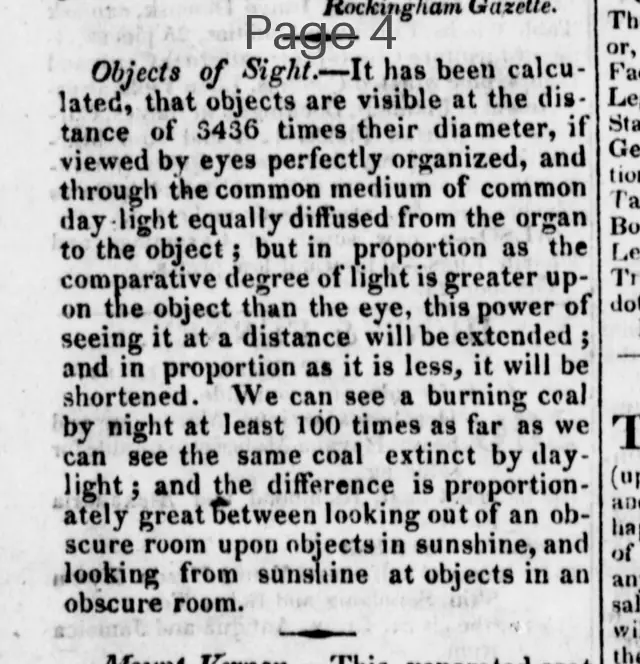
Objects of Sight.
It has been calculated, that objects are visible at the distance of 8436 times their diameter, if viewed by eyes perfectly organized, and through the common medium of common day-light equally diffused from the organ to the object; but in proportion as the comparative degree of light is greater upon the object than the eye, this power of seeing it at a distance will be extended; and in proportion as it is less, it will be shortened. We can see a burning coal by night at least 100 times as far as we can see the same coal extinct by day-light; and the difference is proportionately great between looking out of an obscure room upon objects in sunshine, and looking from sunshine at objects in an obscure room.
It has been calculated, that objects are visible at the distance of 8436 times their diameter, if viewed by eyes perfectly organized, and through the common medium of common day-light equally diffused from the organ to the object; but in proportion as the comparative degree of light is greater upon the object than the eye, this power of seeing it at a distance will be extended; and in proportion as it is less, it will be shortened. We can see a burning coal by night at least 100 times as far as we can see the same coal extinct by day-light; and the difference is proportionately great between looking out of an obscure room upon objects in sunshine, and looking from sunshine at objects in an obscure room.
What sub-type of article is it?
Curiosity
What themes does it cover?
Nature
What keywords are associated?
Visibility Distance
Light Conditions
Optics
Sight
Burning Coal
Story Details
Story Details
Calculation that objects are visible at 8436 times their diameter under perfect conditions with equal daylight; visibility extends with more light on object than eye, shortens otherwise; burning coal visible 100 times farther at night than extinct by day; similar difference in viewing from obscure room to sunshine versus reverse.