Thank you for visiting SNEWPapers!
Sign up free
The Wheeling Repository
Wheeling, Ohio County, West Virginia
What is this article about?
On December 31, 1807, President Jefferson announced that Indigenous groups assembled around Detroit, after councils, decided to return home rather than join British-incited war against the US, citing better US treatment and British weakness.
Merged-components note: Continuation of the extract from the Aurora on Indian councils and British influence.
Clippings
1 of 2
OCR Quality
Full Text
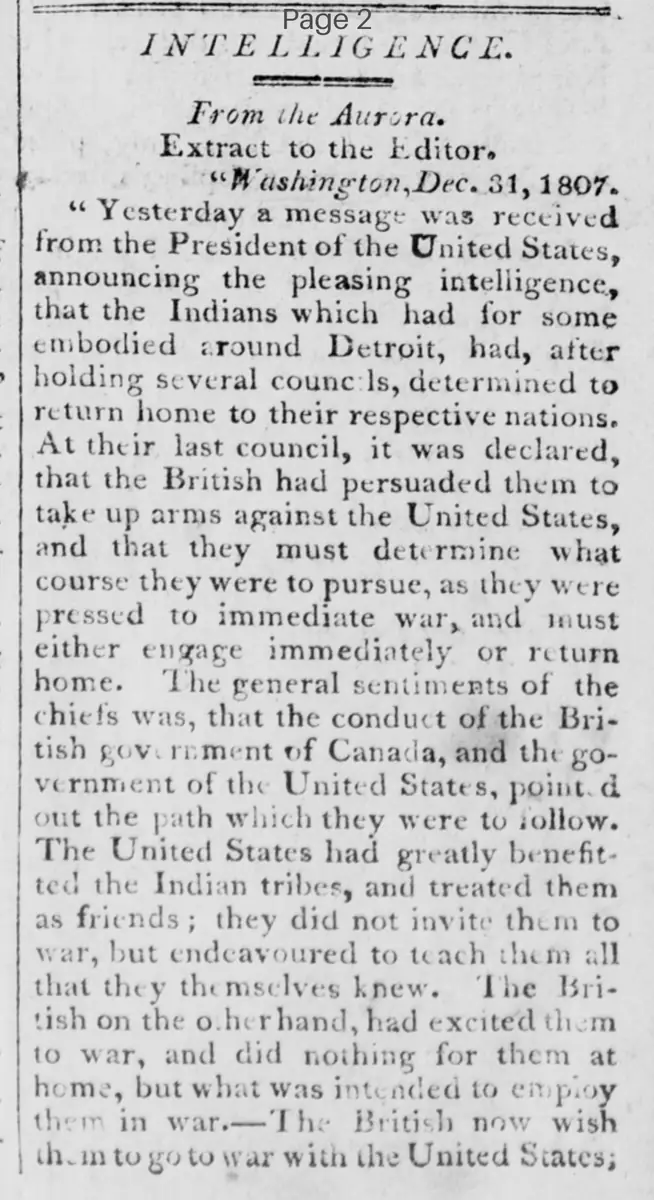
From the Aurora.
Extract to the Editor.
"Washington, Dec. 31, 1807.
Yesterday a message was received from the President of the United States, announcing the pleasing intelligence, that the Indians which had for some embodied around Detroit, had, after holding several councils, determined to return home to their respective nations.
At their last council, it was declared, that the British had persuaded them to take up arms against the United States, and that they must determine what course they were to pursue, as they were pressed to immediate war, and must either engage immediately or return home. The general sentiments of the chiefs was, that the conduct of the British government of Canada, and the government of the United States, pointed out the path which they were to follow.
The United States had greatly benefited the Indian tribes, and treated them as friends; they did not invite them to war, but endeavoured to teach them all that they themselves knew. The British on the other hand, had excited them to war, and did nothing for them at home, but what was intended to employ them in war.—The British now wish them to go to war with the United States; but the United States do the Indians no harm; the British do the Indians no good. The United States do the Indians no harm, they do them a great deal of good, and even now they do not wish the Indians to go to war; they bid the Indians stay at home and be peaceable, and even if a war takes place, not to take part with either party. These points were dwelt on, and these inferences drawn from them. The solicitude of the British, to make the Indians go to war, shewed they had no confidence in their own strength, without the Indians.--The advice of the United States, shewed that they thought themselves strong enough for the British, without Indian aid: a certain sign they were so. Besides that, the United States were friends of the Indians; prudence ought to teach them, that when one power was so strong as to do without them; and the other so weak, as to call upon them, and wish them to begin the war; that the Indians, if they took part with the weakest, would stand a chance of being exterminated. Both interest and prudence then, forbade their going to war against the United States; and they determined to return to their own homes. The facts are the substance of private letters, and of the public dispatch."
What sub-type of article is it?
What keywords are associated?
What entities or persons were involved?
Where did it happen?
Domestic News Details
Primary Location
Detroit
Event Date
Dec. 31, 1807
Key Persons
Outcome
indians determined to return home to their respective nations
Event Details
Indians assembled around Detroit held councils and decided against joining British-persuaded war with the US, citing US benefits and friendship versus British incitement and weakness, based on presidential message received yesterday