Thank you for visiting SNEWPapers!
Sign up free
Gazette Of The United States, & Philadelphia Daily Advertiser
Philadelphia, Philadelphia County, Pennsylvania
What is this article about?
On September 27 in Concord, the Commander in Chief reviewed Massachusetts' third militia division under Major General Hull. Seven cavalry corps, light infantry, artillery, and seven infantry regiments, elegantly uniformed and equipped, executed maneuvers precisely despite a drenching equinoctial storm, then were dismissed early.
Clipping
OCR Quality
Full Text
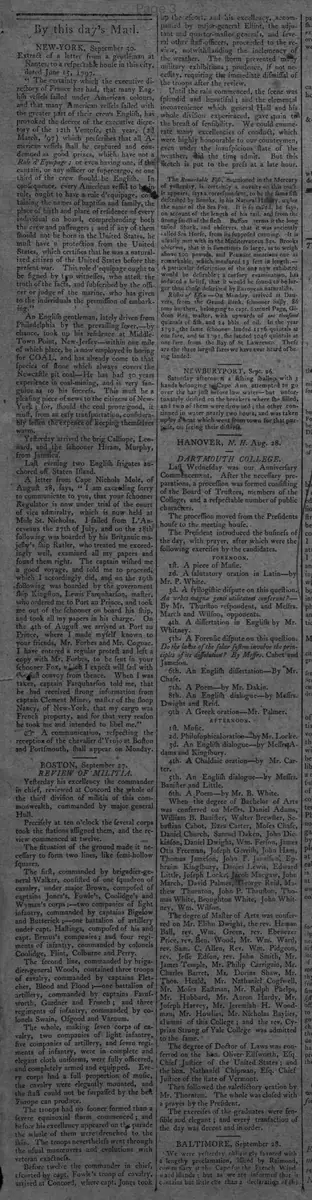
REVIEW OF MILITIA.
Yesterday his excellency the commander in chief, reviewed at Concord the whole of the third division of militia of this commonwealth, commanded by major general Hull.
Precisely at ten o'clock the several corps took the stations assigned them, and the review commenced at twelve.
The situation of the ground made it necessary to form two lines, like semi-hollow squares.
The first, commanded by brigadier-general Walker, consisted of one squadron of cavalry, under major Brown, composed of captains Jones's, Fowle's, Coolidge's and Wyman's corps;—two companies of light infantry, commanded by captains Bigelow and Butterick;—one battalion of artillery under capt. Hastings, composed of his and capt. Bemus's companies; and four regiments of infantry, commanded by colonels Coolidge, Flint, Colburne and Perry.
The second line, commanded by brigadier-general Woods, contained three troops of cavalry, commanded by captains Fletcher, Blood and Flood;—one battalion of artillery, commanded by captains Farnworth, Gardner and French; and three regiments of infantry, commanded by colonels Swain, Osgood and Varnum.
The whole, making seven corps of cavalry, two companies of light infantry, five companies of artillery, and seven regiments of infantry, were in complete and elegant cloth uniforms, were fully officered, and completely armed and equipped. Every corps had a full proportion of music, the cavalry were elegantly mounted, and the staff could not be surpassed by the best Europe can produce.
The troops had no sooner formed than a severe equinoctial storm commenced; and before his excellency appeared on the parade the whole of them were drenched to the skin. The troops nevertheless went through the usual manoeuvres and evolutions with veteran exactness.
Before twelve the commander in chief, escorted by capt. Fowle's troop of cavalry, arrived at Concord, where capt. Jones took up the escort, and his excellency, accompanied by major-general Elliot, the adjutant and quarter-master generals, and several other staff-officers, proceeded to the review, notwithstanding the inclemency of the weather. The storm prevented many military exhibitions; prudence, if not necessity, requiring the immediate dismissal of the troops after the review.
Until the rain commenced, the scene was splendid and beautiful: and the elemental inconvenience which general Hull and his whole division experienced, gave pain to the breast of sensibility. We could enumerate many excellencies of conduct, which were highly honourable to our countrymen, even under the inauspicious state of the weather, did the time admit. But this sketch is put to the press at a late hour.
What sub-type of article is it?
What themes does it cover?
What keywords are associated?
What entities or persons were involved?
Where did it happen?
Story Details
Key Persons
Location
Concord
Event Date
September 27
Story Details
The commander in chief reviewed the third division of militia at Concord, commanded by major general Hull. Troops formed in two lines and performed maneuvers with exactness despite a severe equinoctial storm that drenched them. The review was conducted under inclement weather, leading to early dismissal.