Thank you for visiting SNEWPapers!
Sign up free
Story
May 25, 1932
The Daily Worker
Chicago, Cook County, Illinois
What is this article about?
Article criticizes U.S. Steel Corporation's 15% wage cut in May despite vast historical profits over $4 billion from 1901-1930, large undivided surplus of $742 million, and continued dividends, while worker payrolls fell sharply; calls for organized union struggle by steel workers.
Clipping
OCR Quality
98%
Excellent
Full Text
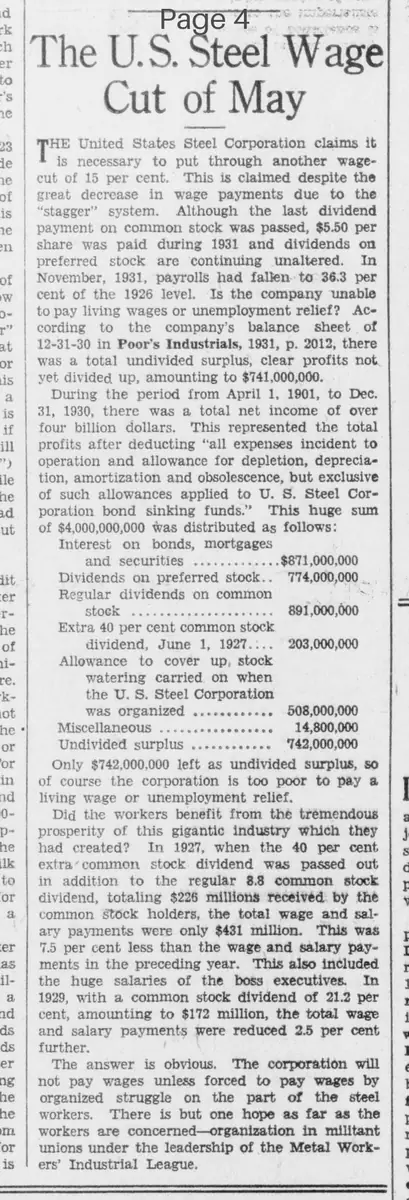
The U.S. Steel Wage Cut of May
THE United States Steel Corporation claims it is necessary to put through another wage-cut of 15 per cent. This is claimed despite the great decrease in wage payments due to the "stagger" system.
Although the last dividend payment on common stock was passed, $5.50 per share was paid during 1931 and dividends on preferred stock are continuing unaltered. In November, 1931, payrolls had fallen to 36.3 per cent of the 1926 level. Is the company unable to pay living wages or unemployment relief? According to the company's balance sheet of 12-31-30 in Poor's Industrials, 1931, p. 2012, there was a total undivided surplus, clear profits not yet divided up, amounting to $741,000,000.
During the period from April 1, 1901, to Dec. 31, 1930, there was a total net income of over four billion dollars. This represented the total profits after deducting "all expenses incident to operation and allowance for depletion, depreciation, amortization and obsolescence, but exclusive of such allowances applied to U. S. Steel Corporation bond sinking funds."
This huge sum of $4,000,000,000 was distributed as follows:
Interest on bonds, mortgages and securities $871,000,000
Dividends on preferred stock.. 774,000,000
Regular dividends on common stock 891,000,000
Extra 40 per cent common stock dividend, June 1, 1927.... 203,000,000
Allowance to cover up, stock watering carried on when the U. S. Steel Corporation was organized 508,000,000
Miscellaneous 14,800,000
Undivided surplus 742,000,000
Only $742,000,000 left as undivided surplus, so of course the corporation is too poor to pay a living wage or unemployment relief.
Did the workers benefit from the tremendous prosperity of this gigantic industry which they had created? In 1927, when the 40 per cent extra common stock dividend was passed out in addition to the regular 8% common stock dividend, totaling $226 millions received by the common stock holders, the total wage and salary payments were only $431 million. This was 7.5 per cent less than the wage and salary payments in the preceding year. This also included the huge salaries of the boss executives. In 1929, with a common stock dividend of 21.2 per cent, amounting to $172 million, the total wage and salary payments were reduced 2.5 per cent further.
The answer is obvious. The corporation will not pay wages unless forced to pay wages by organized struggle on the part of the steel workers.
There is but one hope as far as the workers are concerned—organization in militant unions under the leadership of the Metal Workers' Industrial League.
THE United States Steel Corporation claims it is necessary to put through another wage-cut of 15 per cent. This is claimed despite the great decrease in wage payments due to the "stagger" system.
Although the last dividend payment on common stock was passed, $5.50 per share was paid during 1931 and dividends on preferred stock are continuing unaltered. In November, 1931, payrolls had fallen to 36.3 per cent of the 1926 level. Is the company unable to pay living wages or unemployment relief? According to the company's balance sheet of 12-31-30 in Poor's Industrials, 1931, p. 2012, there was a total undivided surplus, clear profits not yet divided up, amounting to $741,000,000.
During the period from April 1, 1901, to Dec. 31, 1930, there was a total net income of over four billion dollars. This represented the total profits after deducting "all expenses incident to operation and allowance for depletion, depreciation, amortization and obsolescence, but exclusive of such allowances applied to U. S. Steel Corporation bond sinking funds."
This huge sum of $4,000,000,000 was distributed as follows:
Interest on bonds, mortgages and securities $871,000,000
Dividends on preferred stock.. 774,000,000
Regular dividends on common stock 891,000,000
Extra 40 per cent common stock dividend, June 1, 1927.... 203,000,000
Allowance to cover up, stock watering carried on when the U. S. Steel Corporation was organized 508,000,000
Miscellaneous 14,800,000
Undivided surplus 742,000,000
Only $742,000,000 left as undivided surplus, so of course the corporation is too poor to pay a living wage or unemployment relief.
Did the workers benefit from the tremendous prosperity of this gigantic industry which they had created? In 1927, when the 40 per cent extra common stock dividend was passed out in addition to the regular 8% common stock dividend, totaling $226 millions received by the common stock holders, the total wage and salary payments were only $431 million. This was 7.5 per cent less than the wage and salary payments in the preceding year. This also included the huge salaries of the boss executives. In 1929, with a common stock dividend of 21.2 per cent, amounting to $172 million, the total wage and salary payments were reduced 2.5 per cent further.
The answer is obvious. The corporation will not pay wages unless forced to pay wages by organized struggle on the part of the steel workers.
There is but one hope as far as the workers are concerned—organization in militant unions under the leadership of the Metal Workers' Industrial League.
What sub-type of article is it?
Historical Event
What themes does it cover?
Misfortune
Justice
What keywords are associated?
Steel Wage Cut
Corporate Profits
Dividends
Labor Struggle
Unemployment Relief
Undivided Surplus
What entities or persons were involved?
United States Steel Corporation
Steel Workers
Metal Workers' Industrial League
Where did it happen?
United States
Story Details
Key Persons
United States Steel Corporation
Steel Workers
Metal Workers' Industrial League
Location
United States
Event Date
May 1932
Story Details
U.S. Steel announces 15% wage cut despite $742 million surplus and $4 billion net income from 1901-1930, with dividends continuing while worker pay falls; article urges organized labor struggle for fair wages.