Thank you for visiting SNEWPapers!
Sign up free
Literary
December 4, 1766
The Virginia Gazette
Richmond, Williamsburg, Richmond County, Virginia
What is this article about?
In this allegorical epistolary satire, Elizabeth Barebones, personifying Utopia's public credit, writes to her children about her 'illness' caused by political corruption, paper money, and luxury. She critiques physicians (politicians), defends a champion exposing misconduct, and urges frugality, justice, and reform for her recovery.
Clipping
OCR Quality
95%
Excellent
Full Text
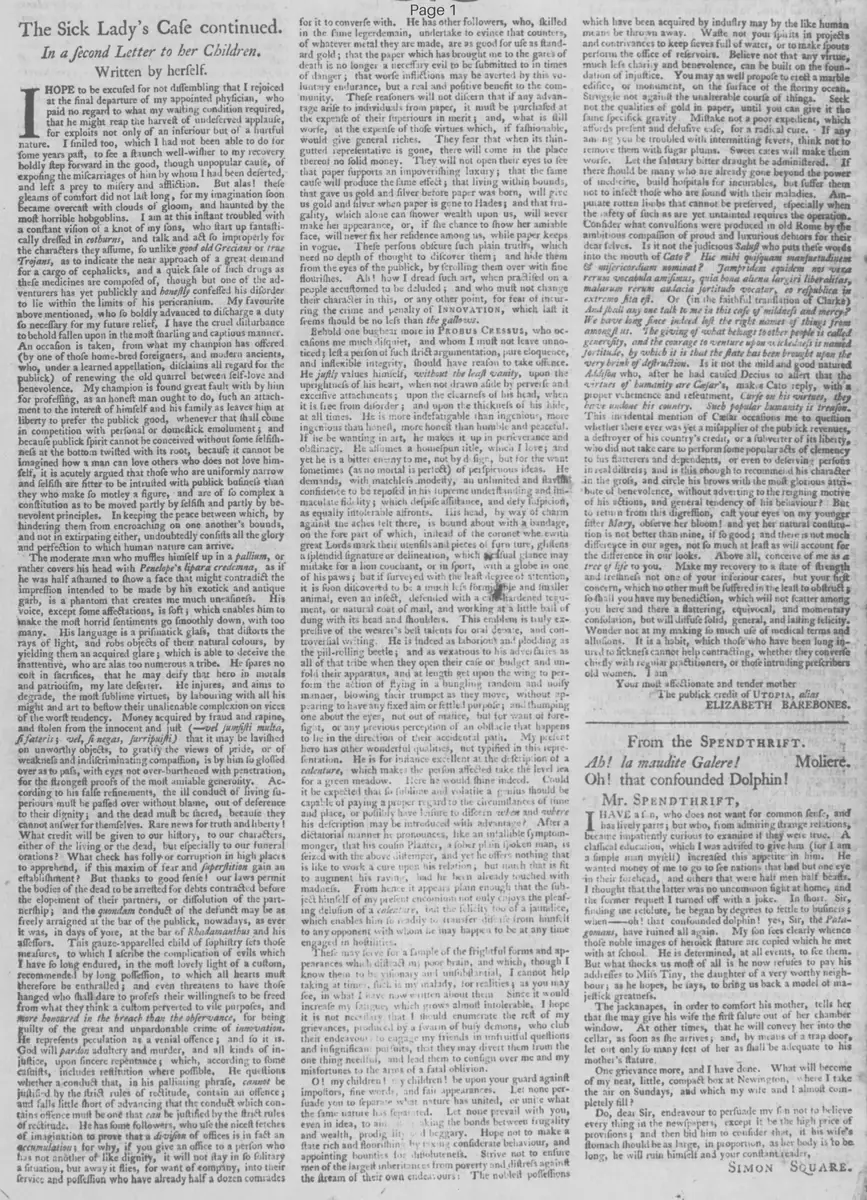
The Sick Lady's Case continued.
In a second Letter to her Children.
Written by herself.
HOPE to be excused for not dissembling that I rejoiced at the final departure of my appointed physician, who
I paid no regard to what my waiting condition required,
that he might reap the harvest of undeserved applause,
for exploits not only of an inferior but of a hurtful
nature. I smiled too, which I had not been able to do for
some years past, to see a staunch well-wisher to my recovery
boldly step forward in the good, though unpopular cause, of
exposing the miscarriages of him by whom I had been deserted,
and left a prey to misery and affliction. But alas! these
gleams of comfort did not last long, for my imagination soon
became overcast with clouds of gloom, and haunted by the
most horrible hobgoblins. I am at this instant troubled with
a constant vision of a knot of my sons, who start up fantastically
dressed in cotburns, and talk and act so improperly for
the characters they assume, so unlike good old Grecians or true
Trojans, as to indicate the near approach of a great demand
for a cargo of cephalicks, and a quick sale of such drugs as
these medicines are composed of, though but one of the adventurers has yet publicly and honestly confessed his disorder
to lie within the limits of his pericranium. My favourite
above mentioned, who so boldly advanced to discharge a duty
so necessary for my future relief, I have the cruel disturbance
to behold fallen upon in the most snarling and captious manner.
An occasion is taken, from what my champion has offered
(by one of those home-bred foreigners, and modern ancients,
who, under a learned appellation, disclaims all regard for the
publick) of renewing the old quarrel between self-love and
benevolence. My champion is found great fault with by him
for professing, as an honest man ought to do, such an attachment
to the interest of himself and his family as leaves him at
liberty to prefer the publick good, whenever that shall come
in competition with personal or domestick emolument; and
because publick spirit cannot be conceived without some selfishness
at the bottom twisted with its root, because it cannot be
imagined how a man can love others who does not love himself,
it is acutely argued that those who are uniformly narrow
and selfish are fitter to be intrusted with publick business than
they who make so motley a figure, and are of so complex a
constitution as to be moved partly by selfish and partly by benevolent
principles. In keeping the peace between which, by
hindering them from encroaching on one another's bounds,
and not in extirpating either, undoubtedly consists all the glory
and perfection to which human nature can arrive.
The moderate man who muffles himself up in a pallium, or
rather covers his head with Penelope's lipara credemna, as if
he was half ashamed to show a face that might contradict the
impression intended to be made by his exotick and antique
garb, is a phantom that creates me much uneasiness. His
voice, except some affectations, is soft; which enables him to
make the most horrid sentiments go smoothly down, with too
many. His language is a prismatick glass, that distorts the
rays of light, and robs objects of their natural colours, by
yielding them an acquired glare; which is able to deceive the
inattentive, who are alas too numerous a tribe. He pares no
cost in sacrifices, that he may deify that hero in morals
and patriotism, my late deserter. He injures, and aims to
degrade, the most sublime virtues, by labouring with all his
might and art to bestow their unalienable complexion on vices
of the worst tendency. Money acquired by fraud and rapine,
and stolen from the innocent and just (-vel jumentis multa,
interis; vel, si negas, surripuisti) that it may be lavished
on unworthy objects, to gratify the views of pride, or of
weakness and indiscriminating compassion, is by him so glozed
over as to pass, with eyes not over-burthened with penetration,
for the strongest proofs of the most amiable generosity. According
to his false refinements, the ill conduct of living superiors
must be passed over without blame, out of deference
to their dignity; and the dead must be sacred, because they
cannot answer for themselves. Rare news for truth and liberty!
What credit will be given to our history, to our characters,
either of the living or the dead, but especially to our funeral
orations? What check has folly or corruption in high places
to apprehend, if this maxim of fear and superstition gain an
establishment? But thanks to good sense! our laws permit
the bodies of the dead to be arrested for debts contracted before
the elopement of their partners, or dissolution of the partnership;
and the quondam conduct of the defunct may be as
freely arraigned at the bar of the publick, nowadays, as ever
it was, in days of yore, at the bar of Rhadamanthus and his
assessors. This gauze-apparelled child of sophistry sets those
measures, to which I ascribe the complication of evils which
I have so long endured, in the most lovely light of a custom,
recommended by long possession, to which all hearts must
therefore be enthralled; and even threatens to have those
hanged who shall dare to profess their willingness to be freed
from what they think a custom perverted to vile purposes, and
more honoured in the breach than the observance, for being
guilty of the great and unpardonable crime of innovation.
He represents peculation as a venial offence; and so it is.
God will pardon adultery and murder, and all kinds of injustice,
upon sincere repentance; which, according to some
canons, includes restitution where possible. He questions
whether a conduct that, in his palliating phrase, cannot be
justified by the strict rules of rectitude, contain an offence;
and falls little short of advancing that the conduct which contains
offence must be one that can be justified by the strict rules
of rectitude. He has some followers, who use the nicest fetches
of imagination to prove that a division of offices is in fact an
accumulation; for why, if you give an office to a person who
has not another of like dignity, it will not stay in a solitary
situation, but away it flies, for want of company, into their
service and possession who have already half a dozen comrades
for it to converse with. He has other followers, who, skilled
in the same legerdemain, undertake to evince that counters,
of whatever metal they are made, are as good for use as standard
gold; that the paper which has brought me to the gates of
death is no longer a necessary evil to be submitted to in times
of danger; that worse inflictions may be averted by this voluntary
endurance, but a real and positive benefit to the community.
These reasoners will not discern that if any advantage arise
to individuals from paper, it must be purchased at
the expense of their superiors in merit; and, what is still
worse, at the expense of those virtues which, if fashionable,
would give general riches. They fear that when its thin-
gutted representative is gone, there will come in the place
thereof no solid money. They will not open their eyes to see
that paper supports an impoverishing luxury; that the same
cause will produce the same effect; that living within bounds,
that gave us gold and silver before paper was born, will give
us gold and silver when paper is gone to Hades; and that frugality,
which alone can shower wealth upon us, will never
make her appearance, or, if she chance to show her amiable
face, will never fix her residence among us, while paper keeps
in vogue. These persons obscure such plain truths, which
need no depth of thought to discover them; and hide them
from the eyes of the publick, by scrawling them over with fine
flourishes. Ah! how I dread such art, when practised on a
people accustomed to be deluded; and who must not change
their character in this, or any other point, for fear of incurring
the crime and penalty of Innovation, which last
seems should be no less than the gallows.
Behold one bugbear more in Probus Cressus, who occasions
me much disquiet, and whom I must not leave unnoticed;
lest a person of such strict argumentation, pure eloquence,
and inflexible integrity, should have reason to take offence.
He justly values himself, without the least vanity, upon the
uprightness of his heart, when not drawn aside by perverse and
excessive attachments; upon the clearness of his head, when
it is free from disorder; and upon the thickness of his hide,
at all times. He is more indefatigable than ingenious, more
ingenuous than honest, more honest than humble and peaceful.
If he be wanting in art, he makes it up in perseverance and
obstinacy. He assumes a homespun title, which I love; and
yet he is a bitter enemy to me, not by design, but for the want
sometimes (as no mortal is perfect) of perspicuous ideas. He
demands, with matchless modesty, an unlimited and implicit
confidence to be reposed in his supreme understanding and immaculate
fidelity; which despises assistance, and defies suspicion,
as equally intolerable affronts. His head, by way of charm
against the aches felt there, is bound about with a bandage,
on the fore part of which, instead of the coronet wherewith
great lords mark their utensils and pieces of furniture, glistens
a splendid signature or delineation, which casual glance may
mistake for a lion couchant, or in port, with a globe in one
of his paws; but if surveyed with the least degree of attention,
it is soon discovered to be a much less formidable and smaller
animal, even an insect, defended with a callous-hardened tegument,
or natural coat of mail, and working at a little ball of
dung with its head and shoulders. This emblem is truly expressive
of the wearer's best talents for oral debate, and controversial
writing. He is indeed as laborious and plodding as
the pill-rolling beetle; and as vexatious to his adversaries as
all of that tribe when they open their case or budget and unfold
their apparatus, and at length get upon the wing to perform
the action of flying in a bungling random and noisy
manner, blowing their trumpet as they move, without appearing
to have any fixed aim or settled purpose; and thumping
one about the eyes, not out of malice, but for want of fore-
sight, or any previous perception of an obstacle that happens
to be in the direction of their accidental path. My present
hero has other wonderful qualities, not typified in this representation.
He is for instance excellent at the description of a
calenture, which makes the person affected take the level sea
for a green meadow. Here he would shine indeed. Could
it be expected that so sublime and volatile a genius should be
capable of paying a proper regard to the circumstances of time
and place, or possibly have leisure to discern when and where
his description may be introduced with advantage? After a
dictatorial manner he pronounces, like an infallible Symptom-
monger, that his cousin Plaster, a sober plain-spoken man, is
seized with the above distemper, and yet he offers nothing that
is like to work a cure upon his relation, but much that is fit
to augment his raving, had he been already touched with
madness. From hence it appears plain enough that the subject
himself of my present concern not only enjoys the pleasing
delusion of a calenture, but the felicity too of a jaundice,
which enables him so readily to transfer disease from himself
to any opponent with whom he may happen to be at any time
engaged in hostilities.
These may serve for a sample of the frightful forms and appearances
which disturb my poor brain, and which, though I
know them to be visionary and unsubstantial, I cannot help
taking at times, such is my malady, for realities; as you may
see, in what I have now written about them. Since it would
increase my fatigue which grows almost intolerable, I hope
it is not necessary that I should enumerate the rest of my
grievances, produced by a swarm of busy demons, who club
their endeavours to engage my friends in unfruitful questions
and insignificant pursuits, that they may divert them from the
one thing needful, and lead them to consign over me and my
misfortunes to the arms of a fatal oblivion.
O! my children! my children! be upon your guard against
impostors, fine words, and fair appearances. Let none persuade
you to separate what nature has united, or unite what
the same nature has separated. Let none prevail with you,
even in idea, to
break the bonds between frugality
and wealth, prodigality and beggary. Hope not to make a
state rich and flourishing by taxing considerate behaviour, and
appointing bounties for slothfulness. Strive not to ensure
men of the largest inheritances from poverty and distress against
the stream of their own endeavours: The noblest possessions
which have been acquired by industry may by the like human
means be thrown away. Waste not your spirits in projects
and contrivances to keep sieves full of water, or to make spouts
perform the office of reservoirs. Believe not that any virtue,
much less charity and benevolence, can be built on the foundation
of injustice. You may as well propose to erect a marble
edifice, or monument, on the surface of the stormy ocean.
Struggle not against the unalterable course of things. Seek
not the qualities of gold in paper, until you can give it the
same specific gravity. Mistake not a poor expedient, which
affords present and delusive ease, for a radical cure. If any
among you be troubled with intermitting fevers, think not to
remove them with sugar plums. Sweet cales will make them
worse. Let the salutary bitter draught be administered. If
there should be many who are already gone beyond the power
of medicine, build hospitals for incurables, but suffer them
not to infect those who are sound with their maladies. Amputate
rotten limbs that cannot be preserved, especially when
the safety of such as are yet untainted requires the operation.
Consider what convulsions were produced in old Rome by the
ambitious compassion of proud and luxurious debtors for their
dear selves. Is it not the judicious Sallust who puts these words
into the mouth of Cato? Hic mihi quisquam mansuetudinem
& misericordiam nominat? Jam pridem equidem nos vera
rerum vocabula amisimus, quia bona aliena largiri liberalitas,
malarum rerum audacia fortitudo vocatur, eo republica in
extremis est. Or (in the faithful translation of Clarke)
And shall any one talk to me in this case of mildness and mercy?
We have long since indeed lost the right names of things from
amongst us. The giving of what belongs to other people is called
generosity, and the courage to venture upon wickedness is named
fortitude, by which it is that the state has been brought upon the
very brink of destruction. Is it not the mild and good natured
Addison who, after he had caused Decius to assert that the
airs of humanity are Caesar's, makes Cato reply, with a
proper vehemence and resentment, Curse on his virtues, they
have undone his country. Such popular humanity is treason.
This incidental mention of Caesar occasions me to question
whether there ever was yet a misapplier of the public revenues,
a destroyer of his country's credit, or a subverter of its liberty
who did not take care to perform some popular acts of clemency
to his flatterers and dependents, or even to deserving persons
in real distresses; and is this enough to recommend his character
in the gross, and circle his brows with the most glorious attribute
of benevolence, without adverting to the reigning motive
of his actions, and general tendency of his behaviour? But
to return from this digression, cast your eyes on my younger
sister Mary, observe her bloom! and yet her natural constitution
is not better than mine, if so good; and there is not much
difference in our ages, not so much at least as will account for
the difference in our looks. Above all, conceive of me as a
tree of life to you. Make my recovery to a state of strength
and freshness not one of your inferior cares, but your first
concern, which no other must be suffered in the least to obstruct;
so shall you have my benediction, which will not scatter among
you here and there a flattering, equivocal, and momentary
consolation, but will diffuse solid, general, and lasting felicity.
Wonder not at my making so much use of medical terms and
allusions. It is a habit, which those who have been long
inured to sickness cannot help contracting, whether they converse
chiefly with regular practitioners, or those intruding prescribers
old women. I am
Your most affectionate and tender mother
The publick credit of UTOPIA, alias
ELIZABETH BAREBONES.
In a second Letter to her Children.
Written by herself.
HOPE to be excused for not dissembling that I rejoiced at the final departure of my appointed physician, who
I paid no regard to what my waiting condition required,
that he might reap the harvest of undeserved applause,
for exploits not only of an inferior but of a hurtful
nature. I smiled too, which I had not been able to do for
some years past, to see a staunch well-wisher to my recovery
boldly step forward in the good, though unpopular cause, of
exposing the miscarriages of him by whom I had been deserted,
and left a prey to misery and affliction. But alas! these
gleams of comfort did not last long, for my imagination soon
became overcast with clouds of gloom, and haunted by the
most horrible hobgoblins. I am at this instant troubled with
a constant vision of a knot of my sons, who start up fantastically
dressed in cotburns, and talk and act so improperly for
the characters they assume, so unlike good old Grecians or true
Trojans, as to indicate the near approach of a great demand
for a cargo of cephalicks, and a quick sale of such drugs as
these medicines are composed of, though but one of the adventurers has yet publicly and honestly confessed his disorder
to lie within the limits of his pericranium. My favourite
above mentioned, who so boldly advanced to discharge a duty
so necessary for my future relief, I have the cruel disturbance
to behold fallen upon in the most snarling and captious manner.
An occasion is taken, from what my champion has offered
(by one of those home-bred foreigners, and modern ancients,
who, under a learned appellation, disclaims all regard for the
publick) of renewing the old quarrel between self-love and
benevolence. My champion is found great fault with by him
for professing, as an honest man ought to do, such an attachment
to the interest of himself and his family as leaves him at
liberty to prefer the publick good, whenever that shall come
in competition with personal or domestick emolument; and
because publick spirit cannot be conceived without some selfishness
at the bottom twisted with its root, because it cannot be
imagined how a man can love others who does not love himself,
it is acutely argued that those who are uniformly narrow
and selfish are fitter to be intrusted with publick business than
they who make so motley a figure, and are of so complex a
constitution as to be moved partly by selfish and partly by benevolent
principles. In keeping the peace between which, by
hindering them from encroaching on one another's bounds,
and not in extirpating either, undoubtedly consists all the glory
and perfection to which human nature can arrive.
The moderate man who muffles himself up in a pallium, or
rather covers his head with Penelope's lipara credemna, as if
he was half ashamed to show a face that might contradict the
impression intended to be made by his exotick and antique
garb, is a phantom that creates me much uneasiness. His
voice, except some affectations, is soft; which enables him to
make the most horrid sentiments go smoothly down, with too
many. His language is a prismatick glass, that distorts the
rays of light, and robs objects of their natural colours, by
yielding them an acquired glare; which is able to deceive the
inattentive, who are alas too numerous a tribe. He pares no
cost in sacrifices, that he may deify that hero in morals
and patriotism, my late deserter. He injures, and aims to
degrade, the most sublime virtues, by labouring with all his
might and art to bestow their unalienable complexion on vices
of the worst tendency. Money acquired by fraud and rapine,
and stolen from the innocent and just (-vel jumentis multa,
interis; vel, si negas, surripuisti) that it may be lavished
on unworthy objects, to gratify the views of pride, or of
weakness and indiscriminating compassion, is by him so glozed
over as to pass, with eyes not over-burthened with penetration,
for the strongest proofs of the most amiable generosity. According
to his false refinements, the ill conduct of living superiors
must be passed over without blame, out of deference
to their dignity; and the dead must be sacred, because they
cannot answer for themselves. Rare news for truth and liberty!
What credit will be given to our history, to our characters,
either of the living or the dead, but especially to our funeral
orations? What check has folly or corruption in high places
to apprehend, if this maxim of fear and superstition gain an
establishment? But thanks to good sense! our laws permit
the bodies of the dead to be arrested for debts contracted before
the elopement of their partners, or dissolution of the partnership;
and the quondam conduct of the defunct may be as
freely arraigned at the bar of the publick, nowadays, as ever
it was, in days of yore, at the bar of Rhadamanthus and his
assessors. This gauze-apparelled child of sophistry sets those
measures, to which I ascribe the complication of evils which
I have so long endured, in the most lovely light of a custom,
recommended by long possession, to which all hearts must
therefore be enthralled; and even threatens to have those
hanged who shall dare to profess their willingness to be freed
from what they think a custom perverted to vile purposes, and
more honoured in the breach than the observance, for being
guilty of the great and unpardonable crime of innovation.
He represents peculation as a venial offence; and so it is.
God will pardon adultery and murder, and all kinds of injustice,
upon sincere repentance; which, according to some
canons, includes restitution where possible. He questions
whether a conduct that, in his palliating phrase, cannot be
justified by the strict rules of rectitude, contain an offence;
and falls little short of advancing that the conduct which contains
offence must be one that can be justified by the strict rules
of rectitude. He has some followers, who use the nicest fetches
of imagination to prove that a division of offices is in fact an
accumulation; for why, if you give an office to a person who
has not another of like dignity, it will not stay in a solitary
situation, but away it flies, for want of company, into their
service and possession who have already half a dozen comrades
for it to converse with. He has other followers, who, skilled
in the same legerdemain, undertake to evince that counters,
of whatever metal they are made, are as good for use as standard
gold; that the paper which has brought me to the gates of
death is no longer a necessary evil to be submitted to in times
of danger; that worse inflictions may be averted by this voluntary
endurance, but a real and positive benefit to the community.
These reasoners will not discern that if any advantage arise
to individuals from paper, it must be purchased at
the expense of their superiors in merit; and, what is still
worse, at the expense of those virtues which, if fashionable,
would give general riches. They fear that when its thin-
gutted representative is gone, there will come in the place
thereof no solid money. They will not open their eyes to see
that paper supports an impoverishing luxury; that the same
cause will produce the same effect; that living within bounds,
that gave us gold and silver before paper was born, will give
us gold and silver when paper is gone to Hades; and that frugality,
which alone can shower wealth upon us, will never
make her appearance, or, if she chance to show her amiable
face, will never fix her residence among us, while paper keeps
in vogue. These persons obscure such plain truths, which
need no depth of thought to discover them; and hide them
from the eyes of the publick, by scrawling them over with fine
flourishes. Ah! how I dread such art, when practised on a
people accustomed to be deluded; and who must not change
their character in this, or any other point, for fear of incurring
the crime and penalty of Innovation, which last
seems should be no less than the gallows.
Behold one bugbear more in Probus Cressus, who occasions
me much disquiet, and whom I must not leave unnoticed;
lest a person of such strict argumentation, pure eloquence,
and inflexible integrity, should have reason to take offence.
He justly values himself, without the least vanity, upon the
uprightness of his heart, when not drawn aside by perverse and
excessive attachments; upon the clearness of his head, when
it is free from disorder; and upon the thickness of his hide,
at all times. He is more indefatigable than ingenious, more
ingenuous than honest, more honest than humble and peaceful.
If he be wanting in art, he makes it up in perseverance and
obstinacy. He assumes a homespun title, which I love; and
yet he is a bitter enemy to me, not by design, but for the want
sometimes (as no mortal is perfect) of perspicuous ideas. He
demands, with matchless modesty, an unlimited and implicit
confidence to be reposed in his supreme understanding and immaculate
fidelity; which despises assistance, and defies suspicion,
as equally intolerable affronts. His head, by way of charm
against the aches felt there, is bound about with a bandage,
on the fore part of which, instead of the coronet wherewith
great lords mark their utensils and pieces of furniture, glistens
a splendid signature or delineation, which casual glance may
mistake for a lion couchant, or in port, with a globe in one
of his paws; but if surveyed with the least degree of attention,
it is soon discovered to be a much less formidable and smaller
animal, even an insect, defended with a callous-hardened tegument,
or natural coat of mail, and working at a little ball of
dung with its head and shoulders. This emblem is truly expressive
of the wearer's best talents for oral debate, and controversial
writing. He is indeed as laborious and plodding as
the pill-rolling beetle; and as vexatious to his adversaries as
all of that tribe when they open their case or budget and unfold
their apparatus, and at length get upon the wing to perform
the action of flying in a bungling random and noisy
manner, blowing their trumpet as they move, without appearing
to have any fixed aim or settled purpose; and thumping
one about the eyes, not out of malice, but for want of fore-
sight, or any previous perception of an obstacle that happens
to be in the direction of their accidental path. My present
hero has other wonderful qualities, not typified in this representation.
He is for instance excellent at the description of a
calenture, which makes the person affected take the level sea
for a green meadow. Here he would shine indeed. Could
it be expected that so sublime and volatile a genius should be
capable of paying a proper regard to the circumstances of time
and place, or possibly have leisure to discern when and where
his description may be introduced with advantage? After a
dictatorial manner he pronounces, like an infallible Symptom-
monger, that his cousin Plaster, a sober plain-spoken man, is
seized with the above distemper, and yet he offers nothing that
is like to work a cure upon his relation, but much that is fit
to augment his raving, had he been already touched with
madness. From hence it appears plain enough that the subject
himself of my present concern not only enjoys the pleasing
delusion of a calenture, but the felicity too of a jaundice,
which enables him so readily to transfer disease from himself
to any opponent with whom he may happen to be at any time
engaged in hostilities.
These may serve for a sample of the frightful forms and appearances
which disturb my poor brain, and which, though I
know them to be visionary and unsubstantial, I cannot help
taking at times, such is my malady, for realities; as you may
see, in what I have now written about them. Since it would
increase my fatigue which grows almost intolerable, I hope
it is not necessary that I should enumerate the rest of my
grievances, produced by a swarm of busy demons, who club
their endeavours to engage my friends in unfruitful questions
and insignificant pursuits, that they may divert them from the
one thing needful, and lead them to consign over me and my
misfortunes to the arms of a fatal oblivion.
O! my children! my children! be upon your guard against
impostors, fine words, and fair appearances. Let none persuade
you to separate what nature has united, or unite what
the same nature has separated. Let none prevail with you,
even in idea, to
break the bonds between frugality
and wealth, prodigality and beggary. Hope not to make a
state rich and flourishing by taxing considerate behaviour, and
appointing bounties for slothfulness. Strive not to ensure
men of the largest inheritances from poverty and distress against
the stream of their own endeavours: The noblest possessions
which have been acquired by industry may by the like human
means be thrown away. Waste not your spirits in projects
and contrivances to keep sieves full of water, or to make spouts
perform the office of reservoirs. Believe not that any virtue,
much less charity and benevolence, can be built on the foundation
of injustice. You may as well propose to erect a marble
edifice, or monument, on the surface of the stormy ocean.
Struggle not against the unalterable course of things. Seek
not the qualities of gold in paper, until you can give it the
same specific gravity. Mistake not a poor expedient, which
affords present and delusive ease, for a radical cure. If any
among you be troubled with intermitting fevers, think not to
remove them with sugar plums. Sweet cales will make them
worse. Let the salutary bitter draught be administered. If
there should be many who are already gone beyond the power
of medicine, build hospitals for incurables, but suffer them
not to infect those who are sound with their maladies. Amputate
rotten limbs that cannot be preserved, especially when
the safety of such as are yet untainted requires the operation.
Consider what convulsions were produced in old Rome by the
ambitious compassion of proud and luxurious debtors for their
dear selves. Is it not the judicious Sallust who puts these words
into the mouth of Cato? Hic mihi quisquam mansuetudinem
& misericordiam nominat? Jam pridem equidem nos vera
rerum vocabula amisimus, quia bona aliena largiri liberalitas,
malarum rerum audacia fortitudo vocatur, eo republica in
extremis est. Or (in the faithful translation of Clarke)
And shall any one talk to me in this case of mildness and mercy?
We have long since indeed lost the right names of things from
amongst us. The giving of what belongs to other people is called
generosity, and the courage to venture upon wickedness is named
fortitude, by which it is that the state has been brought upon the
very brink of destruction. Is it not the mild and good natured
Addison who, after he had caused Decius to assert that the
airs of humanity are Caesar's, makes Cato reply, with a
proper vehemence and resentment, Curse on his virtues, they
have undone his country. Such popular humanity is treason.
This incidental mention of Caesar occasions me to question
whether there ever was yet a misapplier of the public revenues,
a destroyer of his country's credit, or a subverter of its liberty
who did not take care to perform some popular acts of clemency
to his flatterers and dependents, or even to deserving persons
in real distresses; and is this enough to recommend his character
in the gross, and circle his brows with the most glorious attribute
of benevolence, without adverting to the reigning motive
of his actions, and general tendency of his behaviour? But
to return from this digression, cast your eyes on my younger
sister Mary, observe her bloom! and yet her natural constitution
is not better than mine, if so good; and there is not much
difference in our ages, not so much at least as will account for
the difference in our looks. Above all, conceive of me as a
tree of life to you. Make my recovery to a state of strength
and freshness not one of your inferior cares, but your first
concern, which no other must be suffered in the least to obstruct;
so shall you have my benediction, which will not scatter among
you here and there a flattering, equivocal, and momentary
consolation, but will diffuse solid, general, and lasting felicity.
Wonder not at my making so much use of medical terms and
allusions. It is a habit, which those who have been long
inured to sickness cannot help contracting, whether they converse
chiefly with regular practitioners, or those intruding prescribers
old women. I am
Your most affectionate and tender mother
The publick credit of UTOPIA, alias
ELIZABETH BAREBONES.
What sub-type of article is it?
Epistolary
Satire
Essay
What themes does it cover?
Political
Commerce Trade
Liberty Freedom
What keywords are associated?
Public Credit
Political Satire
Paper Money
Frugality
Corruption
Benevolence
Liberty
Utopia
Elizabeth Barebones
Medical Allegory
What entities or persons were involved?
Written By Herself. [Elizabeth Barebones]
Literary Details
Title
The Sick Lady's Case Continued. In A Second Letter To Her Children.
Author
Written By Herself. [Elizabeth Barebones]
Subject
On The Decline Of Public Credit Due To Corruption, Paper Money, And Luxury
Form / Style
Allegorical Epistolary Satire In Prose
Key Lines
Hope To Be Excused For Not Dissembling That I Rejoiced At The Final Departure Of My Appointed Physician, Who I Paid No Regard To What My Waiting Condition Required, That He Might Reap The Harvest Of Undeserved Applause, For Exploits Not Only Of An Inferior But Of A Hurtful Nature.
O! My Children! My Children! Be Upon Your Guard Against Impostors, Fine Words, And Fair Appearances.
Struggle Not Against The Unalterable Course Of Things. Seek Not The Qualities Of Gold In Paper, Until You Can Give It The Same Specific Gravity.
And Shall Any One Talk To Me In This Case Of Mildness And Mercy? We Have Long Since Indeed Lost The Right Names Of Things From Amongst Us.
Curse On His Virtues, They Have Undone His Country. Such Popular Humanity Is Treason.