Thank you for visiting SNEWPapers!
Sign up free
Editorial
April 17, 1934
The Daily Worker
Chicago, Cook County, Illinois
What is this article about?
This editorial critiques the rising wave of labor strikes in the US, attributing it to worsening conditions under the NRA. It criticizes Roosevelt's administration, the National Labor Board, and AFL leaders for suppressing workers. It urges Communists to lead the strikes toward revolutionary goals, highlighting opportunities for radicalization.
Clipping
OCR Quality
95%
Excellent
Full Text
The Strike Storm Rises
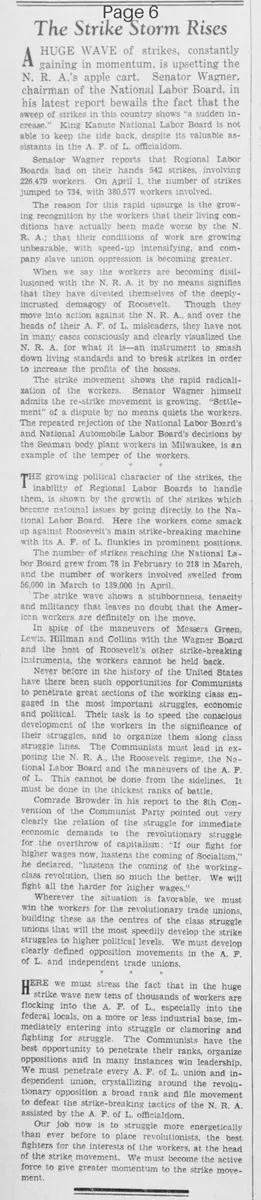
HUGE WAVE of strikes, constantly gaining in momentum, is upsetting the N. R. A.'s apple cart. Senator Wagner, chairman of the National Labor Board, in his latest report bewails the fact that the sweep of strikes in this country shows "a sudden increase." King Kanute National Labor Board is not able to keep the tide back, despite its valuable assistants in the A. F. of L. officialdom.
Senator Wagner reports that Regional Labor Boards had on their hands 542 strikes, involving 226,479 workers. On April 1, the number of strikes jumped to 734, with 380,577 workers involved.
The reason for this rapid upsurge is the growing recognition by the workers that their living conditions have actually been made worse by the N. R. A.; that their conditions of work are growing unbearable, with speed-up intensifying, and company slave union oppression is becoming greater.
When we say the workers are becoming disillusioned with the N. R. A. it by no means signifies that they have divested themselves of the deeply-incrusted demagogy of Roosevelt. Though they move into action against the N. R. A., and over the heads of their A. F. of L. misleaders, they have not in many cases consciously and clearly visualized the N. R. A. for what it is--an instrument to smash down living standards and to break strikes in order to increase the profits of the bosses.
The strike movement shows the rapid radicalization of the workers. Senator Wagner himself admits the re-strike movement is growing. "Settlement" of a dispute by no means quiets the workers. The repeated rejection of the National Labor Board's and National Automobile Labor Board's decisions by the Seaman body plant workers in Milwaukee, is an example of the temper of the workers.
THE growing political character of the strikes, the inability of Regional Labor Boards to handle them, is shown by the growth of the strikes which become national issues by going directly to the National Labor Board. Here the workers come smack up against Roosevelt's main strike-breaking machine with its A. F. of L. flunkies in prominent positions.
The number of strikes reaching the National Labor Board grew from 78 in February to 218 in March, and the number of workers involved swelled from 56,000 in March to 139,000 in April.
The strike wave shows a stubbornness, tenacity and militancy that leaves no doubt that the American workers are definitely on the move.
In spite of the maneuvers of Messers Green. Lewis, Hillman and Collins with the Wagner Board and the host of Roosevelt's other strike-breaking instruments, the workers cannot be held back.
Never before in the history of the United States have there been such opportunities for Communists to penetrate great sections of the working class engaged in the most important struggles, economic and political. Their task is to speed the conscious development of the workers in the significance of their struggles, and to organize them along class struggle lines. The Communists must lead in exposing the N. R. A., the Roosevelt regime, the National Labor Board and the maneuvers of the A. F. of L. This cannot be done from the sidelines. It must be done in the thickest ranks of battle.
Comrade Browder in his report to the 8th Convention of the Communist Party pointed out very clearly the relation of the struggle for immediate economic demands to the revolutionary struggle for the overthrow of capitalism: "If our fight for higher wages now, hastens the coming of Socialism," he declared, "hastens the coming of the working-class revolution, then so much the better. We will fight all the harder for higher wages."
Wherever the situation is favorable, we must win the workers for the revolutionary trade unions, building these as the centres of the class struggle unions that will the most speedily develop the strike struggles to higher political levels. We must develop clearly defined opposition movements in the A. F. of L. and independent trade unions.
HERE we must stress the fact that in the huge strike wave new tens of thousands of workers are flocking into the A. F. of L., especially into the federal locals, on a more or less industrial base, immediately entering into struggle or clamoring and fighting for struggle. The Communists have the best opportunity to penetrate their ranks, organize oppositions and in many instances win leadership.
We must penetrate every A. F. of L. union and independent union, crystallizing around the revolutionary opposition a broad rank and file movement to defeat the strike-breaking tactics of the N. R. A. assisted by the A. F. of L. officialdom.
Our job now is to struggle more energetically than ever before to place revolutionists, the best fighters for the interests of the workers, at the head of the strike movement. We must become the active force to give greater momentum to the strike movement.
HUGE WAVE of strikes, constantly gaining in momentum, is upsetting the N. R. A.'s apple cart. Senator Wagner, chairman of the National Labor Board, in his latest report bewails the fact that the sweep of strikes in this country shows "a sudden increase." King Kanute National Labor Board is not able to keep the tide back, despite its valuable assistants in the A. F. of L. officialdom.
Senator Wagner reports that Regional Labor Boards had on their hands 542 strikes, involving 226,479 workers. On April 1, the number of strikes jumped to 734, with 380,577 workers involved.
The reason for this rapid upsurge is the growing recognition by the workers that their living conditions have actually been made worse by the N. R. A.; that their conditions of work are growing unbearable, with speed-up intensifying, and company slave union oppression is becoming greater.
When we say the workers are becoming disillusioned with the N. R. A. it by no means signifies that they have divested themselves of the deeply-incrusted demagogy of Roosevelt. Though they move into action against the N. R. A., and over the heads of their A. F. of L. misleaders, they have not in many cases consciously and clearly visualized the N. R. A. for what it is--an instrument to smash down living standards and to break strikes in order to increase the profits of the bosses.
The strike movement shows the rapid radicalization of the workers. Senator Wagner himself admits the re-strike movement is growing. "Settlement" of a dispute by no means quiets the workers. The repeated rejection of the National Labor Board's and National Automobile Labor Board's decisions by the Seaman body plant workers in Milwaukee, is an example of the temper of the workers.
THE growing political character of the strikes, the inability of Regional Labor Boards to handle them, is shown by the growth of the strikes which become national issues by going directly to the National Labor Board. Here the workers come smack up against Roosevelt's main strike-breaking machine with its A. F. of L. flunkies in prominent positions.
The number of strikes reaching the National Labor Board grew from 78 in February to 218 in March, and the number of workers involved swelled from 56,000 in March to 139,000 in April.
The strike wave shows a stubbornness, tenacity and militancy that leaves no doubt that the American workers are definitely on the move.
In spite of the maneuvers of Messers Green. Lewis, Hillman and Collins with the Wagner Board and the host of Roosevelt's other strike-breaking instruments, the workers cannot be held back.
Never before in the history of the United States have there been such opportunities for Communists to penetrate great sections of the working class engaged in the most important struggles, economic and political. Their task is to speed the conscious development of the workers in the significance of their struggles, and to organize them along class struggle lines. The Communists must lead in exposing the N. R. A., the Roosevelt regime, the National Labor Board and the maneuvers of the A. F. of L. This cannot be done from the sidelines. It must be done in the thickest ranks of battle.
Comrade Browder in his report to the 8th Convention of the Communist Party pointed out very clearly the relation of the struggle for immediate economic demands to the revolutionary struggle for the overthrow of capitalism: "If our fight for higher wages now, hastens the coming of Socialism," he declared, "hastens the coming of the working-class revolution, then so much the better. We will fight all the harder for higher wages."
Wherever the situation is favorable, we must win the workers for the revolutionary trade unions, building these as the centres of the class struggle unions that will the most speedily develop the strike struggles to higher political levels. We must develop clearly defined opposition movements in the A. F. of L. and independent trade unions.
HERE we must stress the fact that in the huge strike wave new tens of thousands of workers are flocking into the A. F. of L., especially into the federal locals, on a more or less industrial base, immediately entering into struggle or clamoring and fighting for struggle. The Communists have the best opportunity to penetrate their ranks, organize oppositions and in many instances win leadership.
We must penetrate every A. F. of L. union and independent union, crystallizing around the revolutionary opposition a broad rank and file movement to defeat the strike-breaking tactics of the N. R. A. assisted by the A. F. of L. officialdom.
Our job now is to struggle more energetically than ever before to place revolutionists, the best fighters for the interests of the workers, at the head of the strike movement. We must become the active force to give greater momentum to the strike movement.
What sub-type of article is it?
Labor
Economic Policy
Partisan Politics
What keywords are associated?
Strikes
Nra
Labor Board
Workers Radicalization
Communist Leadership
Afl Misleaders
Roosevelt Regime
Class Struggle
What entities or persons were involved?
Senator Wagner
National Labor Board
N. R. A.
Roosevelt
A. F. Of L.
Communists
Comrade Browder
Green
Lewis
Hillman
Collins
Editorial Details
Primary Topic
Rising Strike Wave Against The Nra And Call For Communist Leadership
Stance / Tone
Pro Worker Militancy And Revolutionary Agitation Against Roosevelt's Labor Policies
Key Figures
Senator Wagner
National Labor Board
N. R. A.
Roosevelt
A. F. Of L.
Communists
Comrade Browder
Green
Lewis
Hillman
Collins
Key Arguments
Strikes Are Increasing Rapidly Due To Worsening Living And Working Conditions Under The Nra
Workers Are Disillusioned With The Nra But Still Influenced By Roosevelt's Demagogy
The Strike Movement Indicates Rapid Radicalization Of Workers
National Labor Board And Afl Leaders Are Strike Breaking Instruments
Communists Must Penetrate Strikes To Expose The System And Lead Toward Revolution
Build Revolutionary Trade Unions And Oppositions Within Afl
Fighting For Higher Wages Hastens Socialism