Thank you for visiting SNEWPapers!
Sign up free
Trainman News
Indianapolis, Marion County, Indiana
What is this article about?
TRAINMAN NEWS editorial highlights Sen. Hubert H. Humphrey's April 9, 1954, Senate speech criticizing Eisenhower administration's high-interest fiscal policies for benefiting banks and lenders amid economic decline, with increased defense spending. Includes table on lending corporations' income gains.
Merged-components note: Merged continuation across pages with accompanying image and table; relabeled to editorial due to opinionated critique of economic policies.
Clippings
1 of 2
OCR Quality
Full Text
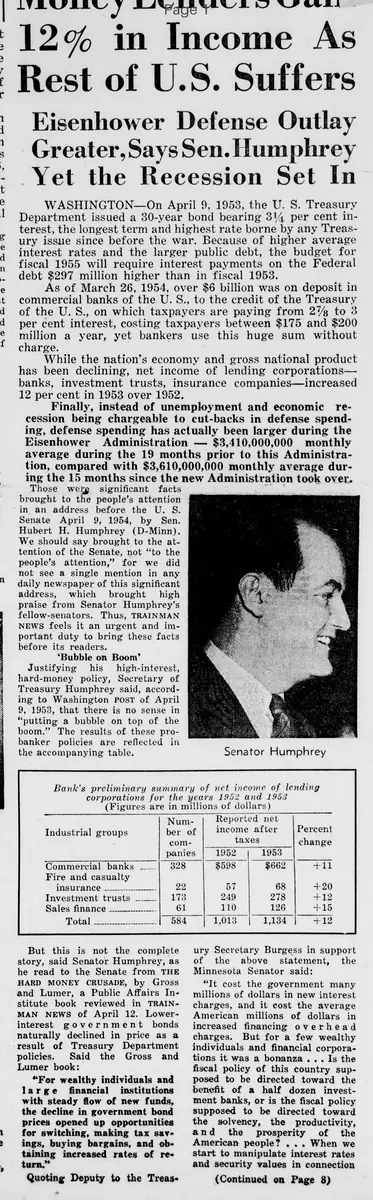
WASHINGTON--On April 9, 1953, the U. S. Treasury Department issued a 30-year bond bearing 31/4 per cent interest, the longest term and highest rate borne by any Treasury issue since before the war. Because of higher average interest rates and the larger public debt, the budget for fiscal 1955 will require interest payments on the Federal debt $297 million higher than in fiscal 1953.
As of March 26, 1954, over $6 billion was on deposit in commercial banks of the U. S., to the credit of the Treasury of the U. S., on which taxpayers are paying from 27/8 to 3 per cent interest, costing taxpayers between $175 and $200 million a year, yet bankers use this huge sum without charge.
While the nation's economy and gross national product has been declining, net income of lending corporations banks, investment trusts, insurance companies--increased 12 per cent in 1953 over 1952.
Finally, instead of unemployment and economic recession being chargeable to cut-backs in defense spending, defense spending has actually been larger during the Eisenhower Administration $3,410,000,000 monthly average during the 19 months prior to this Administration, compared with $3,610,000,000 monthly average during the 15 months since the new Administration took over.
Those were significant facts brought to the people's attention in an address before the U. S. Senate April 9, 1954, by Sen. Hubert H. Humphrey (D-Minn).
We should say brought to the attention of the Senate, not "to the people's attention," for we did not see a single mention in any daily newspaper of this significant address, which brought high praise from Senator Humphrey's fellow-senators. Thus, TRAINMAN NEWS feels it an urgent and important duty to bring these facts before its readers.
'Bubble on Boom'
Justifying his high-interest, hard-money policy, Secretary of the Treasury Humphrey said, according to Washington POST of April 9, 1953, that there is no sense in "putting a bubble on top of the boom." The results of these pro-banker policies are reflected in the accompanying table.
Senator Humphrey
Bank's preliminary summary of net income of lending corporations for the years 1952 and 1953 (Figures are in millions of dollars)
But this is not the complete story, said Senator Humphrey, as he read to the Senate from THE HARD MONEY CRUSADE, by Gross and Lumer, a Public Affairs Institute book reviewed in TRAINMAN NEWS of April 12. Lower-interest government bonds naturally declined in price as a result of Treasury Department policies.
Said the Gross and Lumer book:
"For wealthy individuals and large financial institutions with steady flow of new funds, the decline in government bond prices opened up opportunities for switching, making tax savings, buying bargains, and obtaining increased rates of return."
Quoting Deputy to the Treasury Secretary Burgess in support of the above statement, the Minnesota Senator said:
"It cost the government many millions of dollars in new interest charges, and it cost the average American millions of dollars in increased financing overhead charges. But for a few wealthy individuals and financial corporations it was a bonanza ... Is the fiscal policy of this country supposed to be directed toward the benefit of a half dozen investment banks, or is the fiscal policy supposed to be directed toward the solvency, the productivity, and the prosperity of the American people? ... When we start to manipulate interest rates and security values in connection
(Continued on Page 8)
| Industrial groups | Num-ber of com-panies | Reported net income after taxes | Percent change | |
| 1952 | 1953 | |||
| Commercial banks | 328 | $598 | $662 | +11 |
| Fire and casualty insurance | 22 | 57 | 68 | +20 |
| Investment trusts | 173 | 249 | 278 | +12 |
| Sales finance | 61 | 110 | 126 | +15 |
| Total | 584 | 1,013 | 1,134 | +12 |
Money Lenders Gain While Others Suffer
(Continued from Page 1)
with a public debt of almost $275 billion, I say we are playing with dynamite. This thing can explode right in our faces.
Small Banks, Investors Hurt
Quoting further from THE HARD MONEY CRUSADE, the PAI publication, Senator Humphrey declared that Administration financial policies were hurting the small banks and small investors, causing them to be absorbed by the large and powerful financial institutions, thus enlarging the financial monopoly. Pres. D. E. Brumbaugh of the Independent Bankers Association of America was quoted as saying:
"I have always believed in the law of supply and demand. However, many individuals and banks purchased these bonds in good faith and in the belief that they would always be able to redeem them or sell them at or near par.
"At the present time the long-term bonds are selling at a fraction better than 94 with the result that many banks who liquidate them will suffer a considerable loss.
"This condition adds to the perplexing problems of many of the smaller or unit banks since they usually invest in long-term Government bonds due to the added income they receive.
"The impairment of capital due to the reduced market value of securities also will mean the passing of more unit banks into the hands of the larger banks and holding companies in those states where branch banking is permitted."
Disastrous 1920's Repeated
With an assist from Sen. James E. Murray (D-Mont), the Minnesota senator proved the close parallel of present financial policies with those of the 1920's. which ended in the nation's worst panic. An article from FoRTuNE magazine, in 1938, was quoted as follows:
"American business has consistently misappropriated the principles of democracy. American business has made use of its principles to its own enormous profits, but it has failed to grasp the social implications of its profit-making. As representing the capitalist economy. business has an obligation to build a workable economic system."
Banks Use People's Money
In discussing the over $6 billion reserve kept on hand at all times which costs the American people $175 million to $200 million a year, Sen. Humphrey said:
"Yet that money stays in commercial banks, without drawing one mill, one iota, of interest for the Government of the United States. and it is available there for the banks to use in any of their lending operations, for which they charge interest."
The Minnesota senator then pointed out that there was no excuse for such a huge reserve because of what is called "the overdraft privilege," by which, if at the end of any one day the Government of the United States is short of money, it can the next morning have the Federal Reserve Board purchase whatever certificates are necessary to give the government what money it needs to conduct its business.
Thus this huge reserve is unnecessarily maintained at taxpayers' expense, a reserve on deposit in private banks, which banks are free to lend that money as they see fit and to charge whatever interest rate they choose.
Colossal Blunder Hidden
The Minnesota senator referred to the few wealthy persons and corporations profiting from present Administration financial policies and said:
"On the other hand. Mr. President, if we have a little butter in surplus, it is said to be just awful. Where are the headlines about the policy we are discussing today? Where are the front page stories about overcharging the American people on a billion dollar bond issue? Where are the
headlines about the $90 million profit in one year for a handful of bankers and investment companies?
"Oh, Mr. President, you do not read about that. However, if a poor farmer happens to sell a little butter to the government, that is a major problem, which requires the deliberations of the Cabinet. speeches of Members of Congress, and journalistic gymnastics of the press.
"I shall give them something to think about. The greatest, the most colossal blunder in the monetary history of America was brought about by the vaunted geniuses of business. Let them explain that to the American people. Let them explain to the American people that over-pricing. Let them explain to the American people the additional burden of $297 million a year.
That was just for last year, Mr. President. We have hardly got going. That was only for the first year."
Defense Spending at Peak
Referring to the Republican claim that the current recession is due to the cutback in defense spending following the Korean armistice, Senator Humphrey said the average monthly rate of Defense Department expenditures since the beginning of the Eisenhower Administration has been $3,610,000,000, compared with $3,490,000,000 monthly from July. 1952 to Dec., 1952. The 19-month average defense spending prior to the Eisenhower Administration w a s $3,410,000,000 monthly, compared with $3,610,- 000,000 monthly since the Eisenhower Administration took over.
Continued the Minnesota Senator:
"The impact of the reduced appropriations which we have made will not be felt until this fall and in the latter part of the fourth quarter of 1954.
"If anyone thinks conditions are bad now, with defense spending at an all-time high since World War II. let him wait until the cut in the Air Force--the defense budget-- takes effect. starting about December, 1954. Wait until the cuts in the Federal budget begin taking effect in January of 1955. Let it be quite clear that the difficulty the Nation now faces is not due to defense expenditure. It is due to what I have outlined -the monumental and incredible blunder of this administration in its fiscal and monetary policy."
What sub-type of article is it?
What keywords are associated?
What entities or persons were involved?
Editorial Details
Primary Topic
Critique Of Eisenhower Administration's High Interest Fiscal Policies Benefiting Banks
Stance / Tone
Strongly Critical Of Pro Banker Policies And Administration Blunders
Key Figures
Key Arguments