Thank you for visiting SNEWPapers!
Sign up free
Story
September 4, 1908
Eagle River Review
Eagle River, Vilas County, Wisconsin
What is this article about?
Description of innovative uses for sawdust waste in lumbering: ground into flour using millstones for mixing with nitroglycerin in dynamite production and manufacturing cheap blotting paper, primarily in European countries like Germany.
Clipping
OCR Quality
98%
Excellent
Full Text
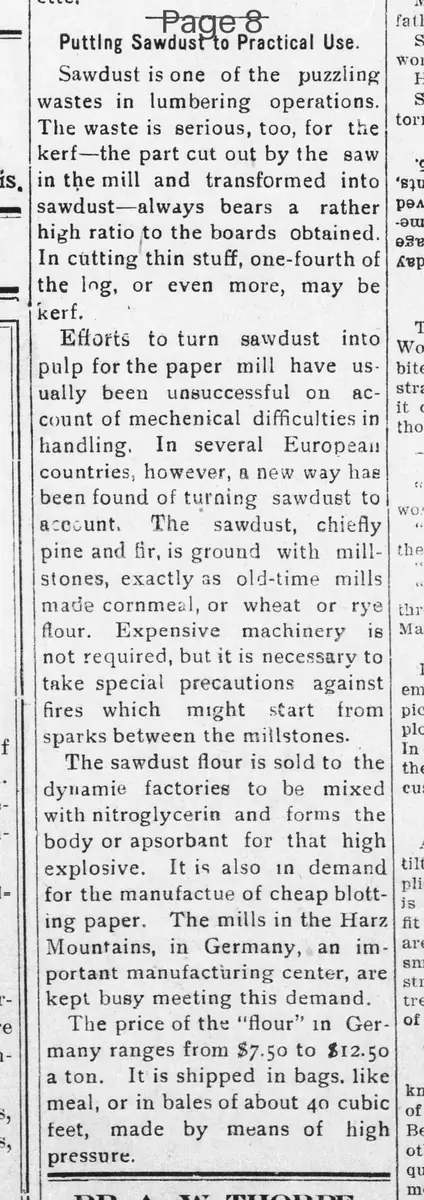
Putting Sawdust to Practical Use.
Sawdust is one of the puzzling wastes in lumbering operations. The waste is serious, too, for the kerf—the part cut out by the saw in the mill and transformed into sawdust—always bears a rather high ratio to the boards obtained. In cutting thin stuff, one-fourth of the log, or even more, may be kerf.
Efforts to turn sawdust into pulp for the paper mill have usually been unsuccessful on account of mechanical difficulties in handling. In several European countries, however, a new way has been found of turning sawdust to account. The sawdust, chiefly pine and fir, is ground with millstones, exactly as old-time mills made cornmeal, or wheat or rye flour. Expensive machinery is not required, but it is necessary to take special precautions against fires which might start from sparks between the millstones.
The sawdust flour is sold to the dynamite factories to be mixed with nitroglycerin and forms the body or absorbent for that high explosive. It is also in demand for the manufacture of cheap blotting paper. The mills in the Harz Mountains, in Germany, an important manufacturing center, are kept busy meeting this demand.
The price of the "flour" in Germany ranges from $7.50 to $12.50 a ton. It is shipped in bags, like meal, or in bales of about 40 cubic feet, made by means of high pressure.
Sawdust is one of the puzzling wastes in lumbering operations. The waste is serious, too, for the kerf—the part cut out by the saw in the mill and transformed into sawdust—always bears a rather high ratio to the boards obtained. In cutting thin stuff, one-fourth of the log, or even more, may be kerf.
Efforts to turn sawdust into pulp for the paper mill have usually been unsuccessful on account of mechanical difficulties in handling. In several European countries, however, a new way has been found of turning sawdust to account. The sawdust, chiefly pine and fir, is ground with millstones, exactly as old-time mills made cornmeal, or wheat or rye flour. Expensive machinery is not required, but it is necessary to take special precautions against fires which might start from sparks between the millstones.
The sawdust flour is sold to the dynamite factories to be mixed with nitroglycerin and forms the body or absorbent for that high explosive. It is also in demand for the manufacture of cheap blotting paper. The mills in the Harz Mountains, in Germany, an important manufacturing center, are kept busy meeting this demand.
The price of the "flour" in Germany ranges from $7.50 to $12.50 a ton. It is shipped in bags, like meal, or in bales of about 40 cubic feet, made by means of high pressure.
What sub-type of article is it?
Curiosity
What themes does it cover?
Triumph
What keywords are associated?
Sawdust Waste
Lumbering Operations
Dynamite Production
Blotting Paper
Harz Mountains
Industrial Innovation
Where did it happen?
Harz Mountains, Germany; Several European Countries
Story Details
Location
Harz Mountains, Germany; Several European Countries
Story Details
Sawdust waste from lumber mills is ground into flour using millstones and used as an absorbent in dynamite production and for cheap blotting paper, with mills in Germany's Harz Mountains meeting demand at $7.50-$12.50 per ton.