Thank you for visiting SNEWPapers!
Sign up free
The Enquirer
Richmond, Henrico County, Virginia
What is this article about?
The Richmond Enquirer reports the Virginia House of Delegates' debate and approval of an address urging President Thomas Jefferson to seek a third term, citing foreign relations, Republican unity, and constitutional reforms. The editorial criticizes the address as untimely, inappropriate for Virginia, and contrary to presidential rotation principles, praising Jefferson's expected refusal.
Merged-components note: The report on the Virginia Legislature debate, the address to Jefferson, and the subsequent critique form a single editorial piece.
Clipping
OCR Quality
Full Text
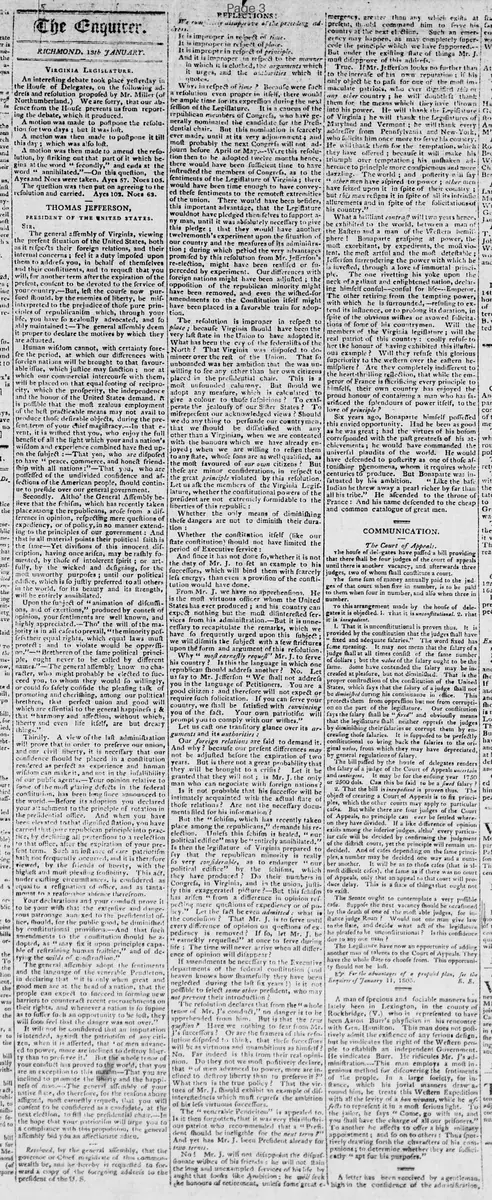
RICHMOND, 13th JANUARY.
Virginia Legislature.
An interesting debate took place yesterday in the House of Delegates, on the following address and resolution proposed by Mr. Miller (of Northumberland.) We are sorry, that our absence from the House prevents us from reporting the debate, which it produced.
A motion was made to postpone the resolution for two days; but it was lost.
A motion was then made to postpone it till this day; which was also lost.
A motion was then made to amend the resolution, by striking out that part of it which begins at the word "secondly," and ends at the word "annihilated."—On this question, the Ayes and Noes were taken. Ayes 57. Noes 105.
The question was then put on agreeing to the resolution and carried. Ayes 102. Noes 63.
THOMAS JEFFERSON,
PRESIDENT OF THE UNITED STATES.
SIR,
The general assembly of Virginia, viewing the present situation of the United States, both as it respects their foreign relations, and their internal concerns; feel it a duty imposed upon them to address you, in behalf of themselves and their constituents, and to request that you will, for another term after the expiration of the present, consent to be devoted to the service of your country.—But, let the course now pursued should, by the enemies of liberty, be misrepresented to the prejudice of those pure principles of republicanism which, through your life, you have so zealously advocated, and so ably maintained:—The general assembly deem it proper to declare the motives by which they are actuated.
Human wisdom cannot, with certainty fore-see the period, at which our differences with foreign nations will be brought to that favourable issue, which justice may sanction: nor at which our commercial intercourse with them, will be placed on that equal footing of reciprocity, which the prosperity, the independence and the honor of the United States demand. It is possible that the most zealous employment of the best practicable means may not avail to produce those desirable objects, during the present term of your chief magistracy.—In that event, it is wished that you, who enjoy the full benefit of all the light which your and a nation's wisdom and experience combined have shed upon the subject:—That you, who are disposed to have "peace, commerce, and honest friendship with all nations:"—That you, who are possessed of the undivided confidence and affections of the American people, should continue to preside over our general government.
Secondly. Altho' the General Assembly believe that the schism, which has recently taken place among the republicans, arose from a difference in opinion, respecting mere questions of expediency, or of policy, in no manner extending to the principles of our government: And that in all material points their political faith is the same—Yet divisions of this innocent description, having once arisen, may be rashly fomented, by those of intolerant spirit; or artfully, by the wicked and designing, for the most unworthy purposes; until our political edifice, which is so justly preferred to all others in the world, for its beauty and its strength, will be entirely annihilated.
Upon the subject of "animation of discussions, and of exertions," produced by contest of opinion, your sentiments are well known, and highly appreciated.—Tho' the will of the majority is in all cases to prevail, "the minority possess their equal rights, which equal laws must protect: and to violate would be oppression."—"Brethren of the same political principle, ought never to be called by different names."—The general assembly know no character, who might probably be elected to succeed you, to whom they would so willingly, or could so safely confide the pleasing task of promoting and cherishing, among our political brethren, that perfect union and good will which are essential to the general happiness; & that "harmony and affection, without which, liberty and even life itself, are but dreary things."
Thirdly. A view of the last administration will prove that in order to preserve our union, and our civil liberty, it is necessary that our confidence should be placed in a constitution rendered as perfect as experience and human wisdom can make it, and not in the infallibility of our public agents.—Your opinion relative to some of the most glaring defects in the federal constitution, has been long since announced to the world.—Before its adoption you declared your attachment to the principle of rotation in the presidential office. And when you have been elevated to that dignified station, you have carried that pure republican principle into practice, by declining all pretensions to a re-election to that office, after the expiration of your present term. Such an instance of rare patriotism hath not frequently occurred, and it is therefore viewed, by the friends of liberty, with the highest and most pleasing sensibility." This act, under existing circumstances, is considered as equal to a resignation of office, and as tantamount to a reasonable absence therefrom.
Your declarations and your conduct prove it to be your wish that the extensive and dangerous patronage annexed to the presidential office, should, for the public good, be diminished by constitutional provisions.—and that such amendments to the constitution should be adopted, as "may fix it upon principles capable of restraining human frailties," and of "defying the wiles of construction."
The general assembly adopt the sentiments and the language of the venerable Pendleton, in declaring that "it is only when great and good men are at the head of a nation, that the people can expect to succeed in forming new barriers to counteract recent encroachments on their rights, and whenever a nation is so supine as to suffer such an opportunity to be lost, they will soon feel that the danger was not over."
It will not be considered that an imputation is intended, against the patriotism of any citizen, when it is asserted, that 'of men advanced to power, more are inclined to destroy liberty than to preserve it.'? But the whole tenor of your conduct has proved to the world, that you are an exception to this maxim—That you are inclined to promote the liberty and the happiness of man.—The general assembly of your native State, do therefore, for the reasons above assigned, most earnestly request, that you will consent to be considered as a candidate, at the next election, to fill the presidential chair.—In the hope that your patriotism will urge you to a compliance with this proposition, the general assembly bid you an affectionate adieu.
Resolved, by the general assembly, that the governor or Chief magistrate of this commonwealth be, and he hereby is requested to forward a copy of the foregoing address to the president of the U. S.
We cannot approve of the preceding address.
It is improper in respect of time.
It is improper in respect of place.
It is improper in respect of principle.
And it is improper in respect to the manner in which it is clothed, the arguments which it urges, and the authorities which it quotes.
Why, in respect of time? Because were such a resolution even proper in itself, there would be ample time for its expression during the next session of the Legislature. It is a caucus of the republican members of Congress, who have generally nominated the candidate for the Presidential chair. But this nomination is scarcely ever made, until at its very adjournment; and most probably the next Congress will not adjourn before April or May.—Were this resolution then to be adopted twelve months hence, there would have been sufficient time to have instructed the members of Congress, as to the sentiments of the Legislature of Virginia; there would have been time enough to have conveyed these sentiments to the remotest extremities of the union. There would have been besides, this important advantage, that the Legislature would not have pledged themselves to support any man, until it was absolutely necessary to give this pledge; that they would have another twelvemonth's experiment upon the situation of our country and the measures of its administration; during which period the very advantages promised by this resolution from Mr. Jefferson's re-election, might have been realized or superseded by experiment. Our differences with foreign nations might have been adjusted; the opposition of the republican minority might have been removed, and even the wished-for amendments to the Constitution itself might have been placed in a favorable train for adoption.
The resolution is improper in respect to place; because Virginia should have been the very last state in the Union to have adopted it. What has been the cry of the federalists of the North? That Virginia was disposed to domineer over the rest of the Union. That so unbounded was her ambition that she was unwilling to see any other than her own citizens placed in the presidential chair. This is a most unfounded calumny. But should we adopt any measure, which is calculated to give a colour to those suspicions? To exasperate the jealousy of our Sister States? To misrepresent our acknowledged views? Should we do any thing to persuade our countrymen, that we should be dissatisfied with any other than a Virginian, when we are contented with the honours which we have already enjoyed; when we are willing to resign them to any state, whose sons are as well qualified, as the most favoured of our own citizens? But these are minor considerations, in respect to the great principle violated by this resolution.
Let us ask the members of the Virginia Legislature, whether the constitutional powers of the president are not extremely formidable to the liberties of this republic:
Whether the only means of diminishing these dangers are not to diminish their duration:
Whether the constitution itself (like our state constitution) should not have limited the period of Executive service:
And since it has not done so, whether it is not the duty of Mr. J. to set an example to his successors, which will bind them with scarcely less energy, than even a provision of the constitution would have done.
From Mr. J. we have no apprehensions. He is the most virtuous officer whom the United States has ever produced; and his country can expect nothing but the most disinterested services from his administration.—But it is unnecessary to recapitulate the remarks, which we have so frequently urged upon this subject; we will dismiss the subject with a few strictures upon the form and argument of this resolution.
Why "most earnestly request" Mr. J. to serve his country? Is this the language in which one republican should address another? No. Let us say to Mr. Jefferson "We shall not address you in the language of Petitioners. You are a good citizen: and therefore will not expect or require such solicitation. If you can serve your country, we shall be satisfied with convincing you of the fact. Your own patriotism will prompt you to comply with our wishes."
Let us cast one transitory glance over its arguments and its authorities:
Our foreign relations are said to demand it. And why? because our present differences may not be adjusted before the expiration of two years. But is there not a great probability that they will be brought to a crisis? Let it be granted that they will not; is Mr. J. the only man who can negotiate with foreign nations? Is it not probable that his successor will be intimately acquainted with the actual state of those relations? Are not the necessary documents filed for his information?
But the "schism, which has recently taken place among the republicans," demands his re-election. Unless this schism is healed, "our political edifice" may be "entirely annihilated." Is then the legislature of Virginia prepared to say that the republican minority is really so very considerable, as to endanger "our political edifice" by the schisms, which they have produced? Do their numbers in Congress, in Virginia, and in the union, justify this exaggerated picture?—But this schism has arisen "from a difference in opinion respecting mere questions of expediency or of policy." Let the fact be even admitted: what is the conclusion? That Mr. J. is to serve until every difference of opinion on questions of expediency is removed? If so, let Mr. J. be "earnestly requested" at once to serve during life: The time will never arrive when all difference of opinion will disappear?
If amendments be necessary to the Executive departments of the federal constitution (and heaven knows how shamefully they have been neglected during the last six years!) is it not possible to select some other president, who may not prevent their introduction?
The resolution declares that from the "whole tenor of Mr. J's conduct," no danger is to be apprehended from him. But is that the true question? Have we nothing to fear from Mr. J's successors? Or are the framers of this resolution disposed to think, that these successors will be as virtuous and unambitious as himself?
No. Far indeed is this from their real opinion. Do they not themselves most positively declare, that "of men advanced to power, more are inclined to destroy liberty than to preserve it?"
What then is the true policy? That the virtues of Mr. J. should exhibit an example of disinterestedness which must repress the ambition of his less virtuous successors.
The "venerable Pendleton" is appealed to. Is it then forgotten, that it was very this illustrious patriot who recommended that a "President should be ineligible for the next term?" And yet has Mr. J. been President already for two terms.
No! Mr. J. will not disappoint the dispassionate wishes of his friends: he will not stain the long and unexampled services of his life by aught that looks like Ambition: he will seek the honours of retirement, unless some great emergency, greater than any which exists at present, should command him to serve his country at the next election. Such an emergency may happen, as may completely supersede the principle which we have supported.— But under the existing state of things Mr. J. must disapprove of this address.
True. "If Mr. Jefferson looks no further than to the increase of his own reputation; if his only object be to pass for one of the most immaculate patriots, who ever dignified this or any other country; he will doubtless thank them for the means which they have thrown into his power. He will thank the Legislature of Virginia; he will thank the Legislatures of Maryland and Vermont: he will thank every addresser from Pennsylvania and New-York, who solicits him once more to serve his country. He will thank them for the temptation, which they have offered; because it will make his triumph over temptation; his unshaken adherence to principle more conspicuous and more dazzling. The world; and posterity will say "other men have aspired to power; other men have seized upon it in spite of their country; but this man resigns it in spite of all its intrinsic allurements and in spite of the solicitations of his country."
What a brilliant contrast will two years hence, be exhibited to the world, between a man of the Eastern and a man of the Western hemisphere! Bonaparte grasping at power, the most exorbitant, by expedients, the most violent, the most artful and the most detestable; Jefferson surrendering the power with which he is invested, through a love of immortal principle. The one riveting his yoke upon the neck of a gallant and enlightened nation, declaring himself consul—consul for life—Emperor. The other retiring from the tempting power, with which he is surrounded,—refusing to extend its influence, or to prolong its duration, in spite of the obvious wishes or avowed solicitations of some of his countrymen. Will the members of the Virginia legislature; will the real patriot of this country; coolly refuse to hear the honour of having exhibited this illustrious example? Will they refuse this glorious superiority to the western over the eastern hemisphere? Are they completely indifferent to the heart-thrilling reflection, that while the emperor of France is sacrificing every principle to himself, their own country has enjoyed the proud honour of containing a man who has sacrificed the splendours of power itself, to the love of principle?
Six years ago, Bonaparte himself possessed this envied opportunity. Had he been as good as he was great; had the virtues of his bosom corresponded with the past greatness of his achievements; he would have commanded the universal plaudits of the world. He would have descended to posterity as one of those astonishing phenomena, whom it requires whole centuries to produce. But Bonaparte was infatuated by his ambition.
"Like the base Indian he threw away a pearl richer by far than all his tribe." He ascended to the throne of France: And his name descended to the cheap and common catalogue of great men.
What sub-type of article is it?
What keywords are associated?
What entities or persons were involved?
Editorial Details
Primary Topic
Critique Of Virginia Legislature's Address Urging Jefferson's Third Term
Stance / Tone
Opposed To The Address, Supportive Of Jefferson's Retirement For Term Limits
Key Figures
Key Arguments