Thank you for visiting SNEWPapers!
Sign up free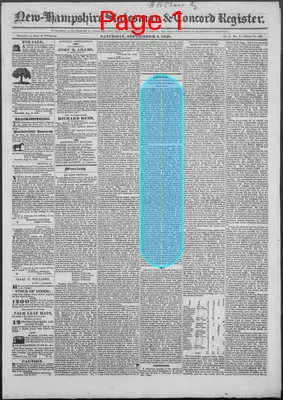
Editorial
September 6, 1828
New Hampshire Statesman And Concord Register
Concord, Merrimack County, New Hampshire
What is this article about?
An editorial from the Maryland Herald dismisses southern threats of disunion over the Tariff law as idle bravado, arguing that a separate southern republic would be unstable due to reliance on slaves and lack of free labor, potentially leading to slave rebellions and collapse.
Clipping
OCR Quality
95%
Excellent
Full Text
Political.
From the Maryland Herald.
THE CRISIS.
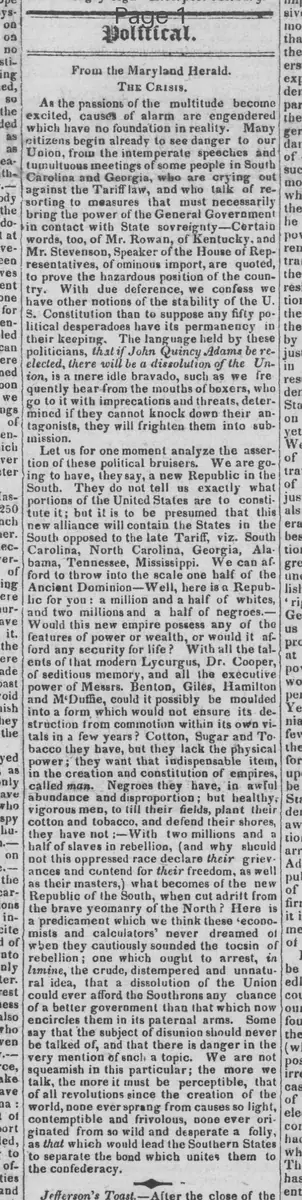
As the passions of the multitude become excited, causes of alarm are engendered which have no foundation in reality. Many citizens begin already to see danger to our Union, from the intemperate speeches and tumultuous meetings of some people in South Carolina and Georgia, who are crying out against the Tariff law, and who talk of resorting to measures that must necessarily bring the power of the General Government in contact with State sovereignty—Certain words, too, of Mr. Rowan, of Kentucky, and Mr. Stevenson, Speaker of the House of Representatives, of ominous import, are quoted to prove the hazardous position of the country. With due deference, we confess we have other notions of the stability of the U. S. Constitution than to suppose any fifty political desperadoes have its permanency in their keeping. The language held by these politicians, that if John Quincy Adams be re-elected, there will be a dissolution of the Union, is a mere idle bravado, such as we frequently hear from the mouths of boxers, who go to it with imprecations and threats, determined if they cannot knock down their antagonists, they will frighten them into submission.
Let us for one moment analyze the assertion of these political bruisers. We are going to have, they say, a new Republic in the South. They do not tell us exactly what portions of the United States are to constitute it; but it is to be presumed that this new alliance will contain the States in the South opposed to the late Tariff. viz. South Carolina, North Carolina, Georgia, Alabama, Tennessee, Mississippi. We can afford to throw into the scale one half of the Ancient Dominion—Well, here is a Republic for you: a million and a half of whites, and two millions and a half of negroes.— Would this new empire possess any of the features of power or wealth, or would it afford any security for life? With all the talents of that modern Lycurgus, Dr. Cooper, of seditious memory, and all the executive power of Messrs. Benton, Giles, Hamilton and M'Duffie, could it possibly be moulded into a form which would not ensure its destruction from commotion within its own vitals in a few years? Cotton, Sugar and Tobacco they have, but they lack the physical power; they want that indispensable item in the creation and constitution of empires, called man. Negroes they have, in awful abundance and disproportion: but healthy, vigorous men, to till their fields, plant their cotton and tobacco, and defend their shores, they have not;—With two millions and a half of slaves in rebellion, (and why should not this oppressed race declare their grievances and contend for their freedom, as well as their masters,) what becomes of the new Republic of the South, when cut adrift from the brave yeomanry of the North? Here is a predicament which we think these 'economists and calculators' never dreamed of when they cautiously sounded the tocsin of rebellion; one which ought to arrest, in limine, the crude, distempered and unnatural idea, that a dissolution of the Union could ever afford the Southrons any chance of a better government than that which now encircles them in its paternal arms. Some say that the subject of disunion should never be talked of, and that there is danger in the very mention of such a topic. We are not squeamish in this particular; the more we talk, the more it must be perceptible, that of all revolutions since the creation of the world, none ever sprang from causes so light, contemptible and frivolous, none ever originated from so wild and desperate a folly, as that which would lead the Southern States to separate the bond which unites them to the confederacy.
From the Maryland Herald.
THE CRISIS.
As the passions of the multitude become excited, causes of alarm are engendered which have no foundation in reality. Many citizens begin already to see danger to our Union, from the intemperate speeches and tumultuous meetings of some people in South Carolina and Georgia, who are crying out against the Tariff law, and who talk of resorting to measures that must necessarily bring the power of the General Government in contact with State sovereignty—Certain words, too, of Mr. Rowan, of Kentucky, and Mr. Stevenson, Speaker of the House of Representatives, of ominous import, are quoted to prove the hazardous position of the country. With due deference, we confess we have other notions of the stability of the U. S. Constitution than to suppose any fifty political desperadoes have its permanency in their keeping. The language held by these politicians, that if John Quincy Adams be re-elected, there will be a dissolution of the Union, is a mere idle bravado, such as we frequently hear from the mouths of boxers, who go to it with imprecations and threats, determined if they cannot knock down their antagonists, they will frighten them into submission.
Let us for one moment analyze the assertion of these political bruisers. We are going to have, they say, a new Republic in the South. They do not tell us exactly what portions of the United States are to constitute it; but it is to be presumed that this new alliance will contain the States in the South opposed to the late Tariff. viz. South Carolina, North Carolina, Georgia, Alabama, Tennessee, Mississippi. We can afford to throw into the scale one half of the Ancient Dominion—Well, here is a Republic for you: a million and a half of whites, and two millions and a half of negroes.— Would this new empire possess any of the features of power or wealth, or would it afford any security for life? With all the talents of that modern Lycurgus, Dr. Cooper, of seditious memory, and all the executive power of Messrs. Benton, Giles, Hamilton and M'Duffie, could it possibly be moulded into a form which would not ensure its destruction from commotion within its own vitals in a few years? Cotton, Sugar and Tobacco they have, but they lack the physical power; they want that indispensable item in the creation and constitution of empires, called man. Negroes they have, in awful abundance and disproportion: but healthy, vigorous men, to till their fields, plant their cotton and tobacco, and defend their shores, they have not;—With two millions and a half of slaves in rebellion, (and why should not this oppressed race declare their grievances and contend for their freedom, as well as their masters,) what becomes of the new Republic of the South, when cut adrift from the brave yeomanry of the North? Here is a predicament which we think these 'economists and calculators' never dreamed of when they cautiously sounded the tocsin of rebellion; one which ought to arrest, in limine, the crude, distempered and unnatural idea, that a dissolution of the Union could ever afford the Southrons any chance of a better government than that which now encircles them in its paternal arms. Some say that the subject of disunion should never be talked of, and that there is danger in the very mention of such a topic. We are not squeamish in this particular; the more we talk, the more it must be perceptible, that of all revolutions since the creation of the world, none ever sprang from causes so light, contemptible and frivolous, none ever originated from so wild and desperate a folly, as that which would lead the Southern States to separate the bond which unites them to the confederacy.
What sub-type of article is it?
Economic Policy
Constitutional
Partisan Politics
What keywords are associated?
Tariff Law
Disunion
Southern Republic
Union Stability
Slavery
Political Bravado
State Sovereignty
What entities or persons were involved?
John Quincy Adams
Mr. Rowan
Mr. Stevenson
Dr. Cooper
Messrs. Benton
Giles
Hamilton
M'duffie
South Carolina
Georgia
Editorial Details
Primary Topic
Dismissal Of Southern Disunion Threats Over Tariff
Stance / Tone
Pro Union, Dismissive Of Secession
Key Figures
John Quincy Adams
Mr. Rowan
Mr. Stevenson
Dr. Cooper
Messrs. Benton
Giles
Hamilton
M'duffie
South Carolina
Georgia
Key Arguments
Threats Of Disunion From Southern States Over Tariff Are Mere Bravado
A Southern Republic Would Include States Like South Carolina, Georgia, Etc., With 1.5m Whites And 2.5m Slaves
Lack Of Free White Labor Would Make The Republic Unstable And Vulnerable To Slave Rebellion
Southern Economy Relies On Cotton, Sugar, Tobacco But Lacks Manpower For Defense And Agriculture
Dissolution Would Cut South Off From Northern Yeomanry, Leading To Destruction
Union Provides Better Government Than Any Separate Southern Entity
Discussing Disunion Reveals Its Frivolous Causes