Thank you for visiting SNEWPapers!
Sign up free
Literary
August 4, 1817
Daily National Intelligencer
Washington, District Of Columbia
What is this article about?
Extracts from 'Fall of Palmyra,' a poem by N. H. Wright, depict the ruins of ancient Palmyra, the destructive power of time over empires, night and morning scenes in the desert, and Zenobia mourning her son Cesario while with her son Julius, offering a prayer for him.
Clipping
OCR Quality
95%
Excellent
Full Text
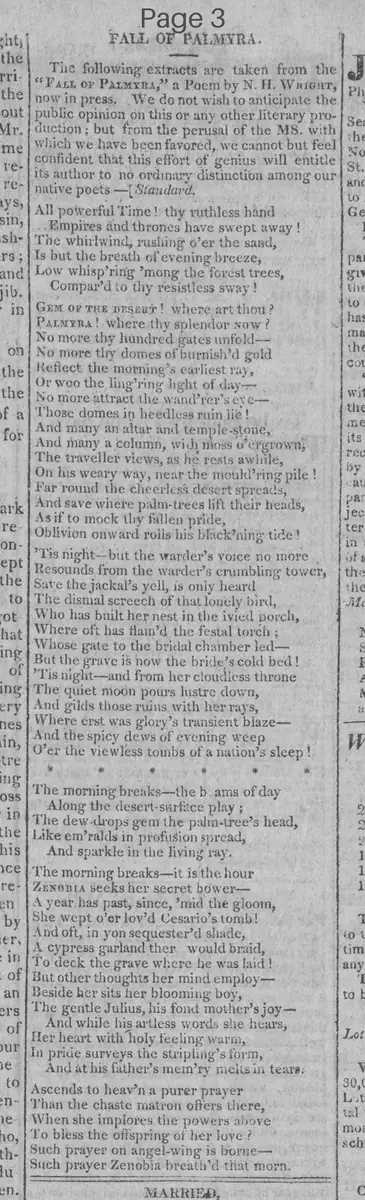
FALL OF PALMYRA.
The following extracts are taken from the "Fall of Palmyra," a Poem by N. H. Wright, now in press. We do not wish to anticipate the public opinion on this or any other literary production; but from the perusal of the MS. with which we have been favored, we cannot but feel confident that this effort of genius will entitle its author to no ordinary distinction among our native poets —[Standard.
All powerful Time! thy ruthless hand
Empires and thrones have swept away!
The whirlwind, rushing o'er the sand.
Is but the breath of evening breeze,
Low whisp'ring 'mong the forest trees,
Compar'd to thy resistless sway!
GEM OF THE DESERT! where art thou?
PALMYRA! where thy splendor now?
No more thy hundred gates unfold-
No more thy domes of burnish'd gold
Reflect the morning's earliest ray,
Or woo the ling'ring light of day-
No more attract the wand'rer's eye—
Those domes in heedless ruin lie!
And many an altar and temple-stone,
And many a column, with moss o'ergrown,
The traveller views, as he rests awhile,
On his weary way, near the mould'ring pile!
Far round the cheerless desert spreads,
And save where palm-trees lift their heads,
As if to mock thy fallen pride.
Oblivion onward rolls his black'ning tide!
'Tis night-but the warder's voice no more
Resounds from the warder's crumbling tower
Save the jackal's yell, is only heard
The dismal screech of that lonely bird,
Who has built her nest in the ivied porch,
Where oft has flam'd the festal torch ;
Whose gate to the bridal chamber led-
But the grave is now the bride's cold bed!
'Tis night—and from her cloudless throne
The quiet moon pours lustre down,
And gilds those ruins with her rays,
Where erst was glory's transient blaze-
And the spicy dews of evening weep
O'er the viewless tombs of a nation's sleep!
The morning breaks—the beams of day
Along the desert-surface play;
The dew-drops gem the palm-tree's head,
Like em'ralds in profusion spread,
And sparkle in the living ray.
The morning breaks—it is the hour
Zenobia seeks her secret bower—
A year has past, since, 'mid the gloom
She wept o'er lov'd Cesario's tomb!
And oft, in yon sequester'd shade,
A cypress garland there would braid,
To deck the grave where he was laid!
But other thoughts her mind employ—
Beside her sits her blooming boy,
The gentle Julius, his fond mother's joy—
And while his artless words she hears,
Her heart with holy feeling warm,
In pride surveys the stripling's form,
And at his father's mem'ry melts in tears.
Ascends to heav'n a purer prayer
Than the chaste matron offers there,
When she implores the powers above
To bless the offspring of her love?
Such prayer on angel-wing is borne—
Such prayer Zenobia breath'd that morn.
The following extracts are taken from the "Fall of Palmyra," a Poem by N. H. Wright, now in press. We do not wish to anticipate the public opinion on this or any other literary production; but from the perusal of the MS. with which we have been favored, we cannot but feel confident that this effort of genius will entitle its author to no ordinary distinction among our native poets —[Standard.
All powerful Time! thy ruthless hand
Empires and thrones have swept away!
The whirlwind, rushing o'er the sand.
Is but the breath of evening breeze,
Low whisp'ring 'mong the forest trees,
Compar'd to thy resistless sway!
GEM OF THE DESERT! where art thou?
PALMYRA! where thy splendor now?
No more thy hundred gates unfold-
No more thy domes of burnish'd gold
Reflect the morning's earliest ray,
Or woo the ling'ring light of day-
No more attract the wand'rer's eye—
Those domes in heedless ruin lie!
And many an altar and temple-stone,
And many a column, with moss o'ergrown,
The traveller views, as he rests awhile,
On his weary way, near the mould'ring pile!
Far round the cheerless desert spreads,
And save where palm-trees lift their heads,
As if to mock thy fallen pride.
Oblivion onward rolls his black'ning tide!
'Tis night-but the warder's voice no more
Resounds from the warder's crumbling tower
Save the jackal's yell, is only heard
The dismal screech of that lonely bird,
Who has built her nest in the ivied porch,
Where oft has flam'd the festal torch ;
Whose gate to the bridal chamber led-
But the grave is now the bride's cold bed!
'Tis night—and from her cloudless throne
The quiet moon pours lustre down,
And gilds those ruins with her rays,
Where erst was glory's transient blaze-
And the spicy dews of evening weep
O'er the viewless tombs of a nation's sleep!
The morning breaks—the beams of day
Along the desert-surface play;
The dew-drops gem the palm-tree's head,
Like em'ralds in profusion spread,
And sparkle in the living ray.
The morning breaks—it is the hour
Zenobia seeks her secret bower—
A year has past, since, 'mid the gloom
She wept o'er lov'd Cesario's tomb!
And oft, in yon sequester'd shade,
A cypress garland there would braid,
To deck the grave where he was laid!
But other thoughts her mind employ—
Beside her sits her blooming boy,
The gentle Julius, his fond mother's joy—
And while his artless words she hears,
Her heart with holy feeling warm,
In pride surveys the stripling's form,
And at his father's mem'ry melts in tears.
Ascends to heav'n a purer prayer
Than the chaste matron offers there,
When she implores the powers above
To bless the offspring of her love?
Such prayer on angel-wing is borne—
Such prayer Zenobia breath'd that morn.
What sub-type of article is it?
Poem
Elegy
What themes does it cover?
Death Mortality
Political
What keywords are associated?
Palmyra
Zenobia
Ruins
Desert
Time
Empires
Mourning
Poem
What entities or persons were involved?
N. H. Wright
Literary Details
Title
Fall Of Palmyra.
Author
N. H. Wright
Subject
Fall Of Palmyra And Zenobia's Mourning
Key Lines
All Powerful Time! Thy Ruthless Hand
Empires And Thrones Have Swept Away!
The Whirlwind, Rushing O'er The Sand.
Is But The Breath Of Evening Breeze,
Low Whisp'ring 'Mong The Forest Trees,
Compar'd To Thy Resistless Sway!
Gem Of The Desert! Where Art Thou?
Palmyra! Where Thy Splendor Now?
No More Thy Hundred Gates Unfold
No More Thy Domes Of Burnish'd Gold
Reflect The Morning's Earliest Ray,
Or Woo The Ling'ring Light Of Day
'Tis Night—And From Her Cloudless Throne
The Quiet Moon Pours Lustre Down,
And Gilds Those Ruins With Her Rays,
Where Erst Was Glory's Transient Blaze
The Morning Breaks—It Is The Hour
Zenobia Seeks Her Secret Bower—
A Year Has Past, Since, 'Mid The Gloom
She Wept O'er Lov'd Cesario's Tomb!
Such Prayer On Angel Wing Is Borne—
Such Prayer Zenobia Breath'd That Morn.